 TajweedTajweed

Madd (مَدّ) in Tajweed means lengthening the sound of a Madd letter (Alif, Waw or Yaa) for a set length while reciting the Quran. The basic, Natural Madd lasts two counts. A Hamzah or a Sukoon after the Madd letter can make it longer: four, five or six counts, depending on the rule.
That is the short answer to “What is Madd in Tajweed?” The harder part is using it. Many learners can repeat “Madd is two counts” yet still freeze when they open a real Mushaf. The full letter they expect is sometimes missing, a small Alif sits above a word instead, or a wavy line appears over a letter they cannot explain.
This guide is built for that moment. You will learn what Madd means, how to spot it on the page, why some sounds are held longer than others, and how to practise the correct length with real Quranic examples.
All counts in this article follow the recitation of Hafs ‘an ‘Asim (by the route of ash-Shatibiyyah), the recitation used in most printed copies of the Quran today. Script examples follow the Madinah Uthmani Mushaf.
To understand Madd in Tajweed, it helps to distinguish its linguistic meaning in Arabic from its technical meaning in Quranic recitation.
The Arabic word madd (مَدّ) means to extend, stretch or increase. You meet the same root in everyday Arabic words linked to extending something, so the idea is simple: something is drawn out.
Among the rules of Tajweed, Madd is the lengthening of a sound on a Madd letter or a Leen letter, by a set amount, according to specific rules.
Two details in that definition matter for beginners:
The lengths of Madd were transmitted orally, from teacher to student. That is why learning the rules from a page is only the first step; you also need to hear them and practise them aloud.
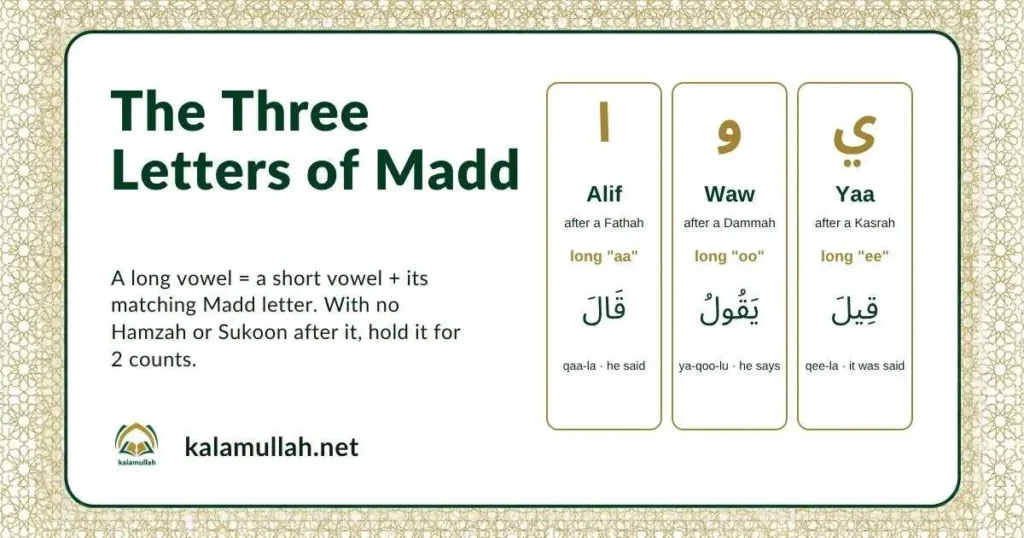
The three letters of Madd are Alif (ا), Waw (و) and Yaa (ي). Each one becomes a Madd letter only when two conditions are met: it carries no vowel of its own, and the letter before it carries the matching short vowel.
Think of it as a pair: a short vowel, then the long letter that stretches it.
| Madd letter | Letter before it carries | Sound | Example | How it sounds |
|---|---|---|---|---|
| Alif (ا) | Fathah ( َ ) | long “aa” | قَالَ | Qaa-la |
| Waw (و) | Dammah ( ُ ) | long “oo” | يَقُولُ | Ya-qoo-lu |
| Yaa (ي) | Kasrah ( ِ ) | long “ee” | قِيلَ | Qee-la |
Alif is always a long vowel when it follows a Fathah. Waw and Yaa are different: they can also be ordinary consonants (“w” and “y”), which is where beginners get confused.
When a silent Waw or Yaa follows a Fathah instead of its matching vowel, it is not a Madd letter. It is a Leen letter (“soft” letter), and it makes a gliding sound such as “aw” or “ay”.
| Letter | Madd letter when it follows | Leen letter when it follows | Leen example |
|---|---|---|---|
| Waw (و) | Dammah ( ُ ) | Fathah ( َ ) | خَوْفٍ (khawf) |
| Yaa (ي) | Kasrah ( ِ ) | Fathah ( َ ) | قُرَيْشٍ (Quraysh) |
In normal reading, a Leen letter is not lengthened. It only gains length when you stop on a word that ends right after it, as you will see in the types section. And when Waw or Yaa carries its own vowel, as in وَ or يَ, it is simply a consonant. There is no Madd at all.
For a printed reference that follows the same recitation, the free booklet An Introduction to Tajweed sets out the Madd letters and their conditions in a clear, beginner-friendly way.
Natural Madd (المد الطبيعي, Madd Tabi’i) is the basic Madd: a Madd letter with no Hamzah and no Sukoon after it. It is held for exactly two counts.
It is called “natural” because the long vowel cannot exist without it. If you shorten it, the long vowel disappears and the word is no longer pronounced correctly. Every other type of Madd is built on top of this one, which is why scholars also call it the original Madd.
Natural Madd occurs whenever all three of these are true:
Two counts, called two harakah. One harakah is roughly the time it takes to say one short vowel, so a Natural Madd sounds like two short vowels joined smoothly into one long sound. You will learn how to measure this in practice later in the article.
The following examples show how each Madd letter produces a natural two-count length.
| Word | Madd letter | Vowel before it | What follows | Length |
|---|---|---|---|---|
| قَالَ (qaa-la, “he said”) | Alif | Fathah on ق | Lam with a vowel | 2 |
| يَقُولُ (ya-qoo-lu, “he says”) | Waw | Dammah on ق | Lam with a vowel | 2 |
| قِيلَ (qee-la, “it was said”) | Yaa | Kasrah on ق | Lam with a vowel | 2 |
In each word, the letter after the Madd carries an ordinary vowel. There is no Hamzah and no Sukoon to extend the sound, so it stays at two counts.
Natural Madd is the starting point. A Hamzah or Sukoon after the Madd letter creates the conditions for the longer types explained below.
If you are just starting with these foundations, a beginner Tajweed course lets you practise Natural Madd with a teacher before moving on to the longer types.
In the Uthmani Mushaf, a Madd is not always written as a full-sized Alif, Waw or Yaa. Sometimes it appears as a small letter above or beside a word, and sometimes a wavy sign tells you to hold it longer.
Learning these signs is what turns textbook rules into real reading, and it is a key step in learning how to read the Quran from an actual Mushaf.
The signs below follow the Madinah Mushaf (King Fahd Complex print). Mushafs printed in South Asia use a slightly different sign system, so check with your teacher if your copy looks different.
In the Madinah Mushaf, full-sized Madd letters are generally written without a vowel or Sukoon mark. A Leen letter, by contrast, is commonly marked with a Sukoon to show that it is a consonant glide rather than a long vowel. Sign conventions can differ slightly between printed editions.
Watch for one more sign. In ءَامَنُوا۟ (“they believed”), the Alif written after the plural Waw carries a small round mark and is not pronounced. Stop the sound at “aamanoo” and do not add an extra “aa”.
The Dagger Alif is a small upright Alif written above a letter (ـٰ). It stands for a long “aa” sound even though no full Alif is written on the line. It is read exactly like a full Alif and, when nothing follows to change the rule, it is a Natural Madd of two counts.
You meet it in the very first surah:
| As written in the Mushaf | Read as | Where |
|---|---|---|
| ٱلرَّحْمَـٰنِ | ar-Raḥmaa-ni | Al-Fatihah 1:1 |
| ٱلْعَـٰلَمِينَ | al-‘aa-lameen | Al-Fatihah 1:2 |
| مَـٰلِكِ | maa-liki | Al-Fatihah 1:4 |
بِسۡمِ ٱللَّهِ ٱلرَّحۡمَٰنِ ٱلرَّحِيمِ ﴿١﴾ ٱلۡحَمۡدُ لِلَّهِ رَبِّ ٱلۡعَٰلَمِينَ ﴿٢﴾ ٱلرَّحۡمَٰنِ ٱلرَّحِيمِ ﴿٣﴾ مَٰلِكِ يَوۡمِ ٱلدِّينِ ﴿٤﴾ إِيَّاكَ نَعۡبُدُ وَإِيَّاكَ نَسۡتَعِينُ ﴿٥﴾ ٱهۡدِنَا ٱلصِّرَٰطَ ٱلۡمُسۡتَقِيمَ ﴿٦﴾ صِرَٰطَ ٱلَّذِينَ أَنۡعَمۡتَ عَلَيۡهِمۡ غَيۡرِ ٱلۡمَغۡضُوبِ عَلَيۡهِمۡ وَلَا ٱلضَّآلِّينَ ﴿٧﴾
(1) In the name of Allah, the Entirely Merciful, the Especially Merciful. (2) [All] praise is [due] to Allah, Lord of the worlds. (3) The Entirely Merciful, the Especially Merciful. (4) Sovereign of the Day of Recompense. (5) It is You we worship and You we ask for help. (6) Guide us to the straight path. (7) The path of those upon whom You have bestowed favor, not of those who have evoked [Your] anger or of those who are astray. (Saheeh International)
The Dagger Alif also sits over a Yaa-shaped letter at the end of words such as عَلَىٰ and بَلَىٰ. There, read a long “aa”, not “ee”.
A small Waw (ۥ) or small Yaa (ۦ) tells you to pronounce a long “oo” or “ee” that is not written in full. It appears most often after the pronoun ه (“him/his”), in a rule called Madd as-Silah.
A small letter does not always mean the same length. Compare these words from the same short surah, Al-Inshiqaq 84:15 (بَلَىٰٓ إِنَّ رَبَّهُۥ كَانَ بِهِۦ بَصِيرًا):
بَلَىٰٓۚ إِنَّ رَبَّهُۥ كَانَ بِهِۦ بَصِيرًا
But yes! Indeed, his Lord was ever of him, Seeing. (Saheeh International)
Now compare Al-Humazah 104:3, يَحْسَبُ أَنَّ مَالَهُۥٓ أَخْلَدَهُۥ:
يَحۡسَبُ أَنَّ مَالَهُۥٓ أَخۡلَدَهُۥ
He thinks that his wealth will make him immortal. (Saheeh International)
So the same small letter can mean two counts, four or five counts, or nothing at all, depending on what comes next and whether you stop.
Hafs also has two well-known exceptions to the Silah rules:
| Verse | As written | What happens |
|---|---|---|
| Az-Zumar 39:7 | يَرْضَهُ لَكُمْ | No Silah. Read “yarḍahu lakum” with a short “u”, even though the usual conditions for Silah appear to be met. |
| Al-Furqan 25:69 | فِيهِۦ مُهَانًا | Silah Sughra, two counts. Read “feehee muhaanaa”, even though a silent Madd letter (Yaa) comes before the ه, which normally prevents Silah. |
إِن تَكۡفُرُواْ فَإِنَّ ٱللَّهَ غَنِيٌّ عَنكُمۡۖ وَلَا يَرۡضَىٰ لِعِبَادِهِ ٱلۡكُفۡرَۖ وَإِن تَشۡكُرُواْ يَرۡضَهُ لَكُمۡۗ وَلَا تَزِرُ وَازِرَةٌ وِزۡرَ أُخۡرَىٰۚ ثُمَّ إِلَىٰ رَبِّكُم مَّرۡجِعُكُمۡ فَيُنَبِّئُكُم بِمَا كُنتُمۡ تَعۡمَلُونَۚ إِنَّهُۥ عَلِيمُۢ بِذَاتِ ٱلصُّدُورِ
If you disbelieve – indeed, Allah is Free from need of you. And He does not approve for His servants disbelief. And if you are grateful, He approves it for you; and no bearer of burdens will bear the burden of another. Then to your Lord is your return, and He will inform you about what you used to do. Indeed, He is Knowing of that within the breasts. (Saheeh International)
يُضَٰعَفۡ لَهُ ٱلۡعَذَابُ يَوۡمَ ٱلۡقِيَٰمَةِ وَيَخۡلُدۡ فِيهِۦ مُهَانًا
Multiplied for him is the punishment on the Day of Resurrection, and he will abide therein humiliated. (Saheeh International)
The wavy Madd sign (ـٓ) placed over a Madd letter is a warning: this Madd is longer than two counts. In the Madinah Mushaf it appears when a Madd letter is followed by a Hamzah or by a permanent Sukoon (including a Shaddah).
| As written | What follows the Madd letter | Rule | Length (Hafs, ash-Shatibiyyah) |
|---|---|---|---|
| جَآءَ (An-Nasr 110:1) | Hamzah in the same word | Madd Muttasil | 4 or 5 |
| إِنَّآ أَنزَلْنَـٰهُ (Al-Qadr 97:1) | Hamzah at the start of the next word | Madd Munfasil | 4 or 5 |
| ٱلضَّآلِّينَ (Al-Fatihah 1:7) | Shaddah (permanent Sukoon) | Madd Lazim | 6 |
| الٓمٓ (Al-Baqarah 2:1) | Letter names with a permanent Sukoon | Madd Lazim (in letters) | 6 |
إِنَّآ أَنزَلۡنَٰهُ فِي لَيۡلَةِ ٱلۡقَدۡرِ
Indeed, We sent the Qur’an down during the Night of Decree. (Saheeh International)
The sign tells you to lengthen, but not by how much. To know the length, look at what comes after the letter. Note also that the sign is not written for every long Madd: the longer Madd that appears only when you stop at the end of a verse is usually unmarked.
When you see a long vowel, work through it in this order:
Recite the Words of Allah With Confidence
Join Kalamullah Quran Academy for live 1-on-1 lessons with Al-Azhar-trained, Ijazah-holding tutors, from your first Qaida letter all the way to Ijazah.
Book Your Free Trial ClassA Madd becomes longer than two counts for only two reasons: a Hamzah or a Sukoon comes after the Madd letter. If you remember these two causes, every longer Madd starts to make sense.
The Hamzah (ء) is a strong, clipped sound made deep in the throat, while a Madd letter is a soft, open sound. When a long vowel runs straight into a Hamzah, the extra length gives the vowel its full space before the sharp stop of the Hamzah.
Where the Hamzah sits decides the rule:
A Sukoon means a letter with no vowel. When a long vowel is followed by a silent letter, the voice holds the vowel longer before closing on that letter. What matters is whether the Sukoon is permanent or only appears when you stop:
This comparison highlights the difference between the basic Madd and the longer types caused by a Hamzah or Sukoon.
| Natural Madd (Tabi’i) | Secondary Madd (Far’i) | |
|---|---|---|
| What it is | The basic long vowel | A long vowel with an extra cause |
| Cause after the Madd letter | No Hamzah, no Sukoon | A Hamzah or a Sukoon |
| Length | 2 counts | 2 to 6 counts, set by the rule |
| Example | قَالَ | جَآءَ, ٱلضَّآلِّينَ |
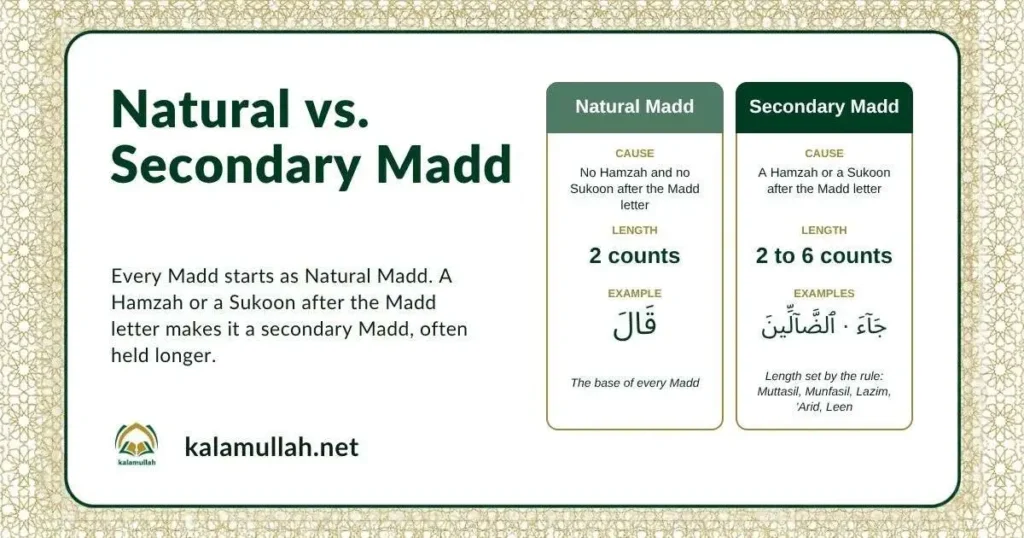
Madd is divided into two families: Natural Madd and Secondary Madd. The secondary types are grouped by their cause, a Hamzah or a Sukoon. Below are the main types a beginner meets in daily recitation.
Natural Madd (Madd Tabi’i): A Madd letter with no Hamzah or Sukoon after it. Two counts. Example: قَالَ. (Covered in detail above.)
Look for a Hamzah immediately after the Madd letter within the same word.
In this type, the Madd letter ends one word and the Hamzah begins the next.
A permanent Sukoon after the Madd letter makes this one of the longest Madd types.
فَإِذَا جَآءَتِ ٱلطَّآمَّةُ ٱلۡكُبۡرَىٰ
But when there comes the greatest Overwhelming Calamity. (Saheeh International)
This Madd occurs when stopping on a word creates a temporary Sukoon after the long vowel.
Madd Leen involves a soft Waw or Yaa that gains length when you stop on the word.
لِإِيلَٰفِ قُرَيۡشٍ
For the accustomed security of the Quraysh. (Saheeh International)
ٱلَّذِيٓ أَطۡعَمَهُم مِّن جُوعٍ وَءَامَنَهُم مِّنۡ خَوۡفِۭ
Who has fed them, [saving them] from hunger and made them safe, [saving them] from fear. (Saheeh International)
These types are all held for two counts in Hafs. You will meet them often:
Once Natural Madd feels comfortable, an intermediate Tajweed course is the natural next step for practising these derived types and their permitted lengths.
Use this table as a quick reference. The lengths are for Hafs ‘an ‘Asim by the route of ash-Shatibiyyah. Other recitations and routes can differ, so they are not universal rules.
| Madd type | Arabic | Cause | Length (counts) |
|---|---|---|---|
| Natural Madd | المد الطبيعي | No Hamzah or Sukoon after it | 2 |
| Badal | مد البدل | Hamzah before the Madd letter | 2 |
| ‘Iwad | مد العوض | Stopping on Fathatan | 2 |
| Silah Sughra | الصلة الصغرى | Pronoun ه between two vowels | 2 |
| Muttasil | المد المتصل | Hamzah in the same word | 4 or 5 |
| Munfasil | المد المنفصل | Hamzah at the start of the next word | 4 or 5 |
| Silah Kubra | الصلة الكبرى | Pronoun ه followed by a Hamzah | 4 or 5 (as Munfasil) |
| ‘Arid lis-Sukoon | المد العارض للسكون | Temporary Sukoon from stopping | 2, 4 or 6 |
| Leen | مد اللين | Leen letter before a stop | 2, 4 or 6 |
| Lazim | المد اللازم | Permanent Sukoon or Shaddah | 6 |
Where a range is given (for example, 4 or 5), every length in that range is correct in this route. Choose one with your teacher and keep it consistent.
Madd counts are measured using Harakah, a unit of time based on the duration of a short vowel.
A harakah (count) is a unit of time in Tajweed. It is about the time it takes to pronounce one short vowel at your current reciting speed.
A harakah is not a fixed number of seconds. If you recite slowly, every count is a little longer; if you recite at a faster pace, every count is shorter. What must stay the same is the ratio: a six-count Madd should always sound about three times as long as a two-count Madd in the same recitation.
Try this with the sound “aa”:
The best way to train your ear is to listen to one reciter at a steady pace and compare these words side by side, then copy them aloud.
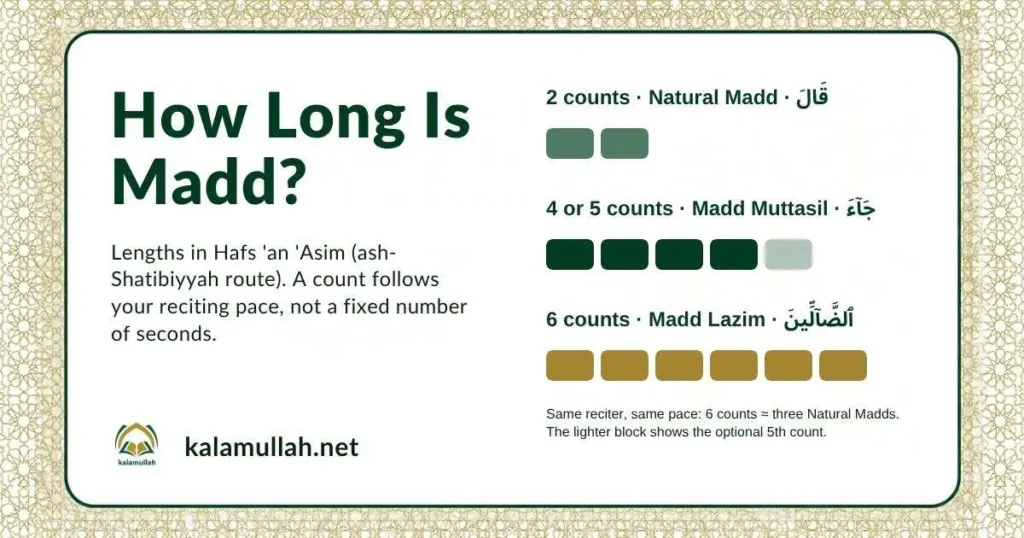
Many teachers let beginners fold one finger per count, or tap lightly, while they learn. This is a useful training aid, not a rule. The goal is to absorb the timing so well that you no longer need to count, and your recitation flows naturally with focus on the words.
Yes, in some cases. Arabic separates short vowels from long vowels, and the difference can produce a different word or grammatical form. Getting Madd right is part of preserving the words exactly as they were revealed.
A clear example is two verbs built from the same letters, where only a Madd separates them:
| As written | Pronunciation | Meaning | Where |
|---|---|---|---|
| قَتَلَ | qatala (short “a”) | “he killed” | Al-Ma’idah 5:32 |
| قَـٰتَلَ | qaatala (long “aa”) | “he fought” | Al-Hadid 57:10 |
The only difference is the long “aa” after the ق, written in the Mushaf as a Dagger Alif. Drop that Madd from قَـٰتَلَ and you pronounce a different verb with a different meaning. This is why a small sign above a letter deserves the same attention as a full-sized letter.
مِنۡ أَجۡلِ ذَٰلِكَ كَتَبۡنَا عَلَىٰ بَنِيٓ إِسۡرَٰٓءِيلَ أَنَّهُۥ مَن قَتَلَ نَفۡسَۢا بِغَيۡرِ نَفۡسٍ أَوۡ فَسَادٍ فِي ٱلۡأَرۡضِ فَكَأَنَّمَا قَتَلَ ٱلنَّاسَ جَمِيعًا وَمَنۡ أَحۡيَاهَا فَكَأَنَّمَآ أَحۡيَا ٱلنَّاسَ جَمِيعًاۚ وَلَقَدۡ جَآءَتۡهُمۡ رُسُلُنَا بِٱلۡبَيِّنَٰتِ ثُمَّ إِنَّ كَثِيرًا مِّنۡهُم بَعۡدَ ذَٰلِكَ فِي ٱلۡأَرۡضِ لَمُسۡرِفُونَ
Because of that, We decreed upon the Children of Israel that whoever kills a soul unless for a soul or for corruption [done] in the land – it is as if he had slain mankind entirely. And whoever saves one – it is as if he had saved mankind entirely. And our messengers had certainly come to them with clear proofs. Then indeed many of them, [even] after that, throughout the land, were transgressors. (Saheeh International)
وَمَا لَكُمۡ أَلَّا تُنفِقُواْ فِي سَبِيلِ ٱللَّهِ وَلِلَّهِ مِيرَٰثُ ٱلسَّمَٰوَٰتِ وَٱلۡأَرۡضِۚ لَا يَسۡتَوِي مِنكُم مَّنۡ أَنفَقَ مِن قَبۡلِ ٱلۡفَتۡحِ وَقَٰتَلَۚ أُوْلَٰٓئِكَ أَعۡظَمُ دَرَجَةً مِّنَ ٱلَّذِينَ أَنفَقُواْ مِنۢ بَعۡدُ وَقَٰتَلُواْۚ وَكُلًّا وَعَدَ ٱللَّهُ ٱلۡحُسۡنَىٰۚ وَٱللَّهُ بِمَا تَعۡمَلُونَ خَبِيرٌ
And why do you not spend in the cause of Allah while to Allah belongs the heritage of the heavens and the earth? Not equal among you are those who spent before the conquest [of Makkah] and fought [and those who did so after it]. Those are greater in degree than they who spent afterwards and fought. But to all Allah has promised the best [reward]. And Allah, with what you do, is Acquainted. (Saheeh International)
This does not mean every Madd mistake changes the meaning. Holding a Natural Madd for three counts instead of two usually does not create a new word. But it is still an error in recitation. Shortening a long vowel so far that it sounds short, or stretching a short vowel into a long one, can affect the word itself.
In short: incorrectly lengthening or shortening a sound can affect the pronunciation of a Quranic word and, in some cases, its meaning. Correct Madd is part of accurate recitation.
Some Madd types allow a choice of length. Where a choice exists, keep the same length for the same type throughout your recitation.
For example, Madd ‘Arid lis-Sukoon can be 2, 4 or 6 counts. If you stop on ٱلْعَـٰلَمِينَ with four counts, you should also give four counts when you stop on ٱلرَّحِيمِ and ٱلدِّينِ in the next verses. Switching to two, then six, then four makes the recitation uneven and is considered a weakness. The same applies to Munfasil: pick the length your teacher teaches and keep it.
Two points help avoid confusion:
Sometimes one Madd letter meets two causes at once. In those cases scholars apply the stronger cause, and the result can differ from what either rule would give alone.
A common example is stopping on ٱلسَّمَآءِ (“the sky”). When continuing, it is Madd Muttasil, held for 4 or 5 counts. When you stop on the word, the final Hamzah becomes silent, adding a temporary Sukoon. In this case 4, 5 or 6 counts are permitted according to the stopping options in Hafs. Follow the length taught by your teacher and keep it consistent.
This applies only when the Hamzah is the last letter of the word you stop on. A Muttasil whose Hamzah sits in the middle of a word, such as جَآءَ when continuing into the next word, does not become six counts.
These cases go beyond beginner level. Do not try to solve them with a general rule. Check each word with your teacher.
The fastest way to learn Madd is to break real words down step by step. Here are four annotated examples, each one a different situation.
Start by identifying the long vowel and checking whether anything after it changes its length.
Follow the Madd letter to the Hamzah to identify the cause of lengthening.
Look at the Shaddah following the Madd letter to determine why this Madd lasts six counts.
Compare the pronunciation when continuing with the pronunciation when stopping at the end of the verse.
Surah An-Nasr is short, yet it contains five different Madd situations. Read it from your Mushaf, stopping at the end of each verse, and try to answer the questions before checking.
إِذَا جَآءَ نَصۡرُ ٱللَّهِ وَٱلۡفَتۡحُ ﴿١﴾ وَرَأَيۡتَ ٱلنَّاسَ يَدۡخُلُونَ فِي دِينِ ٱللَّهِ أَفۡوَاجًا ﴿٢﴾ فَسَبِّحۡ بِحَمۡدِ رَبِّكَ وَٱسۡتَغۡفِرۡهُۚ إِنَّهُۥ كَانَ تَوَّابَۢا ﴿٣﴾
(1) When the victory of Allah has come and the conquest. (2) And you see the people entering into the religion of Allah in multitudes. (3) Then exalt [Him] with praise of your Lord and ask forgiveness of Him. Indeed, He is ever Accepting of repentance. (Saheeh International)
| Word (verse) | Question |
|---|---|
| إِذَا (1) | Is this Madd longer than two counts? |
| جَآءَ (1) | What follows the Madd letter, and where? |
| وَرَأَيْتَ (2) | Is the Yaa lengthened? |
| أَفْوَاجًا (2, stopping) | What happens to the Tanween when you stop? |
| وَٱسْتَغْفِرْهُ إِنَّهُۥ (3) | Which ه is lengthened, and which is not? |
| تَوَّابًا (3, stopping) | How many Madds do you hear, and of what type? |
The following mistakes are common when learners begin applying Madd rules during actual Quran recitation.
| Mistake | Why it happens | Correct practice |
|---|---|---|
| Stretching every long vowel the same | Learning the letters without their rules | Check what follows each Madd letter before deciding the length |
| Over-stretching Natural Madd | Confusing it with the longer types | Keep it to two counts unless a Hamzah or Sukoon follows |
| Shortening Madd Lazim | Not seeing the Shaddah after the Madd letter | A Madd sign plus a Shaddah after it means a full six counts |
| Lengthening Leen letters while continuing | Treating “aw” and “ay” like “oo” and “ee” | Leen letters only lengthen when you stop on the word |
| Ignoring small letters | Reading only full-sized letters | Learn the Dagger Alif, small Waw and small Yaa |
| Reading the silent Alif after a plural Waw | Not knowing the sign | In ءَامَنُوا۟, the final Alif is written but not read |
| Changing lengths from verse to verse | No fixed recitation method | Choose one permitted length per type and keep it |
| Learning from text only | No audio or feedback | Listen to a qualified reciter and recite to a teacher |
If the vowels and letters themselves still slow you down, it may help to strengthen your reading first with a beginner Quran reading course before going deeper into Madd.
Recite the Words of Allah With Confidence
Join Kalamullah Quran Academy for live 1-on-1 lessons with Al-Azhar-trained, Ijazah-holding tutors, from your first Qaida letter all the way to Ijazah.
Book Your Free Trial ClassWork through every long vowel with the same short routine until it becomes automatic:
Go through one page of your Mushaf and mark every wavy Madd sign, Dagger Alif and small Waw or Yaa you can find. Spotting them quickly is half the work.
Listen to one reciter you trust at a steady pace. Compare a Natural Madd with a Muttasil and a Lazim in the same surah, so you hear the 2, 4 or 5, and 6 counts side by side.
Recite whole verses, not single words, because stopping and continuing change some Madds. Keep your chosen lengths consistent, and ask for correction regularly. For a broader practice plan, read our guide to learning Quran recitation.
You may identify the correct Madd rule and still hold the sound too short or change its length without noticing. A qualified teacher can identify these errors as you recite and correct them before they become habits.
A qualified teacher closes that gap:
| Skill | What the teacher does |
|---|---|
| Visual recognition | Points out Madd signs and small letters on your actual Mushaf page |
| Pronunciation | Models the correct long vowel for you to copy |
| Timing | Corrects the length of each Madd as you recite |
| Consistency | Notices when your lengths change from verse to verse |
| Application | Checks Madd in full verses, including stopping and continuing |
| Feedback | Corrects mistakes in the moment, before they become habits |
This is also how the Quran has always been taught: the lengths of Madd were passed on orally, from teacher to student, in an unbroken chain.
Recite the Words of Allah With Confidence
Join Kalamullah Quran Academy for live 1-on-1 lessons with Al-Azhar-trained, Ijazah-holding tutors, from your first Qaida letter all the way to Ijazah.
Book Your Free Trial ClassKnowing when to stretch a vowel for two, four, or six counts is only the beginning. Applying these lengths correctly throughout your Quran recitation takes listening, guided practice, and feedback from a qualified Tajweed teacher.
At Kalamullah Quran Academy, live one-on-one lessons help you recognize Madd rules in the Mushaf, hear the differences between their lengths, and apply them correctly when reciting complete verses.
Our Al-Azhar-trained, Ijazah-holding tutors provide real-time correction tailored to your reading level, helping you build accuracy and consistency without feeling overwhelmed by complex rules.
Whether you are learning the basics of Tajweed or refining your recitation, you can progress at your own pace with a structured learning plan and personal guidance.
Start applying what you have learned. Book your free trial class today and receive personalized guidance to improve your Quran recitation.
Explore Our Tajweed Courses
Madd is more than stretching a vowel. It is learning to give every Quranic letter its proper sound and length. Once you recognize the three Madd letters, understand the causes of lengthening, and learn how to count Harakah, the rules become easier to apply during recitation.
You do not need to master every type of Madd in one sitting. Start with Natural Madd, practise identifying Hamzah and Sukoon, and gradually work through the longer types. Listen carefully, recite regularly, and pay attention to the consistency of your lengths, especially when stopping at the end of verses.
Understanding the rules is an important milestone, but hearing and correcting your own recitation is what turns knowledge into practice. With consistent effort and guidance from a qualified Tajweed teacher, you can develop a more accurate, confident, and fluent Quran recitation.
Take the next step in your Quran learning journey with Kalamullah Quran Academy. Practise with qualified tutors who can identify your mistakes, guide your pronunciation, and help you apply Tajweed rules correctly, one verse at a time.
Book Your Free Trial Class and begin improving your recitation with personalized guidance.
In the Quran, Madd is the lengthening of a long vowel (aa, oo or ee) for a set number of counts while reciting. It is part of pronouncing Quranic words correctly.
Alif after a Fathah, Waw after a Dammah, and Yaa after a Kasrah, each without a vowel of its own.
Scholars group Madd into two families: Natural and Secondary. Counted individually, most beginner books list around ten types, including Muttasil, Munfasil, Lazim, ‘Arid lis-Sukoon, Leen, Badal, ‘Iwad and Silah. The exact number depends on how a book classifies them.
A Madd letter follows its matching vowel and is always a long vowel. A Leen letter (Waw or Yaa with Sukoon) follows a Fathah, gives a gliding sound like “aw” or “ay”, and is only lengthened when you stop on the word.
Yes. Natural Madd is part of the word itself, so it must always be given its two counts. Longer types have set lengths, and some allow a choice within a permitted range.
Look for a Madd letter (full or small), check the vowel before it, then look at what comes after it. A wavy Madd sign is a reminder that a longer Madd is coming.
Learn the rules, practise spotting them in your Mushaf, listen to a qualified reciter, then recite to a teacher who can correct your lengths as you read.

Articles teach theory — a live teacher hears you. Book a free one-on-one trial class this week.
Book Free TrialTajweed Tajweed
 Tajweed