 2:45
Parent Progress Review (Live)
Live one-to-one lesson example.

Our Quran Classes for Beginners are built for anyone starting from zero — no prior reading experience required. It's designed to help you learn Quran for beginners with zero prior experience, whether you're an adult picking up the Quran for the first time or a parent enrolling a child.
Every lesson is delivered by a qualified Quran teacher for beginners, one-to-one, over live video, so you get real-time correction instead of guessing on your own. By the end of the program, you'll be able to read short surahs independently and understand the foundations you'll build on for years to come.
 6–9
This is a foundational course for students who are new to reading the Quran in Arabic. If you already know the Arabic alphabet, this level is not for you — it's built specifically for true beginners who need to learn Quran basics from the very first letter. Lessons move gradually from letter recognition to joining letters into words, then from words into full ayahs, so nothing is assumed and nothing is rushed.
The course is designed for both adults and children who want to learn the Quran for beginners in a structured, guided way rather than through scattered videos or apps. Adults enrolling in this Quran beginner course for adults often start with zero prior exposure to Arabic script, and the pace adjusts accordingly.
Each session is one-to-one with a dedicated tutor, so progress depends on how quickly the student is picking things up — not a fixed classroom schedule. By combining short daily practice with live correction, students typically move from zero to confidently reading short surahs within a few months.
Learning to read the Quran as an adult beginner feels different from learning it as a child in a classroom, and generic quran course for beginners programs rarely account for that. Our beginner program is built around one-to-one attention, a teacher who specializes in absolute beginners, and a pace that never moves on until a rule is actually understood.
Not every tutor is suited to teaching someone starting from zero. Our teachers for this level are trained specifically to work with absolute beginners — correcting Makharij patiently, explaining Harakat without rushing, and adjusting their teaching style for adults and children alike.
There's no group setting where mistakes go unnoticed. Every lesson is one-on-one over live video, so the teacher hears exactly how you pronounce each letter and corrects it on the spot — not after you've already practiced it wrong.
The course follows five structured stages — from letters, to vowels, to joined words, to your first surahs. Nothing is assumed and nothing is skipped, so you always know exactly where you stand and what comes next.
Whether you're an adult starting from scratch or a parent enrolling a child, the pace adjusts to the student — not a fixed classroom schedule. Progress depends on how quickly you're picking things up, session by session.
By the end of the course, you won't just finish — you'll know exactly where you stand. Your teacher gives a personalized assessment and recommends whether Tajweed or Hifz is the right next step for you.
Book a free first class and we will identify the right level and next milestone.
Book Your Free Trial Class!The course is broken into five stages, moving from individual letters to full surahs. Each stage builds directly on the one before it, so progress is easy to track and nothing is skipped. This step-by-step path is what makes it a genuine learn to read Quran for beginner course rather than a loosely structured set of videos.
You'll learn to recognize and correctly pronounce all 28 Arabic letters, including sounds that don't exist in English. Letters are introduced a few at a time, in both their isolated and joined forms, so recognition becomes automatic rather than something you have to work out letter by letter.
The teacher listens to each letter individually and corrects mouth and tongue position (Makharij) before moving forward, since this is the single most common gap beginners bring into later stages. This module lays down the Quran basics you'll rely on for every later course, so nothing here is glossed over.
You’ll learn to recognize and correctly pronounce all 28 Arabic letters, including sounds that don’t exist in English. Letters are introduced a few at a time in their isolated form, so you learn each shape and sound on its own before seeing it inside a word.
The teacher listens to each letter individually and corrects mouth and tongue position (Makharij) before moving forward, because this is the most common gap beginners carry into later stages. This module lays down the Quran basics you’ll rely on in every later course, so nothing here is glossed over.
Arabic letters change shape depending on their position in a word — at the start, middle, or end. This module works through the Qaidah, a beginner's reading primer, to build recognition of these joined forms rather than treating every word as a new puzzle.
Alongside joined letters, you’ll learn to read shadda, sukoon and basic tanween, practicing simple words until you read them smoothly instead of sounding them out one letter at a time. By the end of this stage, short words no longer take conscious decoding.
With reading fluency in place, you'll move into short, commonly recited surahs — such as Al-Fatiha and the final chapters of the Quran — reading real Quranic text for the first time rather than practice words from the Qaidah.
Alongside these surahs, you'll learn the basic Tajweed rules that apply to them: elongation (madd), stopping rules (waqf), and the handful of letter rules that come up most often in short chapters, so correct recitation becomes a habit from the start.
The final stage consolidates everything covered so far with mixed reading practice across letters, vowels, joined words, and the surahs you've learned, so gaps from earlier stages surface and get corrected before the course ends.
The teacher then assesses your reading speed and accuracy and gives a clear recommendation for what comes next — Tajweed or Hifz — so you leave the course knowing exactly which next-level course fits where you've landed.
These are things you'll actually be able to do, not just topics you'll have been taught.
You'll be able to identify every Arabic letter by sight, in both its isolated and joined forms, without pausing to work it out. This includes letters that look similar to each other and are easy to mix up early on.
You'll also pronounce each letter from its correct point of articulation (Makharij), including the sounds that don't exist in English and are usually the hardest for a beginner to get right without direct correction.
You'll apply short vowels — fatha, kasra, and damma — to change how a letter is read, and read joined-letter words as whole units instead of sounding out each letter separately.
You'll also apply sukoon and basic tanween rules in simple words, and be able to work through a page of the Qaidah on your own between sessions, checking your own reading before the teacher reviews it.
You'll be able to recite at least three short surahs, either from memory or by reading, applying the elongation (madd) rules that appear in them rather than reading every letter at the same length.
You'll also apply the correct stopping rules (waqf) at the end of ayahs.
You'll complete short daily reading practice on your own, without needing a teacher present for every repetition, using a Mushaf or a reading app to keep practicing between classes.
You'll also know which sounds and rules are worth double-checking when you're unsure, rather than guessing — a skill that matters more once regular classes end and practice becomes self-directed.
You'll be able to notice your own most frequent errors — a mispronounced letter, a rushed vowel, a skipped stopping rule — instead of relying entirely on the teacher to catch them.
You'll also understand why each of these mistakes happens, which makes it far less likely they'll resurface once you move into a more advanced course.
You'll receive a teacher assessment of your reading level at course completion, based on your actual performance across the five modules rather than a generic completion certificate.
You'll understand the difference between the Tajweed course and the Hifz (memorization) track, and leave with a personal recommendation and a realistic timeline for continuing your progress.
See real classes from this online Quran learning for beginners program below before you book your free trial lesson.
Short class snippets show how the teacher explains, listens, corrects and confirms progress.
2:45Live one-to-one lesson example.
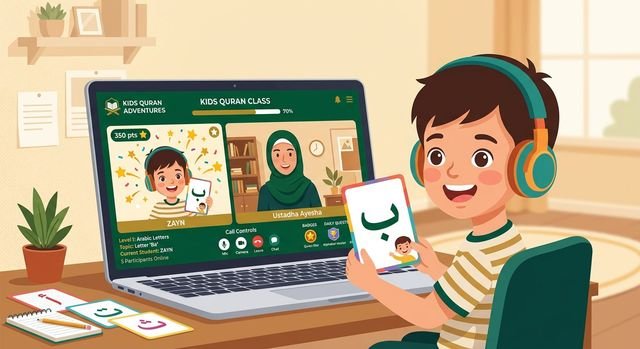 2:45
Live one-to-one lesson example.
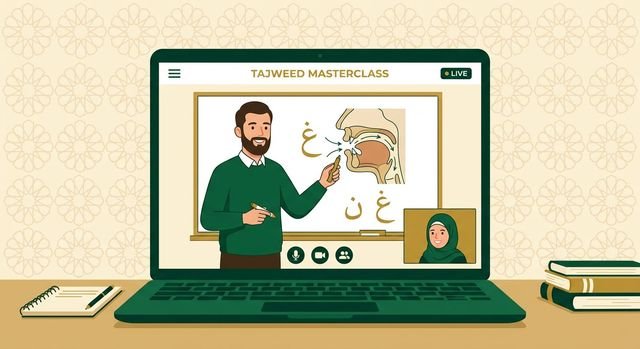 2:45
Live one-to-one lesson example.
Unscripted words from the people who took the course — recorded after their final class.
“Live correction made my recitation clearer and gave me a practical path to keep improving.”
“Live correction made my recitation clearer and gave me a practical path to keep improving.”
“Live correction made my recitation clearer and gave me a practical path to keep improving.”
Teacher language, speciality and availability are considered before the regular schedule starts.
New to the Quran? Our beginner classes teach you the Arabic letters, correct pronunciation, and basic recitation step by step, with a qualified teacher guiding you at your own pace. Start your first class today.
“The teacher gives clear correction and a practical next step every week.”
“The teacher gives clear correction and a practical next step every week.”
“The teacher gives clear correction and a practical next step every week.”
See measurable examples from learners who started at different levels.
Follows a weekly target and muraja’ah plan independently.
Applies core rules naturally with fewer corrections.
Reads short surahs with stronger fluency and confidence.
Compare nearby routes before choosing the best starting point.
BeginnerUnderstand recurring Quranic vocabulary and sentence patterns.
View courseBeginnerBeginnerBeginnerBeginnerA quick answer to the questions that come up most often before someone books their first trial class — a mix of questions specific to this course and questions about the academy as a whole.
No. This course is built as a learn to read Quran for beginner course — a Quran beginner course for adults and children who don't yet know the alphabet. If you can already read Arabic, a higher-level Tajweed course is a better fit.
Both. The same beginner curriculum works for adults and for children — the teacher simply adjusts pacing and examples for the student's age.
A teacher for this level specializes in absolute beginners, meaning they're used to correcting Makharij from scratch and moving at a slower, more patient pace than a tutor teaching intermediate or advanced students.
Most students move from the alphabet to reading short surahs within a few months of consistent, regular classes — though pace varies by how many sessions per week you take.
Yes. Classes can be rescheduled with reasonable notice through your student dashboard — this applies across all courses at the academy, not just this beginner level.
Yes. You can request a male or female teacher when you book your free trial, and the academy will match you accordingly for ongoing classes.
Book the free first class. We will check level, match the teacher and show the next milestone.
7 free trial spots remaining this week
Choose the weekly frequency that fits the learner after the free trial.