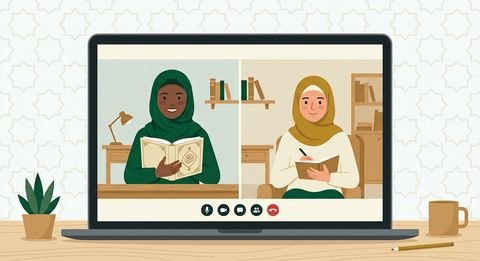
 2:45
Parent Progress Review (Live)
Live one-to-one lesson example.

Join thousands of students learning to read, recite and understand the Quran from the comfort of home. Our online Quran classes pair every student with a certified Quran teacher on Skype or Zoom for one-on-one sessions built around your schedule, your level and your goals.
Whether you're starting with the basics of Arabic pronunciation or working toward fluent, Tajweed-perfect recitation, our Quran academy online makes consistent, guided learning possible from anywhere in the world — as one of the leading destinations for online Quran learning, with Quran courses online covering everything from Qaida foundations to full memorization.
There's no long-term contract to worry about before you start. Every student begins with a free trial class, so you can meet your tutor, see how online Quran teaching actually runs over Skype, and decide from there — with no pressure and nothing to lose.
 6–9
Our online Quran classes are built around a simple idea: real, live teaching from a qualified tutor, delivered one-on-one, on a schedule that fits your life. After a short assessment, every student — child or adult, complete beginner or returning learner — is placed into the track that matches their current level, then guided step by step through pronunciation, Tajweed and recitation with regular feedback.
Classes run over Skype or Zoom, so all you need is a stable internet connection and a device with a camera. Sessions can be recorded on request, homework is set between lessons, and progress is reviewed regularly with your tutor so you always know exactly where you stand and what comes next in your online Quran course.
This isn't a one-size-fits-all curriculum forced onto every learner. A seven-year-old starting the Arabic alphabet and a working adult refining Tajweed both move through the same Quran learning academy, but on separate tracks, at separate paces, built around what each of them actually needs next — whether they found us searching for Quran classes, skype Quran classes, or zoom Quran classes.
Kalamullah was built specifically for online Quran learning, not adapted from a classroom curriculum. Every part of the course — from tutor training to lesson pacing — is designed around what actually works over a video call, so progress is steady and measurable from the first free trial onward.
Every tutor is vetted for Tajweed proficiency, teaching experience and the patience to work with children and adult beginners alike, so recitation is corrected properly from the first lesson rather than picked up by ear.
This is what separates a real Quran teacher on Skype from an unverified freelancer offering lessons on the side — every tutor here has gone through the same vetting process before ever teaching a paying student.
Group classes divide a tutor's attention between many students; here every session is one student and one teacher, so pacing, corrections and homework are built around exactly how you learn.
It's the same reason parents specifically search for online quran classes on skype rather than group platforms — a mispronounced letter gets caught and corrected in real time, not lost in a room of twenty students.
Lessons are booked in the time zone and time slot that works for you, with rescheduling built into the plan, so travel, school and work don't derail your progress.
Because everything runs over Skype or Zoom, a family relocating abroad or a student traveling for work can usually keep the same tutor and the same weekly slot, just adjusted for the new time zone.
Families can choose a tutor they're comfortable with, including female tutors for children and for women who prefer to learn with one, without it affecting the pace or quality of teaching.
This is one of the most common questions we get before a family books their first online quran course, and it's answered upfront here rather than left for someone to discover mid-enrollment.
Every lesson sits inside a level-based curriculum with clear milestones, so you can see exactly how today's session connects to becoming a confident, correct reciter.
That structure is what turns a single skype quran class into an actual course — each week builds on the last instead of existing as an isolated, disconnected session.
Book a free first class and we will identify the right level and next milestone.
Book a free trialThe course is organized into five stages. Every student begins with an assessment so lessons start at the right level, whether that's a five-year-old learning the Arabic alphabet or an adult refining Tajweed rules.
Before your first paid lesson, a tutor spends a short session listening to your current recitation (or, for complete beginners, your familiarity with Arabic letters) and talks through your goals — memorization, recitation, or understanding meaning — so you're placed at the right starting point instead of repeating what you already know or being pushed ahead of where you're ready.
There's no cost and no obligation attached to this session — it exists purely to make sure the paid lessons that follow start from exactly where you are, rather than from a generic first day that assumes everyone begins at zero.
For students starting from the beginning, this stage covers the Arabic alphabet, correct pronunciation points (makharij) and the Noorani Qaida, building the base every later stage depends on. Letters are introduced gradually, with heavy repetition and correction, so pronunciation habits are formed correctly the first time rather than fixed later.
Most students spend several months here before moving on, and that pace is intentional — rushing this stage is the single most common reason students struggle with Tajweed later, so tutors are trained to hold a student here until pronunciation is genuinely solid.
Once the foundations are solid, lessons move into the rules of Tajweed — from basic noon and meem rules through to the finer points of madd and waqf — applied directly to Quran recitation rather than taught as theory alone.
Each rule is practiced on real verses as soon as it's introduced, not memorized as an isolated fact. Your tutor listens for the rule in your live recitation and corrects it in the moment, so the goal throughout is application you can repeat unprompted, not a definition you can recite back on request.
Students working toward Hifz move into structured memorization with a daily new-portion target and a rotating revision schedule, so previously memorized sections stay fresh instead of fading. The pace is set individually — some students memorize a line a day, others a full page, depending on age, availability and goals.
Revision isn't an afterthought here: roughly as much class time goes into reviewing older portions as into learning new ones, because retention, not just coverage, is what this stage is actually measured on.
Regular reviews track fluency and accuracy against course milestones, giving both you and your tutor a clear record of what's improved and what still needs work. These aren't informal check-ins — each review is logged against the same benchmarks used to decide when a student is ready to move on.
Students who complete the level receive a certificate and a recommendation for their next course, whether that's advanced Tajweed, Tafseer, or continued Hifz, so the end of one stage always points clearly to what comes next.
By the end of this course, you'll be able to demonstrate real, practical progress — not just have covered a list of topics.
You can pronounce every Arabic letter from its correct articulation point (makharij), including letters that don't exist in English, confirmed by a tutor in live recitation rather than in written exercises.
This matters because mispronounced letters can change the meaning of a word being recited — so getting this right early is treated as a prerequisite for everything that follows, not a nice-to-have.
You can apply the core Tajweed rules — noon and meem rules, madd, qalqalah and waqf — while reciting at a natural pace, rather than only being able to state the rule when asked.
Your tutor tests this by listening for the rules during ordinary recitation, not through a separate quiz, because applying a rule under normal reading conditions is a different (and more useful) skill than naming it in isolation.
You can read a new, unfamiliar page of the Quran aloud with correct Tajweed and without word-by-word sounding out, showing the fluency has transferred beyond memorized passages.
This is usually the clearest sign of real progress for families to see, since it's easy to check yourself: hand your child or yourself a page you've never read before and listen for hesitation.
If you're on the Hifz track, you can recite your memorized portions from memory during a review session, with your tutor's revision log as evidence of what's retained.
Because the log tracks both new memorization and older revision, it also shows whether earlier portions are staying solid — not just how much new material has been added.
You can explain, in simple terms, the general meaning of the verses you've recited most often, so recitation connects to comprehension rather than staying purely mechanical.
This isn't a substitute for a dedicated Tafseer course, but it means memorization and recitation here are never taught as pure sound repetition disconnected from meaning.
You've completed a set number of consecutive weeks of lessons and homework, showing the course fits into your routine well enough to continue past the initial course period.
For most families, this consistency — not any single skill — is what ends up mattering most, since steady weekly progress compounds into far more than any single intensive session could.
Watch real lessons from our online Quran classes before you commit to a single one. No sign-up required to watch — just a few minutes to see how a real lesson actually runs.
Short class snippets show how the teacher explains, listens, corrects and confirms progress.
2:45Live one-to-one lesson example.
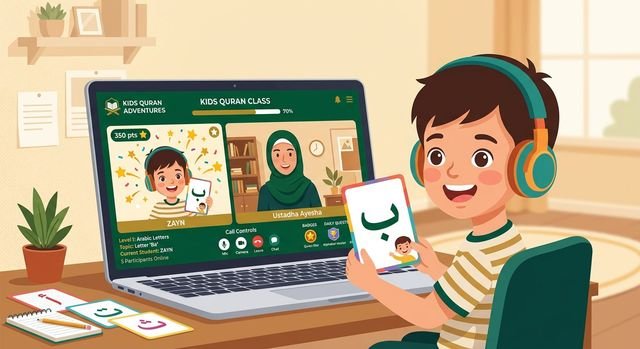 2:45
Live one-to-one lesson example.
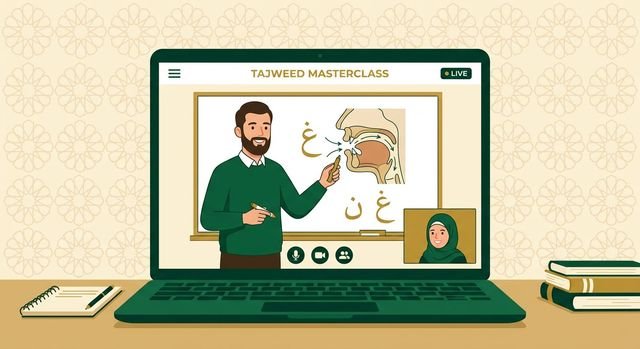 2:45
Live one-to-one lesson example.
Unscripted words from the people who took the course — recorded after their final class.
“Live correction made my recitation clearer and gave me a practical path to keep improving.”
“Live correction made my recitation clearer and gave me a practical path to keep improving.”
“Live correction made my recitation clearer and gave me a practical path to keep improving.”
Teacher language, speciality and availability are considered before the regular schedule starts.
Real ratings and real reviews from students in this course — a five-minute read that can tell a new visitor more than any feature list on this page.
If you're still deciding between different online quran classes, this is usually the section that settles it, since it comes directly from people who've already made the same decision you're weighing now.
“The teacher gives clear correction and a practical next step every week.”
“The teacher gives clear correction and a practical next step every week.”
“The teacher gives clear correction and a practical next step every week.”
See measurable examples from learners who started at different levels.
Follows a weekly target and muraja’ah plan independently.
Applies core rules naturally with fewer corrections.
Reads short surahs with stronger fluency and confidence.
A quick answer to the questions that come up most often before someone books their first trial class — a mix of questions specific to this course and questions about the academy as a whole.
No. If you're completely new to Arabic, your first lessons start with letter recognition and pronunciation before moving into recitation — there's no need to already know how to read Quran.
A tutor listens to a short assessment during your free trial (or asks about your Arabic reading level, if you're a complete beginner) and places you into the appropriate stage of the course.
Yes. Female tutors are available, and you can request one when you book your free trial or at any point afterward.
You can reschedule a lesson with reasonable notice through your student account or by messaging your tutor directly, following the academy's rescheduling policy.
Most students start with two to three classes a week, though this can be adjusted based on your goals and availability — more frequent sessions generally lead to faster progress, especially for memorization.
Just a device with a camera and microphone (a phone, tablet or computer works), a quiet space, and a copy of the Quran or the Noorani Qaida if you're at that stage.
Book the free first class. We will check level, match the teacher and show the next milestone.
7 free trial spots remaining this week
Choose the weekly frequency that fits the learner after the free trial.