 2:45
Parent Progress Review (Live)
Live one-to-one lesson example.

Kalamullah’s Arabic pronunciation course is built on Arabic Makharij-based pronunciation training, covering every letter’s precise point of origin. In live one-on-one Arabic phonetics lessons, students learn Arabic sounds accurately, including the ones English doesn’t have, with qualified tutors who correct each letter in real time.
 6–9
The course trains students in the 17 articulation points of Arabic, covering throat, emphatic, uvular, and lip sounds systematically. Tutors certified through recognized Islamic institutions deliver each live session, focused entirely on accurate letter production and vowel distinction.
Students who want to go beyond letter sounds to the full rules of Quranic recitation can continue into our Beginner Tajweed Course.
Most learners who struggle to learn Arabic sounds were taught words before articulation. This course begins with Makharij isolation drilling before any vocabulary is introduced, building correct habits that never need to be unlearned.
Kalamullah selects tutors with verified credentials from recognized Islamic institutions and experience teaching Arabic sounds to non-native speakers at every level, before assigning them to this course.
Every Arabic pronunciation course session is a private live class between the student and a single assigned tutor. Feedback on specific letter production happens during the session, not through written notes reviewed afterward, so corrections take effect immediately and are reinforced in the same class.
Kalamullah provides qualified female tutors for the Arabic pronunciation course. Female students and families can request a female tutor at enrollment, and Kalamullah will match them with a qualified instructor without delay or additional cost to the student.
Arabic pronunciation course sessions at Kalamullah are available morning, afternoon, and evening across all international time zones. Students in any country can book sessions that fit school hours, work shifts, or family schedules without being restricted to a fixed timetable.
The course follows a five-stage progression: letter sounds, vowels, diacritics, words, and connected phrases. Students advance only when their tutor confirms the current stage is accurate, so foundational errors never compound.
Book a free first class and we will identify the right level and next milestone.
Book a free trialEach stage builds directly on the one before it, giving students a clear path from first sounds to accurate connected speech.
Students begin by learning the 17 articulation points across five regions: the oral cavity (Jawf), the throat, the tongue, the lips, and the nasal passage. Each letter is drilled in isolation until the tutor confirms consistent accurate production.
Particular attention is given to pharyngeal sounds including Ayn and Ha, emphatic consonants including Sad, Dad, Ta, and Dha, and the uvular Qaf. These sounds have no English equivalents and require deliberate muscular conditioning that the tutor monitors closely in every session.
Once letter sounds are confirmed accurate, students move to short vowel production covering Fatha, Kasrah, and Dammah, followed by long vowels Alif, Waw, and Ya. Tutors use minimal pair contrasts to train the ear to detect differences that directly affect word meaning.
Students also practice how short vowel quality shifts near emphatic letters, a nuance that native speakers produce automatically but non-native learners must train deliberately. This stage prevents the vowel mispronunciations that compound into reading errors at higher levels.
Students advance to the Arabic pronunciation course's diacritics stage, covering Tanween in its three forms, Shaddah as a consonant doubling marker, and Sukoon as a vowelless consonant indicator. Each diacritic is first drilled in isolation before being applied to real syllable contexts.
Tutors use self-recording exercises to help students identify the gap between their own output and the model pronunciation. The three-stage feedback loop of produce, compare, and adjust is applied during every session to accelerate accurate diacritic handling across different letter environments.
At the word stage, students carry each sound into real words, where neighboring letters and vowels make accurate production harder. Emphatic letters such as Sad and Dad are drilled within words, focusing on raising the back of the tongue (Isti’la’) and pressing it toward the palate (Itbaq) without rounding the lips, a common error among non-native speakers.
Students do not progress to phrase reading until word-level accuracy is confirmed.
The final stage of the Arabic pronunciation course moves students from isolated word accuracy to fluent connected phrase production. Tutors introduce short phrases where target sounds appear in natural context, training the transitions between letters that define natural Arabic rhythm.
Students read aloud in progressively longer passages while tutors monitor articulation accuracy, vowel length, and emphatic consonant consistency. This stage also covers syllable stress patterns and how different Arabic-speaking regions approach penultimate syllable stress in Modern Standard Arabic.
Every outcome in the Arabic pronunciation course is a demonstrable skill confirmed by the assigned tutor before the student advances. Progress is measured by what the student can produce, not what they have been exposed to.
Students can produce each Arabic letter from its correct Makharij point, distinguishing pharyngeal, emphatic, and uvular sounds from their near-identical counterparts. Tutors verify production accuracy before the student moves to syllable-level practice.
Students distinguish and produce Fatha, Kasrah, and Dammah accurately in both regular and emphatic letter environments. Long vowels Alif, Waw, and Ya are applied with correct duration so word meaning is preserved in reading and speaking.
Students apply Tanween in all three forms, produce doubled consonants under Shaddah without reducing them, and handle Sukoon-marked letters without adding a vowel. Each skill is confirmed by the tutor in live reading exercises before the stage closes.
Students pronounce every letter correctly inside fully voweled words, including emphatic and throat letters next to other sounds.
The tutor confirms this through oral reading drills before phrase-level work begins.
Students distinguish minimal pairs such as Seen versus Sad and Qaf versus Kaf in both listening and production. This phonemic discrimination skill is measured through tutor-administered listening tasks and confirmed before the student proceeds to connected speech practice.
Students read connected Arabic phrases with accurate articulation, correct vowel duration, and consistent emphatic consonant quality throughout. Syllable stress and letter-to-letter transitions are monitored by the tutor in extended oral reading passages at the course's final stage.
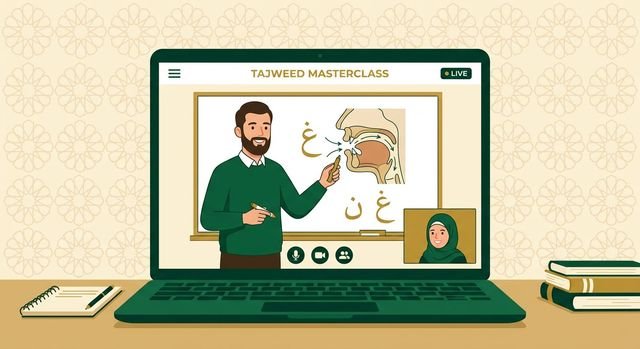
Watch a real lesson below to hear how Kalamullah tutors deliver live Makharij-based articulation training.
Short class snippets show how the teacher explains, listens, corrects and confirms progress.
2:45Live one-to-one lesson example.
 2:45
Live one-to-one lesson example.
 2:45
Live one-to-one lesson example.
Unscripted words from the people who took the course — recorded after their final class.
“Live correction made my recitation clearer and gave me a practical path to keep improving.”
“Live correction made my recitation clearer and gave me a practical path to keep improving.”
“Live correction made my recitation clearer and gave me a practical path to keep improving.”
Teacher language, speciality and availability are considered before the regular schedule starts.
Read what enrolled students and parents say about Kalamullah's Arabic pronunciation course below.
“The teacher gives clear correction and a practical next step every week.”
“The teacher gives clear correction and a practical next step every week.”
“The teacher gives clear correction and a practical next step every week.”
See measurable examples from learners who started at different levels.
Follows a weekly target and muraja’ah plan independently.
Applies core rules naturally with fewer corrections.
Reads short surahs with stronger fluency and confidence.
Compare nearby routes before choosing the best starting point.
BeginnerBeginnerBeginnerUnderstand recurring Quranic vocabulary and sentence patterns.
View courseBeginnerUnderstand recurring Quranic vocabulary and sentence patterns.
View courseBeginnerUnderstand recurring Quranic vocabulary and sentence patterns.
View courseA quick answer to the questions that come up most often before someone books their first trial class — a mix of questions specific to this course and questions about the academy as a whole.
Kalamullah's Arabic pronunciation course accepts students with no prior Arabic background. Tutors begin at the isolated letter level and assess each student's starting point individually during the free trial class.
Kalamullah accepts students of all ages into the Arabic pronunciation course. Children, teenagers, and adults each receive a tutor whose teaching approach is matched to their age group and prior Arabic phonetics exposure.
Kalamullah maintains qualified female Arabic pronunciation tutors. Students requesting a female tutor indicate this preference at enrollment and are matched before their first session, with no additional cost or waiting period involved.
Sessions run seven days a week across all international time zones. Students select session times at enrollment and can reschedule with advance notice if their weekly schedule requires it.
Each tutor assesses articulation accuracy at the close of every session and confirms stage completion before the student advances. Kalamullah provides parents and adult learners with regular progress reports covering each skill area in the Arabic pronunciation course.
No. This course focuses on producing every Arabic sound correctly, which is the foundation of Tajweed and of clear spoken Arabic. Tajweed goes further, covering the rules of recitation such as Noon Sakinah and Madd. Students who complete this course are well prepared for our Beginner Tajweed Course.
Book the free first class. We will check level, match the teacher and show the next milestone.
7 free trial spots remaining this week
Choose the weekly frequency that fits the learner after the free trial.