 2:45
Parent Progress Review (Live)
Live one-to-one lesson example.

Kalamullah's Arabic Alphabet course for beginners takes students from the name and sound of each of the twenty-eight letters through their written shapes, vowel marks, and joining rules, straight to reading and writing simple Arabic words with confidence.
 6–9
Kalamullah's Arabic alphabet course covers the name, sound, and articulation point of all twenty-eight letters, their isolated, initial, medial, and final shapes, handwriting of every letter in the correct stroke order, the short vowels, Sukoon, Shaddah, and Tanween, the long vowel letters, and the rules for joining letters, before moving to reading and writing complete words.
This course is designed for students starting from zero, with no prerequisite level required. Arabic alphabet learning at Kalamullah combines reading, pronunciation, and writing in every lesson, so beginners recognize, say, and write each letter correctly before moving on to the next.
Your teacher introduces one letter or mark at a time, models its sound, corrects every attempt, and closes each session with a short reading and writing task.
Every teacher assigned to this course has formal study in Arabic and experience teaching beginners. Credentials are verified before assignment, so every letter’s sound is modeled accurately from the first session.
Letters such as 'Ayn, Ghayn, Qaf, and the heavy letters are the hardest part of learning to read Arabic. Kalamullah's teachers explain exactly where each sound is produced and drill it until the student pronounces it correctly.
Every alphabet lesson at Kalamullah is private, so the teacher hears and sees every letter the student reads and writes. Errors are corrected immediately, and difficult letters are repeated until they are secure.
Kalamullah provides qualified female Arabic teachers for students who prefer or require a same-gender teacher. The preference is selected at registration and honored from the trial session onward, with no change to scheduling or lesson content.
Kalamullah's alphabet curriculum moves from letters to shapes, vowel marks, and joining in a fixed order. No step is skipped, and the teacher confirms each one is mastered, not simply covered, before the student advances.
Book a free first class and we will identify the right level and next milestone.
Book a free trialEach module builds directly on the previous one, giving beginners a clear path from their first Arabic letter to reading and writing complete words.
The course opens with how Arabic is written, from right to left, and how letters connect within a word. The teacher also checks whether the student has any previous exposure to Arabic letters.
Complete beginners start here, while students who already recognize some letters move quickly to the modules that fill their gaps.
Students learn the name and sound of every letter, grouped by their articulation points in the throat, tongue, and lips. Letters with similar shapes, such as Ba, Ta, and Tha, are taught side by side so students can tell them apart.
By the end of this module, students recognize and pronounce all twenty-eight letters correctly in isolation.
The teacher introduces the isolated, initial, medial, and final shape of each letter, along with the six letters that never connect to the letter after them. Students write every shape in the correct stroke order.
Handwriting is reviewed in every session, so students write clearly and consistently before adding vowel marks.
Students study Fathah, Kasrah, and Dammah, then Sukoon, Shaddah, and Tanween, and the long vowel letters Alif, Waw, and Ya. Each mark is practiced on every letter until it is read on sight.
The teacher reviews each mark across many combinations before moving on, so students read voweled syllables without hesitation.
The final module brings every skill together. Students join letters into complete words, read voweled words aloud, and write short words from dictation.
At the close of this module, students read and write simple Arabic words independently and are ready for Kalamullah's Quran Reading or Arabic Language course.
Every outcome below is something the student can demonstrate to their Kalamullah teacher by the end of the Arabic Alphabet course, not simply a topic that was covered during sessions.
Students name and identify every Arabic letter on sight, in any order.
This is assessed in live reading, including letters with similar shapes.
Students produce the sound of each letter from its correct articulation point.
They pronounce sounds that do not exist in English, such as 'Ayn and Qaf, accurately.
Students recognize each letter in its isolated, initial, medial, and final form.
They identify letters correctly inside connected words.
Students write every letter in all its shapes using the correct stroke order.
Their handwriting is clear and consistent, verified by the teacher in live sessions.
Students read Fathah, Kasrah, Dammah, Sukoon, Shaddah, and Tanween correctly on any letter.
They extend long vowels to the correct length without teacher prompting.
Students read voweled Arabic words aloud and write short words from dictation.
This is the measurable endpoint of the Arabic Alphabet course at Kalamullah.
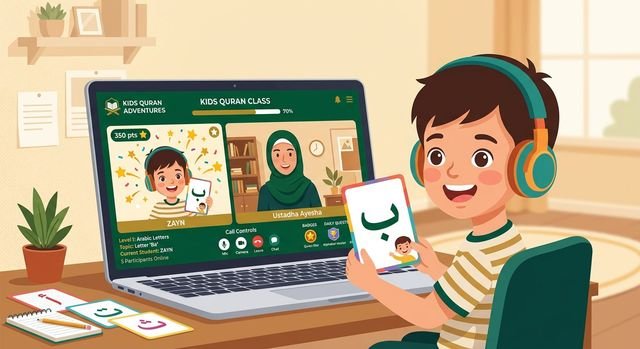
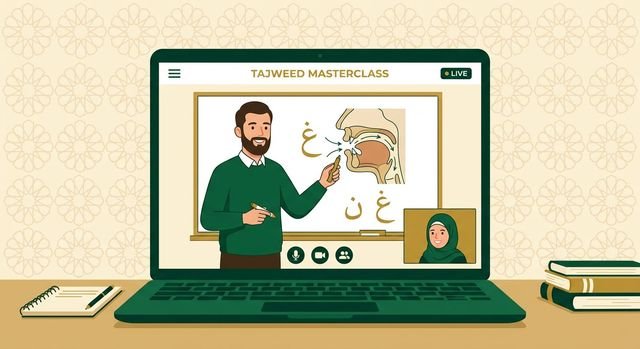
Watch real Kalamullah alphabet lessons below and see how beginners read their first Arabic words.
Short class snippets show how the teacher explains, listens, corrects and confirms progress.
2:45Live one-to-one lesson example.
 2:45
Live one-to-one lesson example.
 2:45
Live one-to-one lesson example.
Unscripted words from the people who took the course — recorded after their final class.
“Live correction made my recitation clearer and gave me a practical path to keep improving.”
“Live correction made my recitation clearer and gave me a practical path to keep improving.”
“Live correction made my recitation clearer and gave me a practical path to keep improving.”
Teacher language, speciality and availability are considered before the regular schedule starts.
Read what students and parents say about learning the Arabic alphabet with Kalamullah before booking your free trial.
“The teacher gives clear correction and a practical next step every week.”
“The teacher gives clear correction and a practical next step every week.”
“The teacher gives clear correction and a practical next step every week.”
See measurable examples from learners who started at different levels.
Follows a weekly target and muraja’ah plan independently.
Applies core rules naturally with fewer corrections.
Reads short surahs with stronger fluency and confidence.
Compare nearby routes before choosing the best starting point.
BeginnerBeginnerBeginnerUnderstand recurring Quranic vocabulary and sentence patterns.
View courseBeginnerUnderstand recurring Quranic vocabulary and sentence patterns.
View courseBeginnerUnderstand recurring Quranic vocabulary and sentence patterns.
View courseA quick answer to the questions that come up most often before someone books their first trial class — a mix of questions specific to this course and questions about the academy as a whole.
No. The Arabic Alphabet course for beginners assumes zero prior knowledge. Students who have never seen an Arabic letter begin with the script itself in their first session.
Yes. Children and adults both enroll in the course. Teachers adjust the pace, session length, and activities to suit younger learners.
If your goal is reading the Quran, Noorani Qaida takes you straight toward the Mushaf. If you also want to write Arabic or plan to study the Arabic language, this course adds handwriting and prepares you for Arabic Language classes. Your free trial includes a short check to confirm your starting point.
Students usually continue to Kalamullah's Quran Reading course to read the Mushaf, or to the Arabic Language course to understand and speak Arabic.
Yes. Kalamullah provides qualified female Arabic teachers for sisters and girls. The preference is confirmed at registration and matched before the free trial session is booked.
Yes. Kalamullah reschedules sessions without penalty when genuine conflicts arise, with morning, afternoon, and evening slots available seven days a week across all time zones.
Book the free first class. We will check level, match the teacher and show the next milestone.
7 free trial spots remaining this week
Choose the weekly frequency that fits the learner after the free trial.