 QuranQuran

You may have heard the Quran recitation all your life, yet the Arabic letters on the page still look unfamiliar. So how do you learn Noorani Qaida in English when Arabic isn’t your first language?
You follow the book’s fixed order: letters, joining, short vowels, Tanween, long vowels, Sukoon and Shaddah, then basic Tajweed. English explanations help you understand each lesson, but your eyes stay on the Arabic script.
Noorani Qaida is a beginner’s Arabic reading primer that teaches letter recognition, vowel sounds, and basic Tajweed before you move on to reading the Quran itself. An English Noorani Qaida keeps the Arabic exercises and adds English instructions, explanations, and sometimes transliteration.
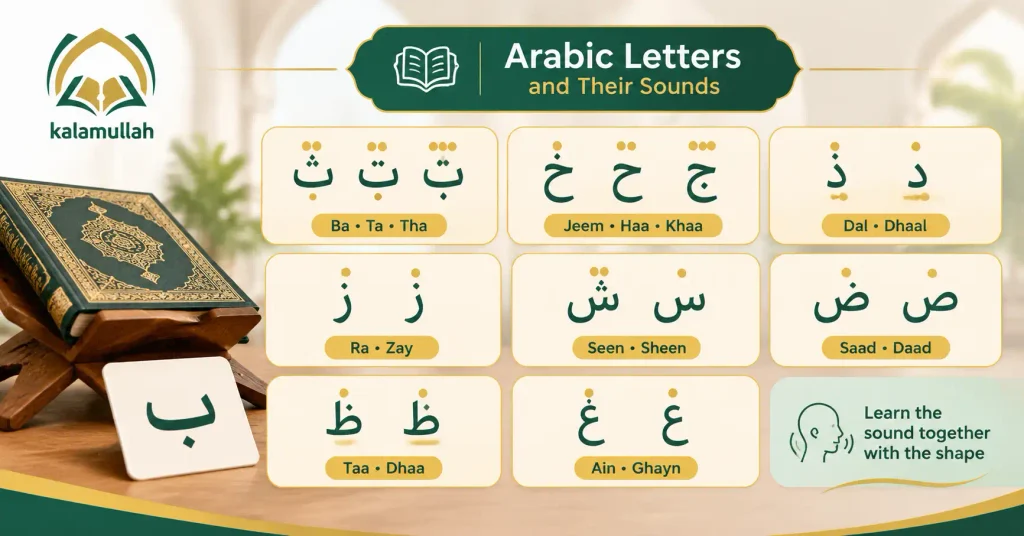
The first lesson introduces the Arabic alphabet in isolated form: 28 letters, though many Qaida editions list 29 by adding Hamza or Lam-Alif. Pay close attention to letters that share a shape and differ only in their dots. For example, ب (Ba), ت (Ta), and ث (Tha) are the same base shape with one dot below, two dots above, and three dots above.
Learn the sound together with the shape. An English hint like “Ba as in bat” helps at first. But letters such as ع (Ain), ح (Haa), and غ (Ghain) have no English equivalent, so you need to hear them pronounced and copy what you hear.
The quickest way to master this lesson is to sort the letters by base shape (ب ت ث, ج ح خ, د ذ, ر ز, س ش, ص ض, ط ظ, ع غ) and study one group at a time. Say each letter aloud while watching your mouth in a mirror. Move on only when you can name a letter you’ve picked at random without hesitating.
Most Arabic letters take a different form at the start, middle, or end of a word. The second stage of the Qaida trains you to spot the same letter in all its forms. You start with two-letter combinations and build up from there.
A useful fact here: six letters (ا د ذ ر ز و) never connect to the letter after them. Knowing this early stops you from misreading where one letter ends and the next begins.
A practical drill for this lesson is to write one letter, such as ه, in its four forms side by side: isolated, initial, middle, and final. Then find that letter in a few words on the Qaida page and trace it with your finger. This trains your eye to recognize it however it’s joined.
Short vowels are small marks above or below a letter that give it its sound. In Noorani Qaida English editions, they’re usually explained like this:
Some English guides describe these as “aa, ee, oo,” but those are long sounds. Learning short vowels as long ones is one of the most common errors at this stage, and it carries straight into recitation.
To lock in the vowels, read every letter with all three marks in one go (بَ بِ بُ، تَ تِ تُ) and keep each sound short and crisp. Once that feels easy, read the same rows in a mixed-up order. That way you’re reading the marks rather than reciting a pattern from memory.
Tanween is a doubled vowel mark at the end of a word that adds an “n” sound: بً (ban), بٍ (bin), بٌ (bun). It looks like two Fathas, two Kasras, or two Dammas, and each one keeps the vowel of the single mark it repeats.
Learners often confuse Tanween with a single vowel and drop the “n,” or they add an “n” where there’s only one mark. Both mistakes change how the word sounds.
The simplest way to train your eye is to read a single vowel and its Tanween one after the other: بَ then بً, بِ then بٍ, بُ then بٌ. Saying each pair aloud makes the extra “n” automatic every time you see the doubled mark.
Madd letters lengthen a vowel. Alif after a Fatha gives “aa” (بَا), Ya after a Kasra gives “ee” (بِي), and Waw after a Damma gives “oo” (بُو). The natural Madd is held for two counts.
Timing feels awkward at first, but it matters. In Quranic recitation, vowel length can change a word’s meaning, so it’s worth getting right while you’re still in the Qaida.
To get the timing right, tap your finger twice on the table while you stretch each long vowel, then read the short version right after it (بَ, then بَا). Contrasting short and long side by side keeps you from cutting a Madd short or stretching a short vowel by mistake.
Read also: How to Read the Quran with Tajweed?
Sukoon (ْ) means the letter has no vowel, so you stop on it cleanly. Shaddah (ّ) doubles a letter, which means you hold and stress it.
The usual mistake with Sukoon is adding a sound that isn’t there. You should say أَبْ as “ab,” not “abu.” With Shaddah, the mistake is the reverse: beginners rush past it, when the letter should be pronounced twice.
The most effective drill here is reading pairs that differ by only one mark, such as أَبَ and أَبْ, or رَبَ and رَبّ, and listening for the difference. Recording yourself helps, because an extra vowel after a Sukoon is easy to miss while you’re speaking.
Recite the Words of Allah With Confidence
Join Kalamullah Quran Academy for live 1-on-1 lessons with Al-Azhar-trained, Ijazah-holding tutors, from your first Qaida letter all the way to Ijazah.
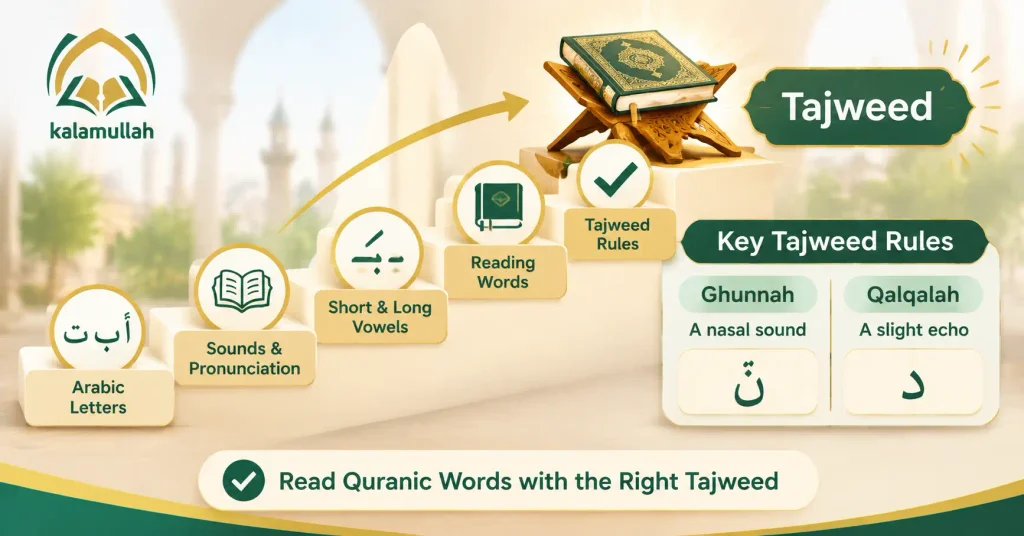
Book Your Free Trial ClassThe last lessons introduce basic Tajweed: Ghunnah, Qalqalah, and heavy versus light letters. Ghunnah is a nasal sound held for about two counts on a noon or meem with Shaddah (نّ، مّ). Qalqalah is a slight echo on five letters (ق ط ب ج د) when they carry a Sukoon.
These lessons connect the Qaida to real recitation. By the end, you should be able to read short Quranic words with the right vowels, lengths, and stops.
You can check both rules yourself. Pinch your nose lightly while saying إِنَّ: if the sound stops, you’re producing a real Ghunnah. For Qalqalah, read أَحَدْ and listen for a light bounce on the final د, without adding a vowel after it.
If you’d like a teacher to explain each step in clear English and correct your sounds as you go, Kalamullah offers structured Noorani Qaida lessons for beginners that follow this same order.
Each Qaida page introduces something new, and the next page assumes you already know it. Revision isn’t an extra. It’s the step that holds all the others together. Short daily sessions work better than one long session a week. A good pattern is to revise yesterday’s page before starting today’s.
To build this habit, open each session by reading the previous page aloud without help, and mark any line you stumble on. Go back over the marked lines the next day. Once a week, reread one earlier lesson at random so the first steps don’t fade while you work on the later ones.
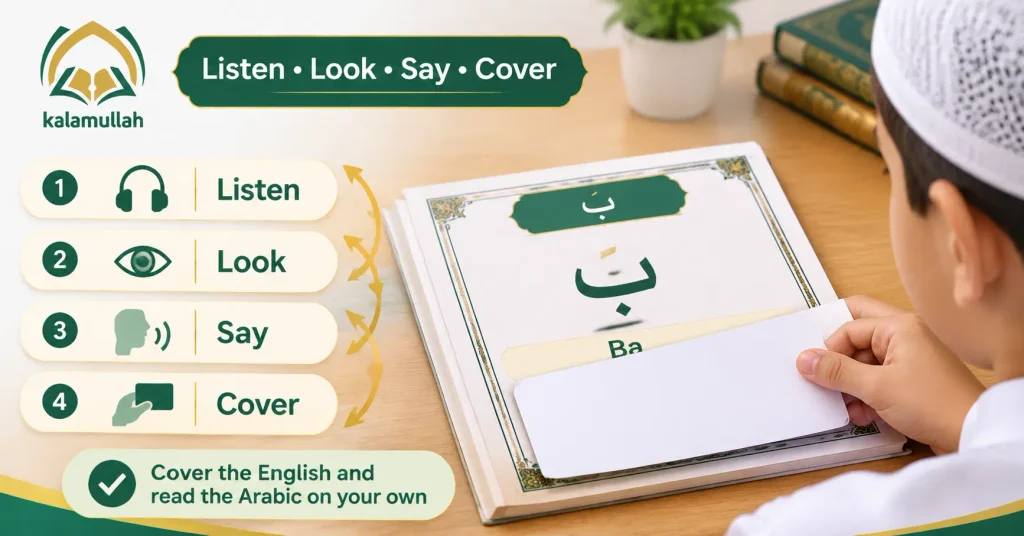
Transliteration means writing Arabic sounds in English letters, like “ba” under بَ. It helps on day one, but it causes trouble if you keep using it. Learners can finish a whole page while reading only the English line, then get stuck as soon as it’s covered.
English spelling can’t carry Arabic sounds on its own. Some systems write ح as “ḥ” and others just use “h,” which makes ح and ه look the same on paper. Stick to one system and ask your teacher what each symbol means.
A reliable way to move past it is the Listen–Look–Say–Cover method, applied to every new line:
The Cover step is your progress check. If you can read the line with the English hidden, you’ve learned it. For many learners, the honest answer to “How do you learn Noorani Qaida in English?” is this: use English to understand the lesson, then cover it to prove you can read.
A live teacher helps most here, because they can hear when you’ve lost a vowel or swapped two throat letters. Kalamullah tutors explain the Qaida in English while keeping your practice on the Arabic page.
Once you’ve worked through the steps, it helps to see all the core rules in one place. Use this table to revise. It isn’t a substitute for hearing each sound pronounced.
| Rule | Mark | What it means in English | Example |
| Fatha | َ | Short “a” sound | بَ = ba |
| Kasra | ِ | Short “i” sound | بِ = bi |
| Damma | ُ | Short “u” sound | بُ = bu |
| Tanween | ً ٍ ٌ | Doubled vowel ending in “n” | بً = ban |
| Madd | ا و ي | Stretch the vowel for two counts | بَا = baa |
| Sukoon | ْ | No vowel; stop cleanly | أَبْ = ab |
| Shaddah | ّ | Letter is doubled and stressed | رَبّ = rabb |
| Ghunnah | نّ مّ | Nasal sound for about two counts | إِنَّ |
| Qalqalah | ق ط ب ج د | Light echo on a letter with Sukoon | أَحَدْ |
Most beginners struggle with the same few habits, and each is easier to fix early than later. A large part of the answer to “How do you learn Noorani Qaida in English correctly?” is simply avoiding these mistakes.
Read also: How Do You Pronounce Ikhfa?
“English Noorani Qaida” can mean several different things, so check what the English support actually is before you commit. The right choice depends on your level and on whether you’ll have a teacher.
| Type | What it gives you | Best for |
| English instructions | How to do each exercise | Self-starters with some guidance |
| English explanations | Descriptions of letters, marks, and rules | Adults who want to understand the “why” |
| Transliteration | Arabic sounds written in English letters | The first few weeks only |
| English-speaking teacher | Lessons from the Arabic pages, explained in English | Most beginners, children and adults |
An English-speaking teacher doesn’t need a transliterated book. They can teach from a standard Arabic Qaida and explain each exercise aloud, which keeps your attention on the script from the start.
What to check before you start
There’s no fixed timeline. Progress depends on age, daily practice time, any Arabic you already know, and how often someone corrects your pronunciation.
If speed matters to you, the practical answer to “How do you learn Noorani Qaida in English faster?” is short daily sessions with a teacher rather than long, irregular ones.
Recite the Words of Allah With Confidence
Join Kalamullah Quran Academy for live 1-on-1 lessons with Al-Azhar-trained, Ijazah-holding tutors, from your first Qaida letter all the way to Ijazah.
Book Your Free Trial ClassEvery hour you spend practising wrong sounds is an hour you’ll later spend unlearning them. Get the foundation right from the first lesson, with a teacher who explains each rule in plain English and corrects you in real time.
With Kalamullah, you learn Noorani Qaida in English step by step: letters, vowels, Tanween, Madd, Sukoon, Shaddah, and the first Tajweed rules, all taught from the Arabic page.
The lessons suit children starting their first Quran steps, adults learning from scratch, and new Muslims who want to read with confidence.
Explore Our Quran Courses:
So, how do you learn Noorani Qaida in English? You go through the steps in the book’s order: letters, joined forms, short vowels, Tanween, Madd, Sukoon and Shaddah, basic Tajweed, and steady revision. English explanations help you understand each rule, while your eyes and tongue train on the Arabic.
Practise aloud every day, use the Listen–Look–Say–Cover method to leave transliteration behind, and revise before each new lesson. Most of all, get regular feedback from someone who can hear your mistakes.
Finishing the Qaida isn’t the finish line. It’s what lets you open the Quran and read it on your own. A good test that you’re ready is to pick a short surah you haven’t practised, such as Al-Ikhlas or Al-Falaq, and read it straight from the Arabic.
If you can get the vowels, long sounds, and stops right without English support, your foundation is solid, and you’re ready to move on to full Tajweed and regular Quran reading.
These are the questions beginners and parents ask most often before they start. Each answer is short and covers one question.
Start with the Arabic letters and their sounds, then move through joining, short vowels, Tanween, Madd, Sukoon, Shaddah, and basic Tajweed, in that order. Use English explanations to understand each rule, and practise aloud with a teacher who corrects your pronunciation.
Yes. Adults can learn Noorani Qaida in English with no previous Arabic. The book starts from the alphabet, and English explanations make each rule clear. Regular practice and pronunciation feedback matter more than age.
No. Noorani Qaida teaches reading and pronunciation, not grammar or vocabulary. You can start the Qaida without any grammar knowledge and study Arabic grammar later if you want to understand the meaning.
No. Transliteration helps you begin, but it can’t teach Arabic sounds like ع, ح, or ق accurately. Use it briefly, then cover it and read the Arabic directly so you build real reading skill.
Yes. An English Noorani Qaida works well for children whose first language is English, as long as lessons are short and repeated often. Children usually do better with a live teacher than with a book alone.

Articles teach theory — a live teacher hears you. Book a free one-on-one trial class this week.
Book Free TrialQuran Quran
 Quran