 TajweedTajweed

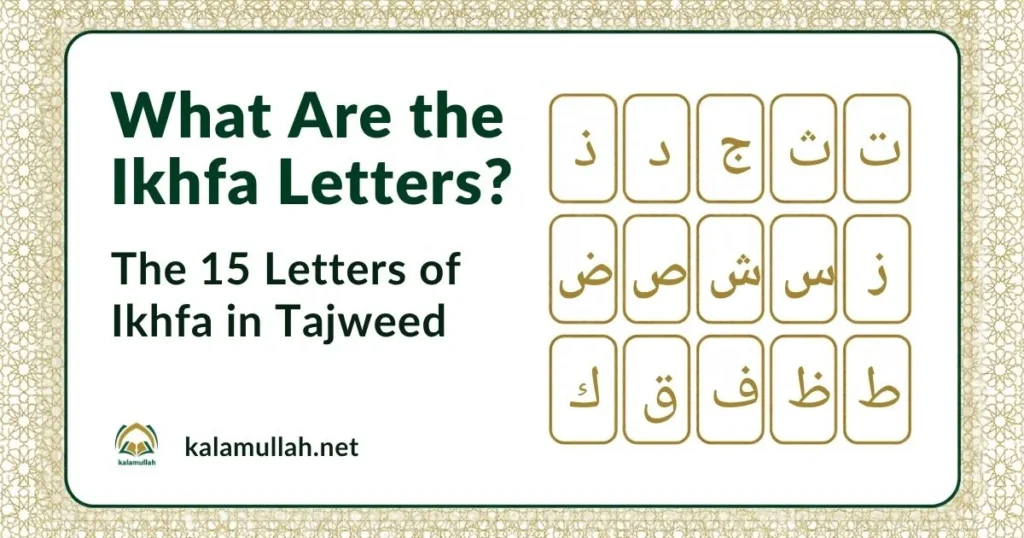
What are the Ikhfa letters? They are 15 Arabic letters that cause the sound of Noon Sakinah or Tanween to be concealed with Ghunnah when one of them follows:
ت ث ج د ذ ز س ش ص ض ط ظ ف ق ك
Ikhfa (إخفاء) means concealment. When you meet one of these letters after a Noon Sakinah or Tanween, you soften the Noon so it is neither fully pronounced nor fully merged, and you hold a nasal sound before moving into the next letter.
This guide shows you how to spot Ikhfa on the page, how to pronounce it, where it appears in the Quran, and how to practise it until it becomes part of your natural recitation.
The 15 letters of Ikhfa are every letter of the Arabic alphabet except the six throat letters (Izhar), the six letters of Idgham, and the single letter of Iqlab: ت ث ج د ذ ز س ش ص ض ط ظ ف ق ك
When one of these letters comes straight after a Noon Sakinah or Tanween in connected recitation, the Ikhfa rule applies. That makes Ikhfa the largest of the four Noon Sakinah and Tanween rules, so you will meet it on almost every page of the Mushaf.
A quick way to check your list: 28 letters of the alphabet, minus 6 for Izhar, 6 for Idgham and 1 for Iqlab, leaves exactly 15.
The following table lists each Ikhfa letter alongside its transliteration and Arabic name.
| Arabic Letter | Transliteration | Letter Name |
|---|---|---|
| ت | t | Taa |
| ث | th | Thaa |
| ج | j | Jeem |
| د | d | Daal |
| ذ | dh | Dhaal |
| ز | z | Zay |
| س | s | Seen |
| ش | sh | Sheen |
| ص | ṣ | Saad |
| ض | ḍ | Daad |
| ط | ṭ | Ṭaa (heavy Taa) |
| ظ | ẓ | Ẓaa (heavy Dhaa) |
| ف | f | Faa |
| ق | q | Qaaf |
| ك | k | Kaaf |
Notice the two Taa letters: ت is the light Taa, while ط is the heavy Ṭaa. Learn each letter by its Arabic shape first. Transliteration is only a reading aid, and it cannot show you exactly how a letter sounds.
In Arabic, ikhfa (إخفاء) means to hide or conceal. In Tajweed, it means reciting a Noon Sakinah or Tanween in a state between clear pronunciation and full merging, while keeping its Ghunnah (the nasal sound), when one of the 15 Ikhfa letters follows.
Think of Ikhfa as the middle ground between two other rules:
Scholars of Tajweed also call this rule Ikhfa Haqiqi (true concealment) to separate it from Ikhfa Shafawi, which applies to Meem Sakinah.
Ikhfa has two triggers. Both are followed by one of the 15 letters.
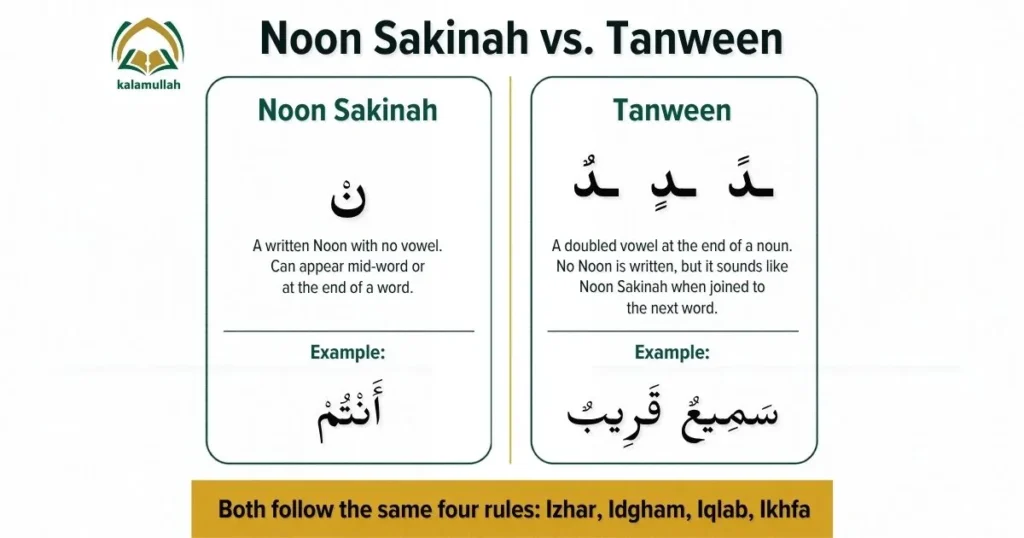
Noon Sakinah (نْ) is a Noon with no vowel. It can appear in the middle of a word, as in أَنْتُمْ, or at the end of a word, as in مِنْ شَرِّ.
Tanween (ـً ـٍ ـٌ) is the doubled vowel sign at the end of a noun. No Noon is written, but it is pronounced as a Noon Sakinah when you join it to the next word, as in سَمِيعٌ قَرِيبٌ.
Because Tanween sounds like a Noon Sakinah, it follows the same four rules: Izhar, Idgham, Iqlab and Ikhfa. Learners usually meet the Sukun and Tanween signs early in a Noorani Qaida course, and Ikhfa builds directly on that foundation.
You do not need to memorize every Ikhfa word in the Quran. The letter that comes after the Noon decides the rule, so a simple three-step check works on every page.
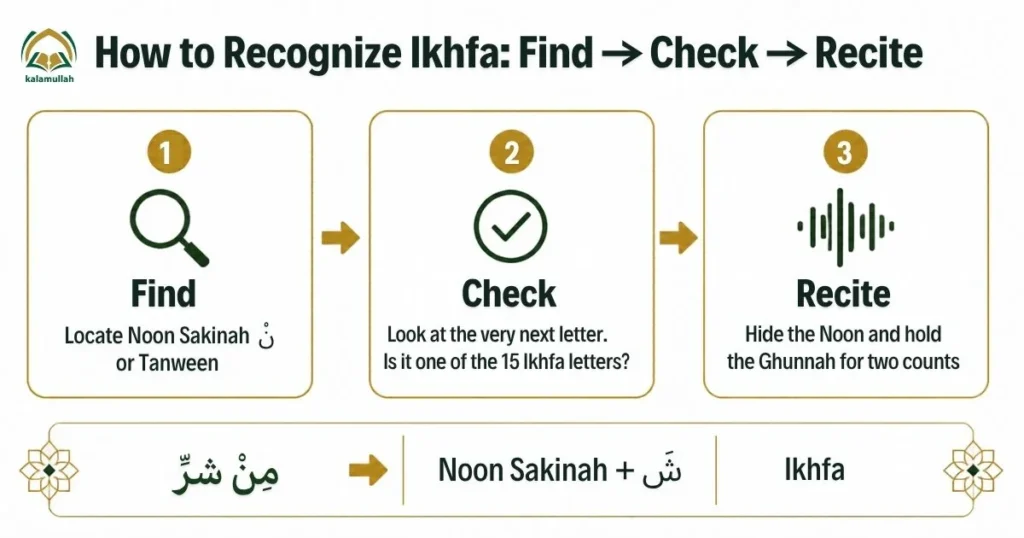
A helpful clue from the Mushaf: in the widely used Madani script, a Noon before an Ikhfa letter is usually written without the Sukun sign, as in مِن شَرِّ. Tanween before an Ikhfa letter is often written with its two marks slightly staggered rather than stacked. These visual cues tell you the Noon is not pronounced clearly. Some Mushaf prints use different conventions, so always confirm by checking the next letter.
The table below gives one Quranic example for each of the 15 Ikhfa letters. Some show a Noon Sakinah inside a single word, some show it across two words, and some show Tanween.
These examples show how each Ikhfa letter appears after Noon Sakinah or Tanween in the Quran.
| Ikhfa Letter | Quranic Example | Type | Surah & Ayah |
|---|---|---|---|
| ت | كُنْتُمْ | Noon Sakinah, one word | Al-Baqarah 2:23 |
| ث | مِنْ ثَمَرَةٍ | Noon Sakinah, two words | Al-Baqarah 2:25 |
| ج | مِنْ جُوعٍ | Noon Sakinah, two words | Quraysh 106:4 |
| د | مِنْ دُونِ اللَّهِ | Noon Sakinah, two words | Al-Baqarah 2:23 |
| ذ | مَنْ ذَا الَّذِي | Noon Sakinah, two words | Al-Baqarah 2:255 |
| ز | أَنْزَلْنَاهُ | Noon Sakinah, one word | Al-Qadr 97:1 |
| س | مِنْ سِجِّيلٍ | Noon Sakinah, two words | Al-Fil 105:4 |
| ش | مِنْ شَرِّ | Noon Sakinah, two words | Al-Falaq 113:2 |
| ص | وَانْصُرْنَا | Noon Sakinah, one word | Al-Baqarah 2:250 |
| ض | مَنْضُودٍ | Noon Sakinah, one word | Al-Waqi’ah 56:29 |
| ط | يَنْطِقُ | Noon Sakinah, one word | An-Najm 53:3 |
| ظ | فَانْظُرْ | Noon Sakinah, one word | Al-Baqarah 2:259 |
| ف | يُنْفِقُونَ | Noon Sakinah, one word | Al-Baqarah 2:3 |
| ق | سَمِيعٌ قَرِيبٌ | Tanween, two words | Saba 34:50 |
| ك | كِرَامًا كَاتِبِينَ | Tanween, two words | Al-Infitar 82:11 |
The Noon is shown here with a Sukun to make it easy to spot. In the Madani Mushaf, these same Noons usually appear without the Sukun sign, as explained above.
مِن شَرِّ مَا خَلَقَ
From the evil of that which He created
Example 1: مِنْ شَرِّ (Al-Falaq 113:2)
إِنَّا أَنزَلْنَاهُ فِي لَيْلَةِ الْقَدْرِ
Indeed, We sent the Qur’an down during the Night of Decree.
Example 2: أَنْزَلْنَاهُ (Al-Qadr 97:1)
قُلْ إِن ضَلَلْتُ فَإِنَّمَا أَضِلُّ عَلَىٰ نَفْسِي ۖ وَإِنِ اهْتَدَيْتُ فَبِمَا يُوحِي إِلَيَّ رَبِّي ۚ إِنَّهُ سَمِيعٌ قَرِيبٌ
Say, “If I should err, I would only err against myself. But if I am guided, it is by what my Lord reveals to me. Indeed, He is Hearing and near.”
Example 3: سَمِيعٌ قَرِيبٌ (Saba 34:50)
كِرَامًا كَاتِبِينَ
Noble and recording;
Example 4: كِرَامًا كَاتِبِينَ (Al-Infitar 82:11)
Knowing the letters is only half the rule. The other half is what your tongue and voice actually do.
During Ikhfa, the tip of the tongue does not press firmly on the spot where you normally say a clear Noon. Instead, it moves toward the position of the letter that follows, while the sound continues through the nose.
The result is a hidden Noon: you can hear its nasal sound, but not its full articulation. The voice then moves smoothly into the next letter without a break or a jump.
In the recitation of Hafs ‘an ‘Asim, the Ghunnah in Ikhfa is commonly taught as lasting two counts (two harakah).
A count is a rhythm, not a fixed number of seconds. It speeds up or slows down with your reading pace. Two common errors break that rhythm: cutting the Ghunnah short so it sounds rushed, and stretching it so long that it sounds like a Madd. The most reliable way to learn the right length is to listen to skilled reciters and have a teacher check your timing.
The Ghunnah takes its quality from the letter that follows it. Five of the 15 Ikhfa letters are heavy letters of Isti’la:
ص ض ط ظ ق
Before these five, the Ghunnah is pronounced with a full, heavy sound (Tafkhim). Before the other ten, it is light and thin (Tarqiq).
| Heavy Ikhfa | Light Ikhfa |
|---|---|
| ص ض ط ظ ق | ت ث ج د ذ ز س ش ف ك |
| Ghunnah with Tafkhim | Ghunnah with Tarqiq |
| مَنْضُودٍ, يَنْطِقُ | أَنْزَلْنَاهُ, مِنْ شَرِّ |
Only the quality changes. The length of the Ghunnah stays at the same two counts whether the next letter is heavy or light. If you want structured, hands-on practice with sounds like these, a practical (Amali) Tajweed course focuses on applying rules in real recitation.
Recite the Words of Allah With Confidence
Join Kalamullah Quran Academy for live 1-on-1 lessons with Al-Azhar-trained, Ijazah-holding tutors, from your first Qaida letter all the way to Ijazah.
Book Your Free Trial ClassNot every Ikhfa sounds equally hidden. Traditional Tajweed teaching groups the 15 letters into three levels, based on how close each letter’s point of articulation is to the Noon. You do not need this to apply Ikhfa correctly as a beginner, but it explains why some Ikhfa sounds feel clearer than others.
«Highest Level of Ikhfa (Closest to Idgham): ت د ط» … «The concealment is strongest here.» / «Lowest Level of Ikhfa (Closest to Izhar): ق ك» … «The concealment is lightest here.»
Most Ikhfa errors come from treating it like one of the neighbouring rules. Here are the five you are most likely to hear, and how to fix each one.
Use this short routine with any verse. It takes a few minutes and builds the habit of spotting and applying Ikhfa on your own.
For each phrase, identify the Noon Sakinah or Tanween, the following letter, whether the rule is Ikhfa, and whether the Ghunnah is heavy or light. Not every phrase is Ikhfa. Before you scroll down, try all eight on your own and write down your answers. Then check them against the answer key to see how well you have understood the rule and where you need more review.
Answer key
Check Your Answers| # | Trigger | Next letter | Rule | Ghunnah |
|---|---|---|---|---|
| 1 | Noon Sakinah | ق | Ikhfa | Heavy |
| 2 | Tanween | أ | Izhar, not Ikhfa | None |
| 3 | Noon Sakinah | ط | Ikhfa | Heavy |
| 4 | Noon Sakinah | ع | Izhar, not Ikhfa | None |
| 5 | Tanween | ص | Ikhfa | Heavy |
| 6 | Noon Sakinah | ي | Idgham with Ghunnah, not Ikhfa | Not Ikhfa |
| 7 | Noon Sakinah | ت | Ikhfa | Light |
| 8 | Tanween | ذ | Ikhfa | Light |
An article can teach you the rule. It cannot hear you recite. Many learners understand Ikhfa perfectly on paper yet still pronounce a clear Noon, or a Ghunnah that is too short, without noticing.
A teacher closes that gap. A qualified tutor can help you:
At Kalamullah Quran Academy, every lesson is live and one-on-one, and your tutor corrects your recitation in real time. Each student begins with a level assessment and a personal learning plan, and you can choose a male or female tutor at a time that suits your time zone. You can read more about our Tajweed teachers and how they work with students.

Recite the Words of Allah With Confidence
Join Kalamullah Quran Academy for live 1-on-1 lessons with Al-Azhar-trained, Ijazah-holding tutors, from your first Qaida letter all the way to Ijazah.
Book Your Free Trial ClassThe classic way to remember the letters comes from Tuhfat al-Atfal, the Tajweed poem by Sulayman al-Jamzuri. In one line, the first letter of each word is one of the 15 Ikhfa letters:
صِفْ ذَا ثَنَا كَمْ جَادَ شَخْصٌ قَدْ سَمَا دُمْ طَيِّبًا زِدْ فِي تُقًى ضَعْ ظَالِمَا
Read the first letters in order and you get ص ذ ث ك ج ش ق س د ط ز ف ت ض ظ, all 15 letters. Memorizing the line also gives you a small piece of the Tajweed tradition that students have recited for centuries.
If the poem feels too much for now, revise the letters in alphabetical groups of five:
| Group | Letters |
|---|---|
| Group 1 | ت ث ج د ذ |
| Group 2 | ز س ش ص ض |
| Group 3 | ط ظ ف ق ك |
These groups are only a memory aid. They are not the same as the three levels of Ikhfa described earlier.
Save or screenshot this card and check it before your next recitation.
| Ikhfa Quick Revision | |
|---|---|
| 15 letters | ت ث ج د ذ ز س ش ص ض ط ظ ف ق ك |
| The rule | Noon Sakinah or Tanween followed by one of the 15 letters, in connected recitation |
| Ghunnah | Commonly taught as two counts |
| Heavy letters | ص ض ط ظ ق |
Before you recite:
Recite the Words of Allah With Confidence
Join Kalamullah Quran Academy for live 1-on-1 lessons with Al-Azhar-trained, Ijazah-holding tutors, from your first Qaida letter all the way to Ijazah.
Book Your Free Trial ClassKnowing the 15 Ikhfa letters is the first step. Applying the rule correctly in your recitation requires practice, listening, and feedback from a qualified Tajweed teacher.
At Kalamullah Quran Academy, live one-on-one lessons help you recognize Tajweed rules in Quranic verses, refine your pronunciation, and practise the correct Ghunnah with real-time correction from Al-Azhar-trained, Ijazah-holding tutors.
Whether you are learning Tajweed for the first time or improving your Quran recitation, your lessons follow your level, pace, and learning goals.
Book your free trial class today and practise Ikhfa with guidance from a qualified teacher.
Mastering Ikhfa is not simply about memorizing 15 letters. It is about learning to recognize the rule, pronounce the hidden Noon correctly, and preserve the Ghunnah every time you recite. With consistent practice, these small improvements can make your Quran recitation more accurate and confident.
Do not let unfamiliar Tajweed rules discourage you from improving. Every letter you learn and every mistake you correct brings you closer to reciting the Quran as it was revealed. Start practising today, listen carefully, and seek guidance from a qualified teacher to help you refine your recitation.
Take the next step in your Quran journey with Kalamullah Quran Academy. Learn with qualified Tajweed tutors who can listen to your recitation, correct your mistakes, and help you grow at your own pace.
Book your free trial class today and begin your journey toward more confident Quran recitation.
There are 15 Ikhfa letters: ت ث ج د ذ ز س ش ص ض ط ظ ف ق ك. They are the letters left after removing the letters of Izhar, Idgham and Iqlab from the alphabet.
Taa ت, Thaa ث, Jeem ج, Daal د, Dhaal ذ, Zay ز, Seen س, Sheen ش, Saad ص, Daad ض, Ṭaa ط, Ẓaa ظ, Faa ف, Qaaf ق and Kaaf ك.
In the recitation of Hafs, it is commonly taught as two counts (two harakah). The length stays the same whether the following letter is heavy or light.
In Ikhfa, the Noon is hidden but its Ghunnah remains, and the next letter is not doubled. In Idgham, the Noon merges into the following letter, which is then pronounced as if doubled.
Ikhfa Haqiqi is the rule in this guide: Noon Sakinah or Tanween before one of the 15 letters. Ikhfa Shafawi applies to Meem Sakinah (مْ) when it is followed by the letter ب.
Yes. A Noon Sakinah can meet an Ikhfa letter inside one word, as in يُنْفِقُونَ, or across two words, as in مِنْ شَرِّ. Tanween only appears at the end of a word, so with Tanween, Ikhfa always happens across two words.

Articles teach theory — a live teacher hears you. Book a free one-on-one trial class this week.
Book Free TrialTajweed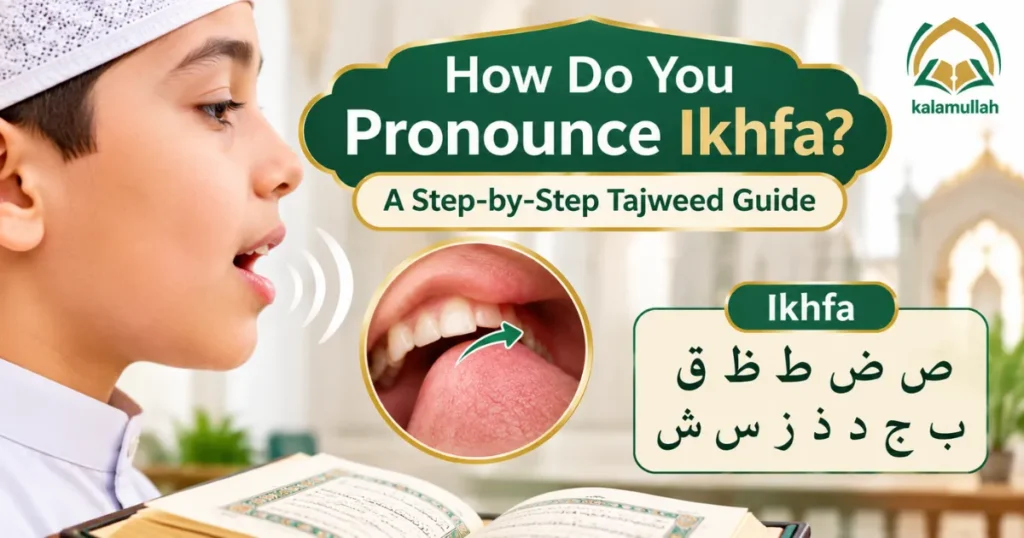 Tajweed
 Tajweed