 TajweedTajweed

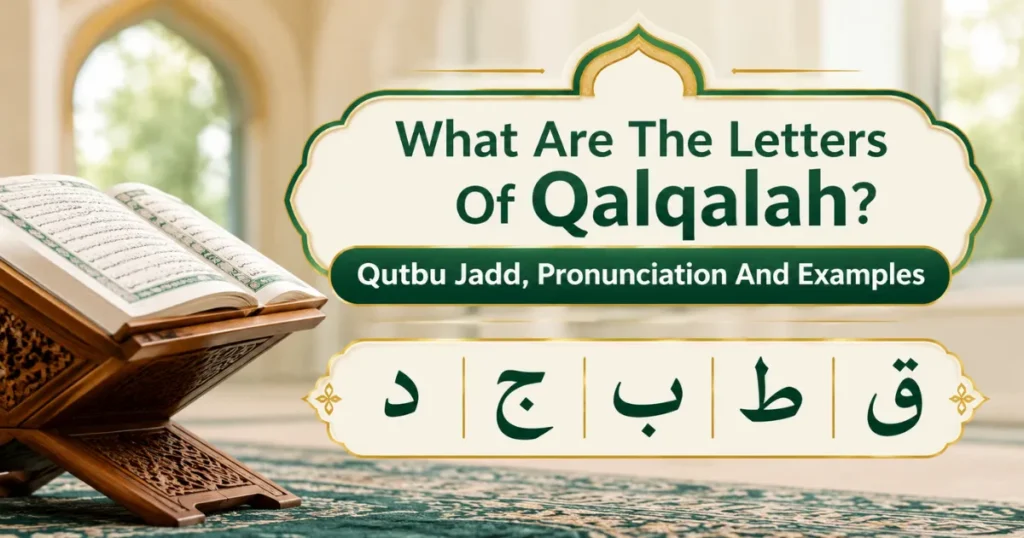
Have you ever heard a reciter stop at the end of an ayah and noticed a short, clean echo on the last letter? That sound is Qalqalah. So what are the letters of Qalqalah? There are five: ق ط ب ج د (Qaf, Ta, Ba, Jeem and Dal). Each one makes a short, controlled bounce when it carries a sukoon or when you stop on it.
This guide covers the five qalqalah letters, why they echo, the three levels of bounce, and how to tell when the rule applies and when it doesn’t. You’ll also find the mistakes teachers correct most often and a short daily drill.
What you’ll learn in this article:
The letters of Qalqalah are ق (Qaf), ط (Ta), ب (Ba), ج (Jeem) and د (Dal). Scholars group them in the phrase قُطْبُ جَدٍّ (Qutbu Jadd), which Imam Ibn al-Jazari used in his classical Tajweed poem. Before getting to the details, it helps to define the rule itself.
Qalqalah (قَلْقَلَة) literally means “shaking” or “disturbance.” In Tajweed, it is a slight bounce or echo on one of the five qalqalah letters when that letter has no vowel, either because it carries a written sukoon or because you stop on it (waqf).
Think of it as a letter that is released instead of stopped dead. It is a brief, controlled vibration, somewhere between a full vowel and silence.
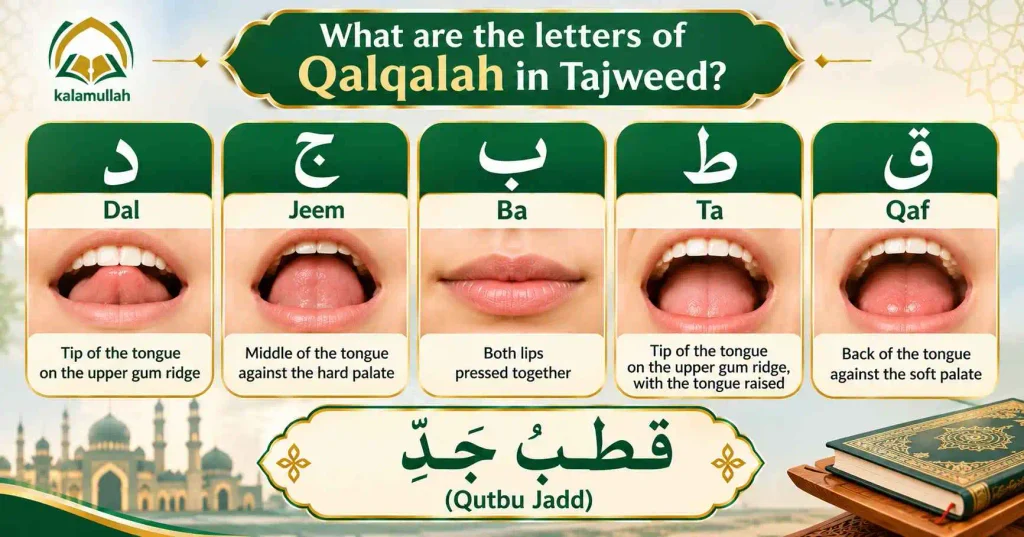
There are exactly five qalqalah letters. Teachers spell the mnemonic in slightly different ways (Qutbu Jadd, Qutb Jad, QaTBaJaD), but all of them hold the same five letters.
| Letter | Name | Articulation point (makhraj) | Quran example |
| ق | Qaf | Back of the tongue against the soft palate | الْفَلَقْ (113:1, when stopping) |
| ط | Ta | Tip of the tongue on the upper gum ridge, with the tongue raised | أَطْعَمَهُم (106:4) |
| ب | Ba | Both lips pressed together | الْأَبْتَرُ (108:3) |
| ج | Jeem | Middle of the tongue against the hard palate | يَجْعَلُونَ (2:19) |
| د | Dal | Tip of the tongue on the upper gum ridge | أَحَدْ (112:1, when stopping) |
The letters of Qalqalah echo because each of them combines two letter qualities (sifat) that work against each other. This is also why the answer to “what are the letters of Qalqalah?” is exactly these five: only letters with both qualities qualify, and one of those is left out on purpose.
Shiddah (strength) means airflow is completely blocked at the articulation point. Jahr (audibility) means the vocal cords vibrate fully.
When one of these letters is sakin, the trapped, voiced sound can’t flow out smoothly. It bursts out as a small rebound, and that rebound is Qalqalah. It comes from how the letter is physically produced, not from style.
Traditional teachers also rank the strength of the bounce within the group. ط is usually considered the strongest, followed by ج, with ق, ب and د after them. You’ll hear the difference most clearly in a trained reciter’s stops.
This edge case is rarely explained. ك and ت are also fully blocked (shiddah), but they are whispered letters (hams). Air escapes with them, so there is no trapped sound to bounce.
Hamzah (ء) does have both shiddah and jahr, but classical scholars left it out of the Qalqalah letters. A bounced hamzah sounds harsh and strained, so its recitation is kept smooth. If someone asks why hamzah isn’t on the list, that’s the reason.
Recite the Words of Allah With Confidence
Join Kalamullah Quran Academy for live 1-on-1 lessons with Al-Azhar-trained, Ijazah-holding tutors, from your first Qaida letter all the way to Ijazah.
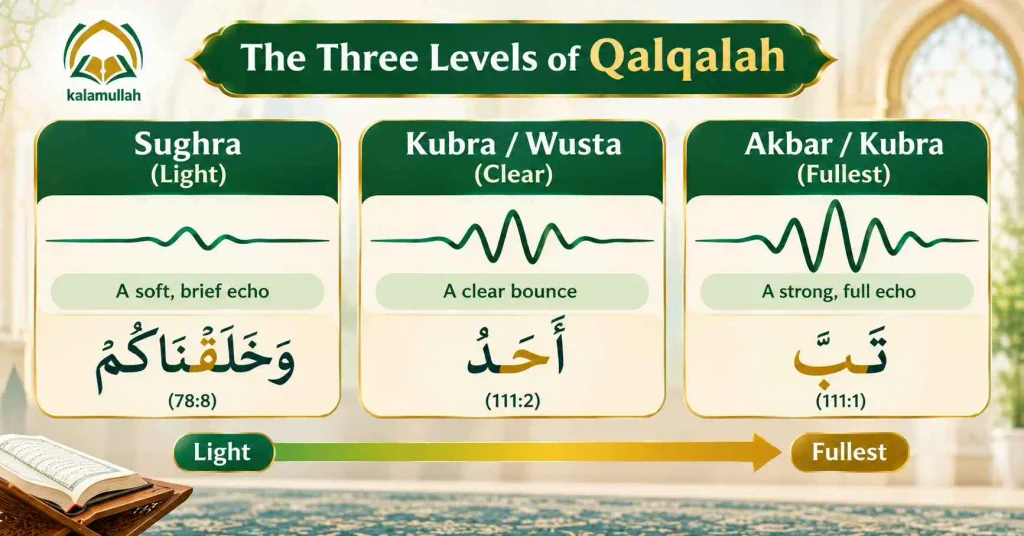
Book Your Free Trial ClassQalqalah gets stronger as the letter becomes more final. Many students get confused here because different teachers and websites use different names for the same levels.
The table below sets the two most common naming systems side by side, so you can match whatever terms your book or teacher uses to the same three situations.
| Situation | System 1 | System 2 | Strength | Example |
| Letter has sukoon in the middle of a word (or at the end while you keep reading) | Sughra | Sughra | Light | يَجْعَلُونَ، خَلَقْنَاكُمْ (78:8) |
| You stop on a letter at the end of a word (no shaddah) | Kubra | Wusta | Clear | أَحَدْ، الْفَلَقْ، كَسَبْ (111:2) |
| You stop on a letter that carries a shaddah | Akbar | Kubra | Fullest | الْحَقّ، تَبّ (111:1)، الْحَجّ |
The practical rule is the same in every system. Follow your own teacher’s terminology, and don’t worry if another book calls the stopped-letter level “Kubra” while yours calls it “Wusta.”
Mid-word, the echo is there but brief, like a soft tap before moving straight on. In وَخَلَقْنَاكُمْ the ق gets a quick release, then the recitation continues.
When you stop at the end of a word, nothing follows the letter to cover it, so the bounce is easier to hear. When the stopped letter carries a shaddah, as in تَبّ, the letter is held slightly before release, and the result is the fullest, most deliberate echo. Students most often under-pronounce this level.
This is the kind of distinction that’s hard to get from a table alone. In Kalamullah’s online Tajweed classes, a teacher recites each level, listens to you repeat it, and corrects the strength of your bounce on the spot.
Read also: How Do Beginners Start Learning the Quran?
Once you know the five qalqalah letters, the next skill is spotting them on the page. Ask these three questions in order, using a simple Letter → Sukoon → Position check.
start with the core question: what are the letters of Qalqalah, and is this one of them? If the letter isn’t ق ط ب ج د, it gets no Qalqalah, however strong it sounds. This alone prevents the common mistake of bouncing ك, ت or ء.
Hear the difference by comparing two words. In يَكْتُبُونَ, the sakin ك closes quietly with a slight release of breath and no bounce. In يَجْعَلُونَ, the sakin ج releases with a short echo. Both letters have a sukoon, but only the qalqalah letter bounces.
The sukoon may be written (ْ) or created by stopping on the word. A qalqalah letter that carries a fathah, kasrah or dammah while you keep reading gets no bounce.
Surah Al-Alaq shows both cases in one word. At the end of 96:1, you stop on خَلَقْ, so the ق becomes sakin and bounces. At the start of 96:2, خَلَقَ الْإِنسَانَ, the ق carries a fathah and you keep reading, so there is no Qalqalah. Same word and same letter, but the rule depends on whether the letter has a vowel.
Mid-word or continuing means light. A stop means clear. A stop on a shaddah means fullest. That gives you the level.
Surah Al-Masad covers all three levels in five short ayat. In حَبْلٌ (111:5), the ب is sakin mid-word, so the bounce is light. At كَسَبْ and مَسَدْ, you stop on the letter, so the bounce is clear. At وَتَبّ (111:1), you stop on a shaddah, so it gets the fullest release.
A sakin qalqalah letter that merges completely (idgham) into the next letter loses its Qalqalah. In قَد تَّبَيَّنَ (2:256), the د merges into the ت, so you don’t bounce the Dal at all. Students who have just learned the rule often over-apply it here.
The same thing happens when the next letter is identical, as in وَقَد دَّخَلُوا (5:61), where the two Dals are read as one doubled letter. It also happens in Hafs’s reading of ارْكَب مَّعَنَا (11:42), where the ب merges into the م. If the next letter doesn’t cause a merge, the bounce stays, as in قَدْ أَفْلَحَ (23:1), where the د keeps its light Qalqalah.
A correct Qalqalah is short, clean and vowel-free. The letter closes briefly, then releases with a slight resonance, like a gentle tap on a drum. Four guidelines keep it accurate.
The most frequent mistake is a flat stop: the letter ends with no resonance, which is especially common mid-word. The second is over-bouncing, which makes the recitation sound jerky. The third is mixing up levels, such as giving a mid-word ق the full echo meant for a stop on الْحَقّ.
If you can’t tell whether your bounce is too flat or too strong, that’s normal. Self-study rarely catches it. A Kalamullah Tajweed teacher can listen to your recitation, point out which of these mistakes you make, and give you a targeted drill to fix it.
A short routine of a few minutes each day helps the qalqalah letters become automatic. Do these steps in order.
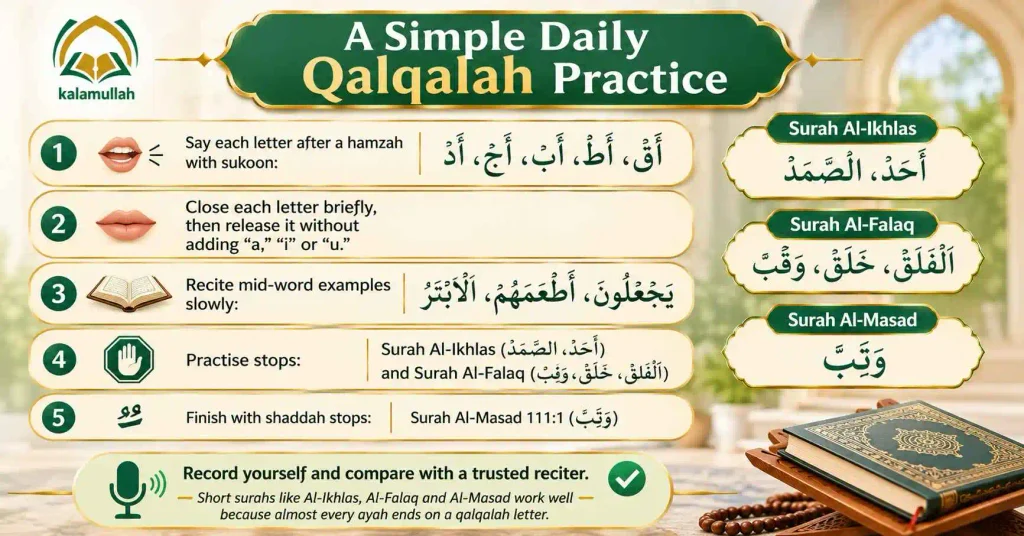
Record yourself and compare with a trusted reciter. Short surahs like Al-Ikhlas, Al-Falaq and Al-Masad work well because almost every ayah ends on a qalqalah letter.
Read also: How To Learn Quran Recitation?
Recite the Words of Allah With Confidence
Join Kalamullah Quran Academy for live 1-on-1 lessons with Al-Azhar-trained, Ijazah-holding tutors, from your first Qaida letter all the way to Ijazah.
Book Your Free Trial ClassLearning the answer to “what are the letters of Qalqalah?” is only the first step. Hearing your own bounce corrected is what fixes it.
Join our Tajweed lessons and get a qualified teacher who recites each level for you, listens to you repeat it, and corrects flat stops, extra vowels and over-bouncing before they become habits. Study from home at a pace that suits you.
Explore Our Tajweed Courses:

So, what are the letters of Qalqalah? They are ق ط ب ج د, gathered in قُطْبُ جَدٍّ. They bounce because each combines complete blockage (shiddah) with full voicing (jahr). The bounce is light mid-word, clear when you stop, and fullest when you stop on a shaddah.
Use the 3-question check (Letter, Sukoon, Position), watch for idgham cases where the bounce disappears, and keep the echo short and free of any vowel. With daily practice on short surahs, a correct Qalqalah becomes automatic.
These are the questions students ask most often after their first lesson on Qalqalah, from how to remember the letters to why some strong letters are left off the list.
The letters of Qalqalah are ق ط ب ج د. Remember them with the phrase قُطْبُ جَدٍّ (Qutbu Jadd), which puts all five qalqalah letters in order.
There are five qalqalah letters in Arabic: Qaf, Ta, Ba, Jeem and Dal. No other letter takes Qalqalah, including hamzah, even though it shares the same strength qualities.
Qalqalah happens when a qalqalah letter has no vowel, either from a written sukoon or because you stop on it. A written sukoon still gets a light bounce while you keep reading, unless the letter merges into the next one, as in قَد تَّبَيَّنَ.
No. Qalqalah should never sound like an extra “a,” “i” or “u.” It is only the release of the stopped letter, and adding a vowel changes the word.
Qalqalah Sughra is the light bounce on a sakin letter in the middle of a word. Kubra is the stronger bounce when you stop on the letter. Some teachers call the stopped level Wusta and keep the name Kubra for stopping on a shaddah.
Hamzah isn’t a qalqalah letter because classical scholars left it out to keep its sound smooth. It has the same shiddah and jahr qualities as the qalqalah letters, but bouncing it sounds harsh and strained.

Articles teach theory — a live teacher hears you. Book a free one-on-one trial class this week.
Book Free TrialTajweed