 TajweedTajweed

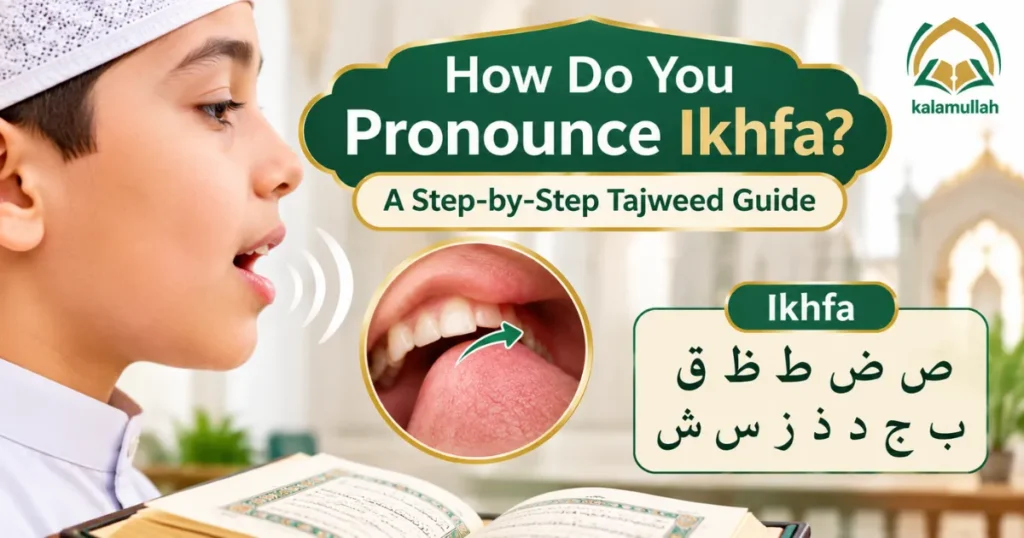
You read أَنتُمْ and your teacher stops you. The noon came out too sharp, or it vanished, or it stretched into a long vowel. If this keeps happening, you’re probably asking: how do you pronounce ikhfa so that it’s neither clear nor merged?
Ikhfa (الإخفاء) means “concealment.” In tajweed, it is pronouncing the noon sakinah or tanween in a state between full clarity (izhar) and full merging (idgham), while keeping its nasal sound (ghunnah). It has more trigger letters than any other noon sakinah rule, so getting it right improves almost every page you recite.
This guide shows you how to do ikhfa in tajweed in five ordered steps, then covers heavy and light ghunnah, the levels of concealment, real Quranic examples, and a self-check you can do at home.
The first step is finding the sound that will be concealed. Look for a noon with a sukoon (نْ) or a tanween mark (ـً ـٍ ـٌ) on the last letter of a word. Answering “How do you pronounce ikhfa?” always starts here, because without a noon sound there’s nothing to hide.
The Madani mushaf gives you a visual hint. When a noon is printed without a sukoon, or a tanween’s two marks are staggered instead of stacked, the reading is either ikhfa or idgham, never izhar. Step 2 tells you which one.
Remember that tanween is a noon sakinah you hear but don’t see written. Also, the alif after a fatha tanween is silent when you keep reading. In ﴿حَسَنًا فَيُضَاعِفَهُ﴾, you don’t pronounce the alif, so the noon sound of the tanween meets ف directly, and that’s what makes it ikhfa.
Ikhfa happens when the next letter is one of these 15: ت ث ج د ذ ز س ش ص ض ط ظ ف ق ك. Scholars remember them by the first letter of each word in this line:
صِفْ ذَا ثَنَا كَمْ جَادَ شَخْصٌ قَدْ سَمَا … دُمْ طَيِّبًا زِدْ فِي تُقًى ضَعْ ظَالِمًا
A faster shortcut: if the next letter isn’t a throat letter (izhar), one of يرملون (idgham), or ب (iqlab), it’s ikhfa. Always judge by the letter you hear, not just the one written. The rule can apply inside one word (﴿أَنتُمْ﴾) or across two words (﴿مِن قَبْلُ﴾).
Watch out for letters whose articulation points are close but whose rules differ. ج and ش come from the middle of the tongue, just like ي, yet ي takes idgham while ج and ش take ikhfa. Learners often mix these up, so check the letter’s group rather than relying on how it feels in the mouth.
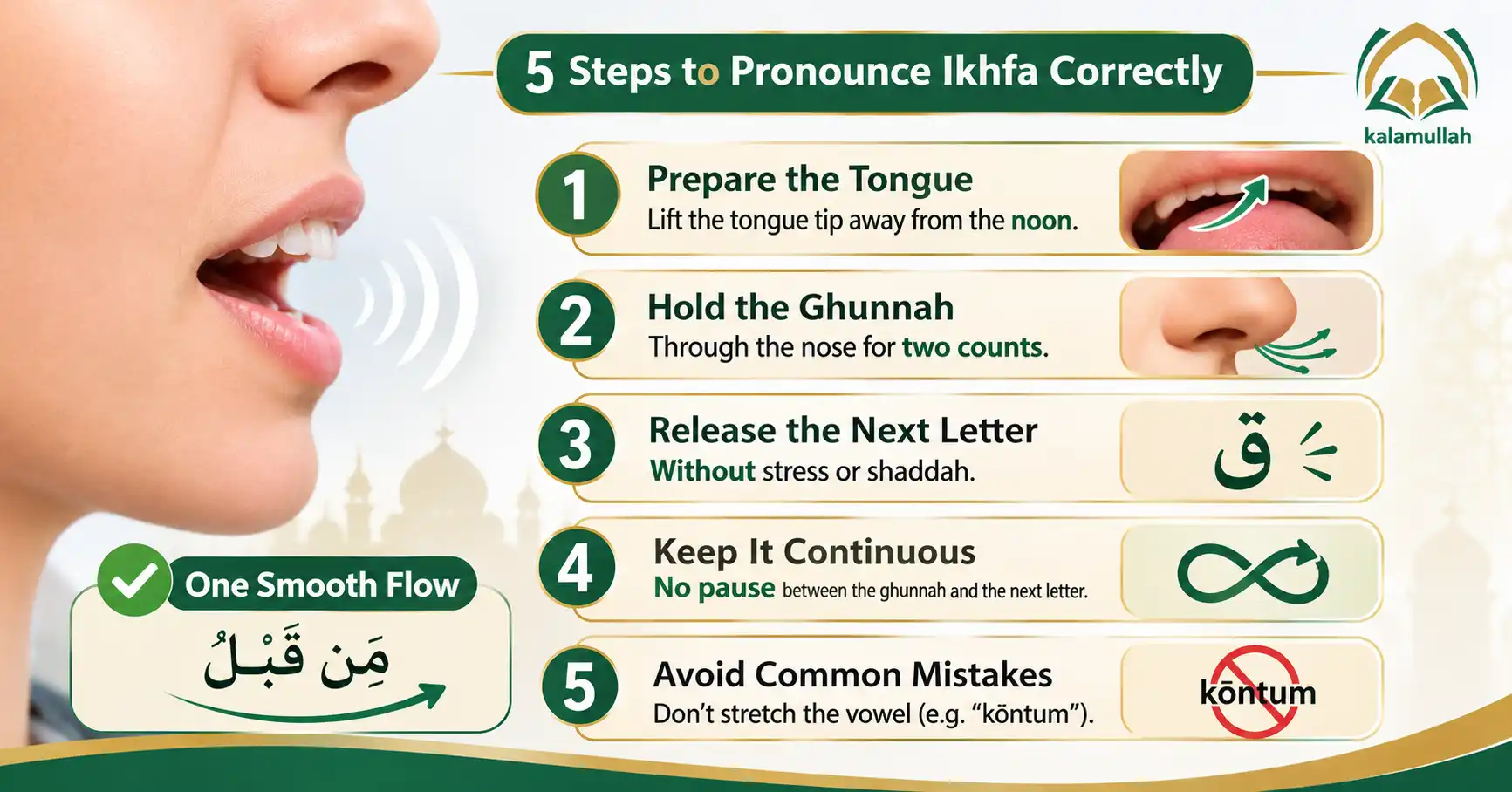
This is the core of pronouncing ikhfa. A clear noon is made with the tongue tip pressed on the gum ridge behind the upper teeth. In ikhfa, the tongue tip doesn’t touch that spot.
Instead, the tongue moves straight toward the articulation point of the next letter. Before ك, the back of the tongue rises toward the soft palate. Before ت, the tip moves toward the teeth without first pressing where the noon is made.
Before ف, the tongue barely moves at all. The lower lip lightly touches the edges of the upper teeth while the ghunnah comes through the nose, as in ﴿أَنفُسَكُمْ﴾. One common sign of an error is a small “n” click right before the next letter. That click means the tongue touched the gum ridge and then pulled away.
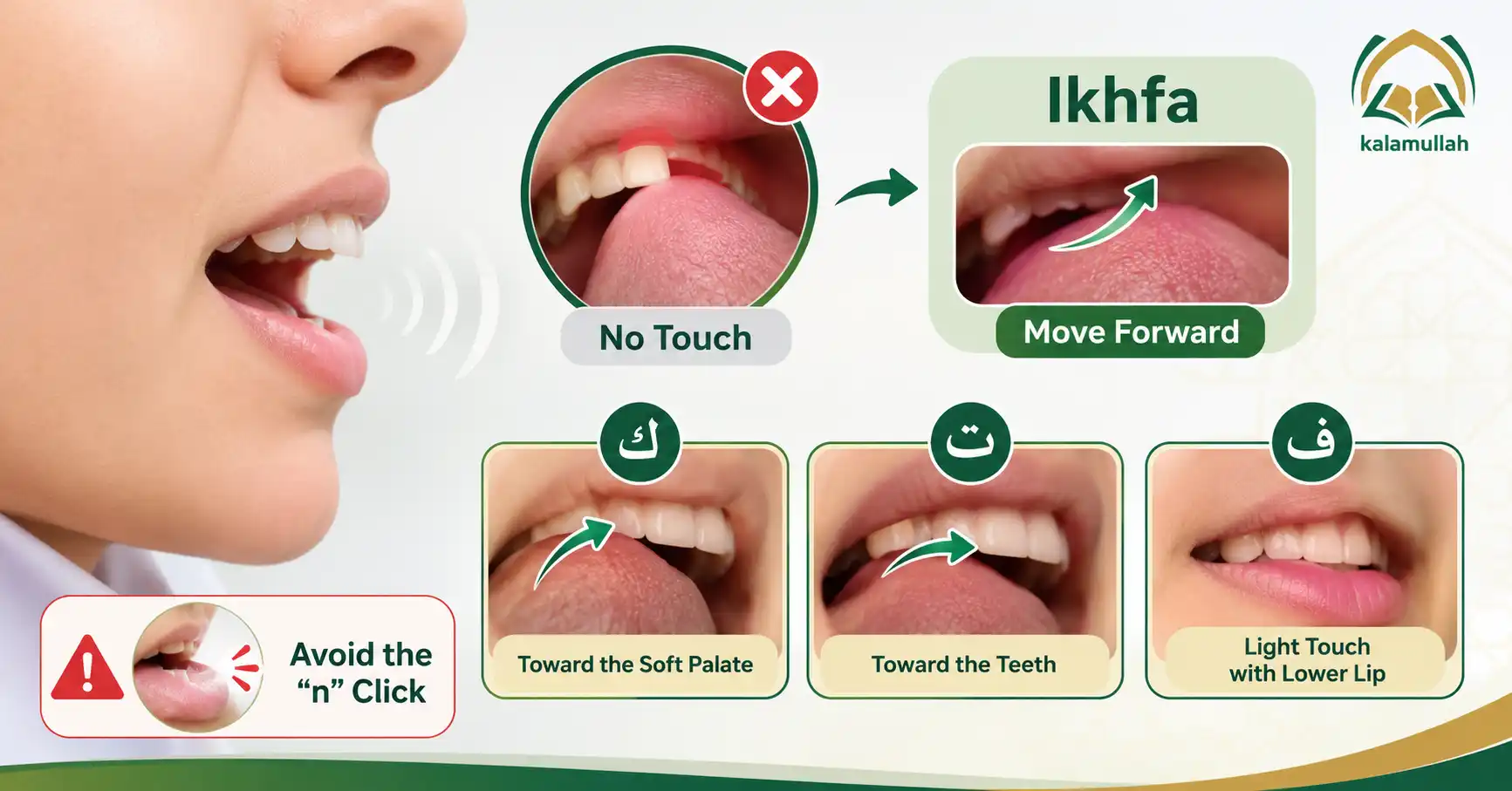
With the tongue in its prepared position, let the sound flow through the nose for two counts. The ghunnah is all that remains of the noon, which is why the rule is called “concealment.”
To check that the sound is really coming from the nose, gently pinch your nostrils while holding the ghunnah. If the sound cuts off or becomes muffled, it’s coming from the nose, which is correct. If it carries on unchanged, it’s coming from the mouth and has turned into a long vowel.
The ghunnah’s length stays fixed, but its weight changes depending on the letter that follows. This is the part of ikhfa pronunciation most guides skip.
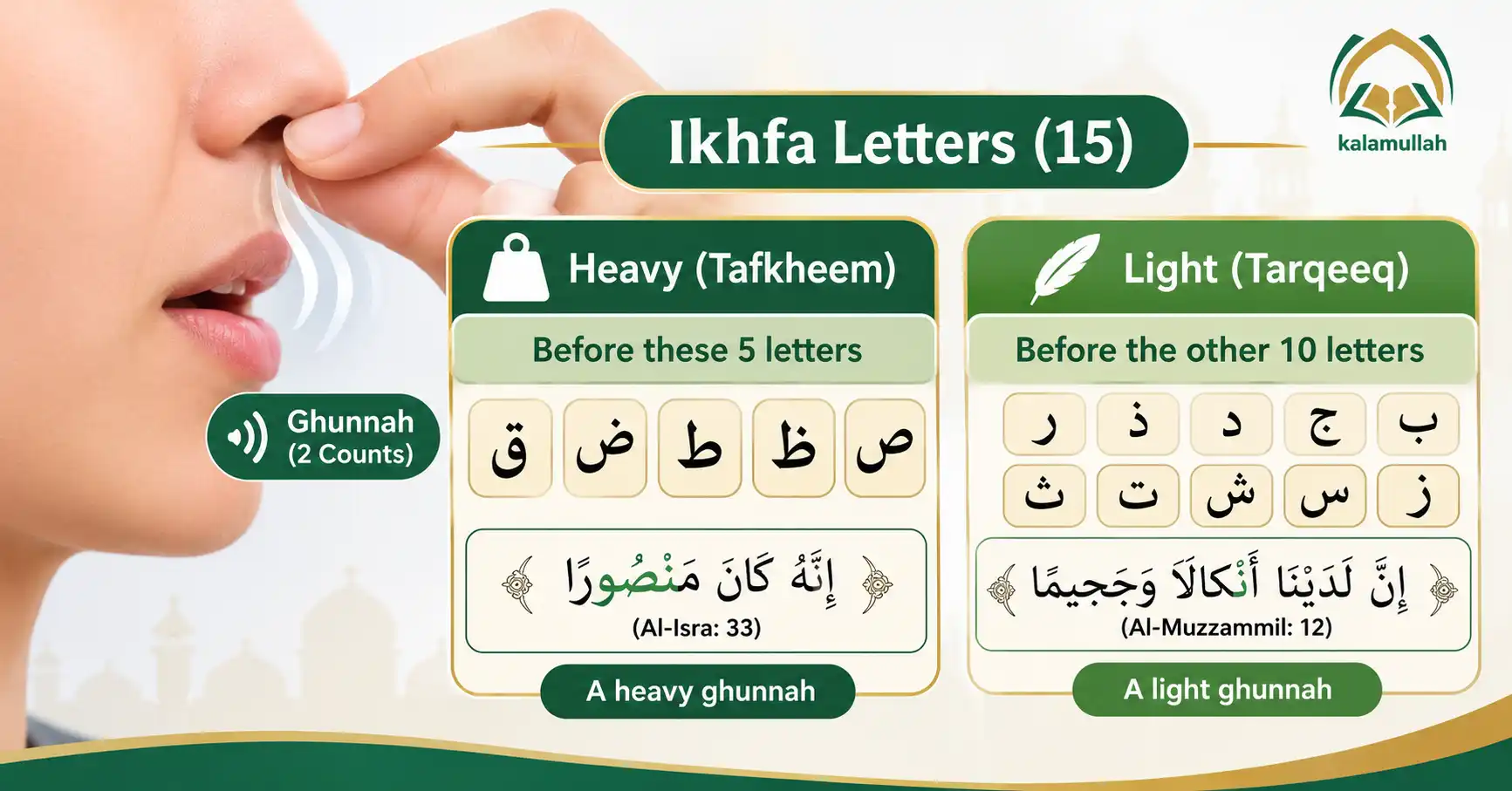
Before the five heavy letters ص ض ط ظ ق, the ghunnah is pronounced heavy (tafkheem), with a fuller, deeper sound. Example: ﴾إِنَّهُ كَانَ مَنْصُورًا﴾ (Al-Isra: 33), where the noon before ص takes the heaviness of ص.
Before the other ten letters, the ghunnah is light (tarqeeq). Example: ﴾إِنَّ لَدَيْنَا أَنكَالًا وَجَحِيمًا﴾ (Al-Muzzammil: 12), where the noon before ك stays light.
Read also: What Are the Letters of Qalqalah?
Recite the Words of Allah With Confidence
Join Kalamullah Quran Academy for live 1-on-1 lessons with Al-Azhar-trained, Ijazah-holding tutors, from your first Qaida letter all the way to Ijazah.
Book Your Free Trial ClassAfter two counts, pronounce the next letter normally, with no shaddah. If you stress it, you’ve performed idgham, not ikhfa. One error to avoid at this point: don’t stretch the vowel before noon. Saying “kōntum” instead of “kuntum” turns the ghunnah into a madd letter.
The move from the ghunnah to the next letter should be continuous, with no gap. If you pause, even briefly, between the ghunnah and ق in ﴿مِن قَبْلُ﴾, it sounds like you stopped and started again.
The goal is one connected sound: the nose carries the ghunnah, and the tongue, already in position, releases the next letter.
The noon isn’t hidden by the same amount every time. The closer the next letter is to the noon’s articulation point, the more the noon is concealed.
A practical check: compare your ikhfa before ق with your ikhfa before ت. If both sound equally hidden, you’ve lost the difference. At the lowest level, a trace of the noon stays more audible.
These examples show ikhfa with both noon sakinah and tanween, inside one word and across two words.
| Example | Location | Trigger letter | Ghunnah |
| ﴿أَنتُمْ﴾ / ﴿كُنتُمْ﴾ | One word | ت | Light |
| ﴿أُنزِلَ﴾ (Al-An’am: 8) | One word | ز | Light |
| ﴿مِن قَبْلُ﴾ | Two words | ق | Heavy |
| ﴿مَّن ذَا الَّذِي﴾ (Al-Baqarah: 245) | Two words | ذ | Light |
| ﴿حَسَنًا فَيُضَاعِفَهُ﴾ (Al-Baqarah: 245) | Two words, tanween | ف | Light |
| ﴿بِرِيحٍ صَرْصَرٍ﴾ (Al-Haqqah: 6) | Two words, tanween | ص | Heavy |
Notice that a single verse can mix rules. In Al-Haqqah: 6, the tanween before ص is ikhfa, but the next tanween before ع is izhar. Spotting these switches mid-verse is much easier with a teacher pointing them out, and that’s the kind of guided practice Kalamullah’s tajweed lessons focus on.
Recite ﴿كُنتُمْ﴾ slowly and pause in the middle of the ghunnah. Then notice where your tongue tip is:
Repeat with ﴿مِن قَبْلُ﴾. This time the tip should be relaxed and the back of the tongue raised toward qaf. If you can’t tell which result you got, record yourself and have a teacher listen. A Kalamullah instructor can catch this in a single session.
Even learners who know how to pronounce ikhfa in theory slip into one of these five errors during real recitation.
Read also: How To Read The Quran With Tajweed?
Recite the Words of Allah With Confidence
Join Kalamullah Quran Academy for live 1-on-1 lessons with Al-Azhar-trained, Ijazah-holding tutors, from your first Qaida letter all the way to Ijazah.
Book Your Free Trial ClassReading the rules is one thing; hearing your own mistakes is another. Ikhfa is hard to fix alone because right and wrong are separated by a few millimetres of tongue movement.
With Kalamullah, a teacher listens to every ghunnah, corrects your tongue position, and follows your progress until the rule becomes automatic.
Explore Our Tajweed Courses:

So, how do you pronounce ikhfa? Spot the noon sakinah or tanween, confirm the next letter is one of the 15, lift the tongue tip away from the noon’s position, hold the ghunnah through the nose for two counts, and release into the next letter without stress.
From there, refine it. Make the ghunnah heavy before ص ض ط ظ ق, adjust the concealment level by letter, and use the tongue-touch test to catch errors early. Mastering these points corrects one of the most frequent sounds in the whole Quran.
Don’t try to fix everything at once. Spend a few days on single words like ﴿أَنتُمْ﴾ and ﴿كُنتُمْ﴾ until the ghunnah feels natural, then move to two-word examples like ﴿مِن قَبْلُ﴾. After that, practise full verses where ikhfa sits next to izhar or idgham.
Learning it in this order builds the habit step by step, so correct ikhfa pronunciation becomes automatic instead of something you have to think through in the middle of a verse.
These are the questions learners ask most once they start applying ikhfa in real recitation. Each answer is short enough to review before your next practice session.
You pronounce ikhfa by hiding the noon and holding a two-count ghunnah through the nose, without your tongue tip touching the gum ridge. Practise on single words like ﴿أَنتُمْ﴾ before moving to full verses.
There are 15 ikhfa letters: ت ث ج د ذ ز س ش ص ض ط ظ ف ق ك. They’re every letter not used by izhar, idgham, or iqlab.
The ghunnah in ikhfa lasts two counts. Keep that length the same whether the ghunnah is heavy or light.
In idgham, the noon merges fully and the next letter is stressed with a shaddah. In ikhfa, the noon is hidden but not merged, the next letter isn’t stressed, and the ghunnah stays.
No, ikhfa doesn’t apply when you stop on a tanween. At a stop, the tanween’s “n” sound is dropped, so there’s no noon left to conceal.
Ikhfa haqiqi applies to noon sakinah and tanween before the 15 letters. Ikhfa shafawi applies only to meem sakinah before ب, and the lips close for it.

Articles teach theory — a live teacher hears you. Book a free one-on-one trial class this week.
Book Free TrialTajweed Tajweed