 HifzHifz

Ask any hafiz what changed in their life, and the answer is rarely “my memory got better.” It is usually something quieter — the way a verse arrives unprompted during a hard night, or how prayer stopped feeling like a routine.
So what is the reward for memorising the Quran, precisely? It sits on two levels at once: what Allah has promised in the Hereafter, and what the discipline builds in you right now. Both are documented — the first in the Quran and authentic Sunnah, the second in the lived experience of every structured hifz halaqah.
The rewards named in the texts are more than can fit in one article. What follows is seven of the greatest among them, each with its source attached — including which widely-quoted narrations on this subject are actually classed as weak.
The clearest answer to what is the reward for memorising the Quran concerns status in Paradise. The hafiz does not simply enter Jannah — he ascends through it, verse by verse, according to what he carried in his chest during his life.
Abdullah ibn ‘Amr reported that the Prophet ﷺ said:
” يُقَالُ يَعْنِي لِصَاحِبِ الْقُرْآنِ اقْرَأْ وَارْتَقِ وَرَتِّلْ كَمَا كُنْتَ تُرَتِّلُ فِي الدُّنْيَا فَإِنَّ مَنْزِلَتَكَ عِنْدَ آخِرِ آيَةٍ تَقْرَأُ بِهَا”
“It will be said to the companion of the Quran: Recite and rise in status, recite as you used to recite in the world, for your status will be at the last verse that you recite.”
(At-Tirmidhi 2914)
Ibn Hajar Al-Haytami made a precision point here that most articles skip. He held that this hadith applies specifically to the one who memorised by heart, not the one reading from a mushaf — because reading from the page does not vary between people, while memorisation does.
The difference in ranks reflects a difference in what was memorised. That commentary is why “companion of the Quran” is read by scholars as hafiz, and why hafiz reward in Islam is discussed in terms of levels rather than a single prize.
Memorisation does not only decide where you end up; it decides the company you are placed in. The Prophet ﷺ compared the hafiz to a specific group of created beings, then added a separate promise for anyone who finds the work hard.
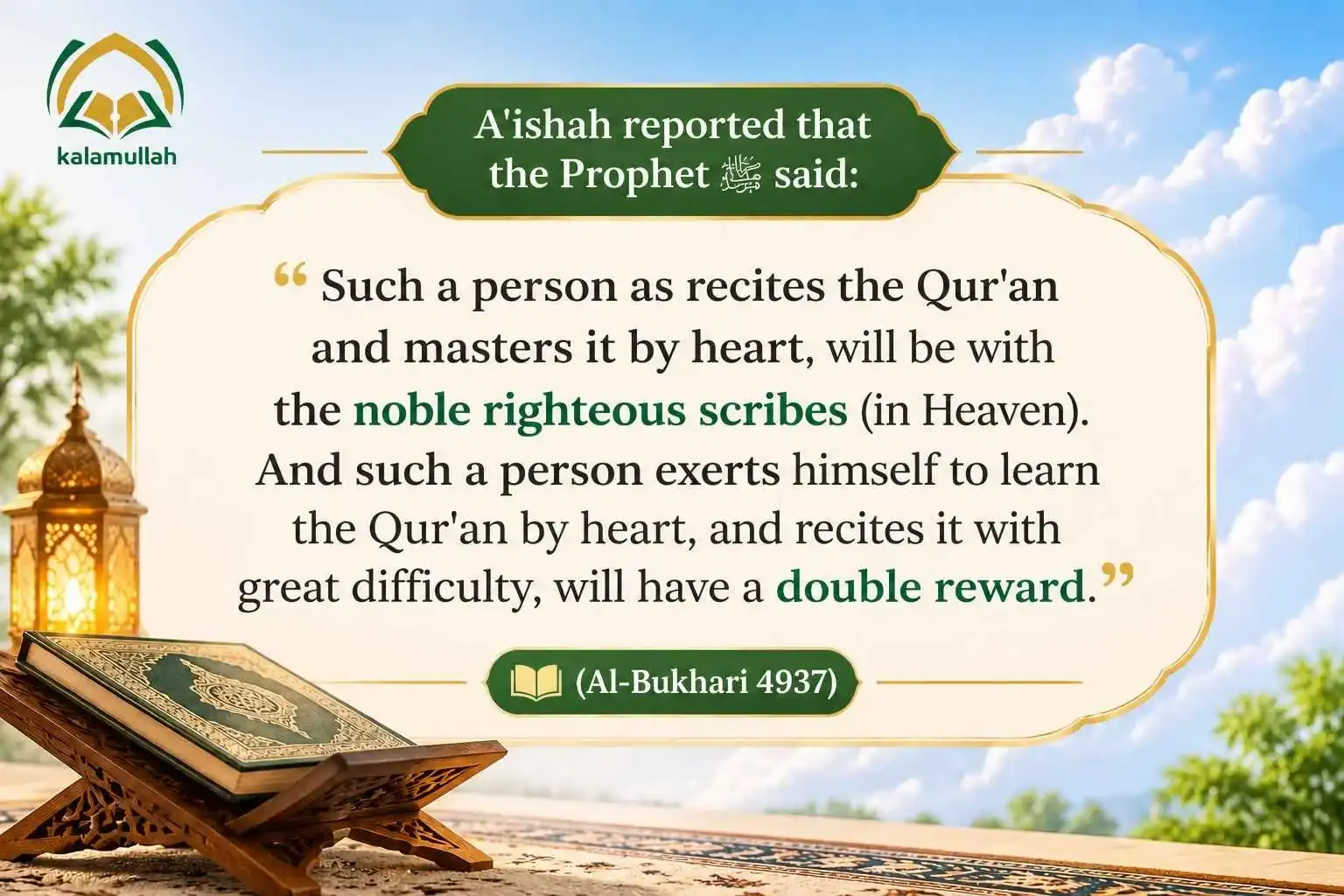
‘A’ishah reported that the Prophet ﷺ said:
“Such a person as recites the Qur’an and masters it by heart, will be with the noble righteous scribes (in Heaven). And such a person exerts himself to learn the Qur’an by heart, and recites it with great difficulty, will have a double reward. “ (Al-Bukhari 4937)
Read the second half carefully, because it reverses an assumption most beginners carry. Difficulty does not reduce the reward — it doubles it.
The student who stumbles through a page twenty times is not behind the one who absorbs it in three. He is being paid twice.
On a day when no one speaks without permission, the Quran itself will speak on behalf of the people who carried it. This is one of the few rewards described as an active defence rather than a prize handed over.
The Prophet ﷺ said:
“اقْرَءُوا الْقُرْآنَ فَإِنَّهُ يَأْتِي يَوْمَ الْقِيَامَةِ شَفِيعًا لأَصْحَابِهِ”
“Recite the Quran, for it will come on the Day of Resurrection as an intercessor for its companions.” (Sahih Muslim 804a)
A second authentic narration pairs the Quran with fasting. Fasting says:
“الصِّيَامُ وَالْقُرْآنُ يَشْفَعَانِ لِلْعَبْدِ يَقُولُ الصِّيَامُ: أَيْ رَبِّ إِنِّي مَنَعْتُهُ الطَّعَامَ وَالشَّهَوَاتِ بِالنَّهَارِ فَشَفِّعْنِي فِيهِ وَيَقُولُ الْقُرْآنُ: مَنَعْتُهُ النُّوْمَ بِاللَّيْلِ فَشَفِّعْنِي فِيهِ فيشفعان”
“O Lord, I deprived him of food and desires during the day, so let me intercede for him.” The Quran says: “O Lord, I deprived him of his sleep at night, so let me intercede for him.” Then both intercede. (Mishkat al-Masabih 1963)
The phrasing deserves attention: the Quran’s claim rests on nights the hafiz gave up. Intercession is tied to effort that cost something.
The intercession above is not the end of the Quran’s role on that Day. In an authentic narration it keeps asking — three times — for its companion to be honoured, and each request is granted.
Abu Hurayrah reported that the Prophet ﷺ said:
“The Quran will come on the Day of Resurrection and will say: O Lord, adorn him. So he will be given a crown of nobility to wear. Then it will say: O Lord, give him more. So he will be clothed in a garment of nobility. Then it will say: O Lord, be pleased with him. So He will be pleased with him…” (At-Tirmidhi 2915)
Notice the sequence: adornment, then clothing, then Allah’s pleasure. Among the rewards of memorizing the Quran, this is the one scholars point to when they say the hafiz is honoured publicly, in front of everyone who ever outranked him in the world.
Beyond ranks and crowns, there is a title. The Prophet ﷺ was asked directly who Allah’s own people are among mankind, and his answer named one group only.
Anas ibn Malik reported that the Prophet ﷺ said:
“إِنَّ لِلَّهِ أَهْلِينَ مِنَ النَّاسِ ” . قَالُوا يَا رَسُولَ اللَّهِ مَنْ هُمْ قَالَ ” هُمْ أَهْلُ الْقُرْآنِ أَهْلُ اللَّهِ وَخَاصَّتُهُ”
“Allah has His own people among mankind.’ They said: ‘O Messenger of Allah, who are they?’ He said: ‘The people of the Qur’an, the people of Allah and those who are closest to Him.“ (Sunan Ibn Majah 215)
Scholars treat this as the summit of the virtues of memorizing the Quran, and the highest answer to what is the reward for memorising the Quran.
People compete for titles, wealth, and proximity to the powerful. No description any language offers reaches “the people of Allah and His special ones.”
Read also: How Do You Remember The Quran After Memorising It?
Recite the Words of Allah With Confidence
Join Kalamullah Quran Academy for live 1-on-1 lessons with Al-Azhar-trained, Ijazah-holding tutors, from your first Qaida letter all the way to Ijazah.
Book Your Free Trial ClassNafi’ ibn Al-Harith, Umar’s governor over Makkah, met Umar ibn Al-Khattab at ‘Usfan. Umar asked whom he had placed in charge of the people of the valley.
He said: “Ibn Abza.” Umar asked: “And who is Ibn Abza?” He replied: “A freed slave of ours.” Umar said: “You appointed a freed slave over them?” He answered: “He is a reciter of the Book of Allah, and he is knowledgeable about the obligatory shares of inheritance.”
قَالَ عُمَرُ أَمَا إِنَّ نَبِيَّكُمْ صلى الله عليه وسلم قَدْ قَالَ ” إِنَّ اللَّهَ يَرْفَعُ بِهَذَا الْكِتَابِ أَقْوَامًا وَيَضَعُ بِهِ آخَرِينَ
Umar then said: “Indeed your Prophet ﷺ said: ‘Allah raises some people by this Book and lowers others by it.’” (Sahih Muslim 817)
That is the reward arriving early. A man with no wealth, lineage, or standing held authority over Makkah on the strength of what he carried of the Book.
Three authentic reports establish the hafiz’s precedence in practical Muslim life, covering prayer, counsel, and the grave itself.
If precedence was granted among the martyrs, the implication for the living is heavier, not lighter.
Every reward above assumes correct recitation. A hafiz who memorised with uncorrected errors in makharij or tajweed carries those errors for life, and unlearning them is harder than learning them the first time.
At Kalamullah, each new portion is read back to a qualified teacher and verified before it is locked in — so what you memorise is what you keep.
Everything said so far about what is the reward for memorising the Quran rests on a single condition, and most lists leave it out.
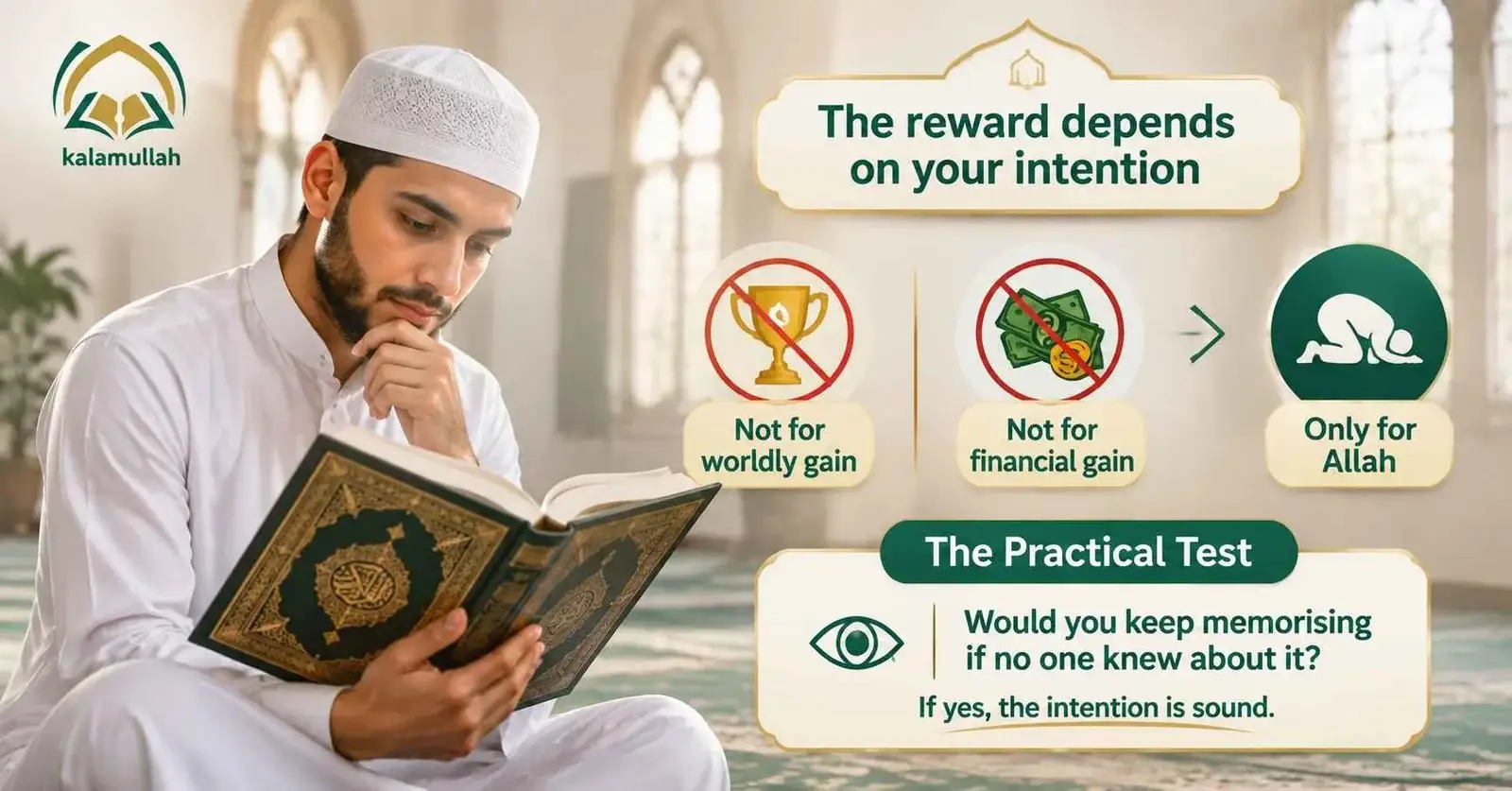
Al-Albani, immediately after authenticating the “recite and rise” hadith, attached it: the reward applies “on the condition that he memorises it for the sake of Allah, not for worldly purposes or financial gain.” He then cited the warning reported from the Prophet ﷺ: “Most of the hypocrites of my Ummah are among those who have memorised the Quran.”
Memorisation is not self-validating. It is an act of worship, and like every act of worship its value is decided by intention. A hafiz who memorized a certificate, a title, or a salary has collected the certificate — and that may be the whole of it.
The practical test scholars suggest is simple: ask whether you would continue memorising if no one ever learned that you had. If the answer is yes, the intention is likely sound. If it hesitates, correct it and continue — the correction itself is rewarded.
The Hereafter is the reason. But the answer to what is the reward for memorising the Quran has a second half that shows up within months of starting, and it is what keeps most students going.
Most Muslims cycle through the same short surahs for decades. A hafiz recites long passages in qiyam and in fard prayers, and the content of the prayer changes with the content of the heart. Allah says:
“ٱللَّهِ ۗ أَلَا بِذِكْرِ ٱللَّهِ تَطْمَئِنُّ ٱلْقُلُوبُ”
“Indeed, in the remembrance of Allah do hearts find rest.” (Ar-Ra’d 13:28)
Memorised text behaves differently from read text. It surfaces on its own — in grief, in a decision, in an argument you were about to lose your temper in.
This is the mechanism behind what people describe as sakinah: the hafiz does not have to go looking for the reminder.
Hifz demands a fixed daily slot, honest self-assessment, and tolerance for slow progress. Students consistently report that the habit does not stay inside the hifz hour; it shows up in study and work.
The skill being trained is not memory. It is returning to a task you have not finished.
Every letter carries reward:
“مَنْ قَرَأَ حَرْفًا مِنْ كِتَابِ اللَّهِ فَلَهُ بِهِ حَسَنَةٌ وَالْحَسَنَةُ بِعَشْرِ أَمْثَالِهَا لاَ أَقُولُ الم حَرْفٌ وَلَكِنْ أَلِفٌ حَرْفٌ وَلاَمٌ حَرْفٌ وَمِيمٌ حَرْفٌ”
“Whoever recites a letter from the Book of Allah will be credited with a good deed, and a good deed gets a ten-fold reward. I do not say that Alif-Lam-Mim is one letter, but Alif is a letter, Lam is a letter and Mim is a letter.” (At-Tirmidhi 2910)
When a hafiz teaches, that reward continues through the student, and through the student’s students. This is why hafiz reward in Islam is described as compounding rather than fixed.
Here is the framework that separates students who finish from students who restart: new memorisation is a deposit; revision is the interest payment. Miss the payment and the deposit disappears.
A working ratio used in established hifz halaqat is roughly one part new to three parts old — if you memorise half a page today, revise one and a half to two pages of earlier material in the same session.
Students who invert this ratio memorise quickly for six months, then discover they cannot recite any of it.
Three mistakes cost the most:
Forgetting itself is normal. The Prophet ﷺ said:
” تَعَاهَدُوا الْقُرْآنَ فَوَالَّذِي نَفْسِي بِيَدِهِ لَهُوَ أَشَدُّ تَفَصِّيًا مِنَ الإِبِلِ فِي عُقُلِهَا”
“Keep refreshing your knowledge of the Quran, for by Him in Whose Hand my soul is, it escapes more quickly than camels released from their tethers.” (Al-Bukhari 5033)
Forgetting is not a sign to stop; it is the reason revision exists. A structured revision schedule, like the one Kalamullah builds into every hifz plan, is what turns that hadith from a warning into a system.
Read also: What Does Hafiz Mean?
Recite the Words of Allah With Confidence
Join Kalamullah Quran Academy for live 1-on-1 lessons with Al-Azhar-trained, Ijazah-holding tutors, from your first Qaida letter all the way to Ijazah.
Book Your Free Trial ClassYou have read what Allah has promised the hafiz. The gap between reading it and receiving it is one decision and a consistent daily slot.
Kalamullah builds hifz around verified recitation and structured revision — a memorisation plan matched to your real schedule, one-to-one sessions with qualified teachers, and a revision system that protects what you have already memorised instead of letting it slip.
Programmes run for children, adults, and women, with flexible timing for anyone studying or working full-time. You do not need to commit to the whole Quran today. You need to commit to the next page.
Explore Our Hifz Courses

What is the reward for memorising the Quran? Not a single promise but a layered one: ascent through Jannah at the level of your last verse, intercession on the Day of Judgment, companionship with the honourable scribes, a crown of light for your parents, and membership among Ahl Allah.
Alongside these, the Quran raises its people in this world, as it raised Ibn Abza from obscurity to authority over Makkah. Two conditions govern all of it. The first is sincerity: memorisation pursued for status or income does not carry the promise. The second is consistency: what is not revised is not retained.
If there is one takeaway, let it be this — the reward is proportional, not binary. You are not waiting at zero until you finish. Every verse secured is a rank earned.
The questions below cover what students most often ask before starting hifz: partial memorisation, forgetting, age, and whether understanding the meaning is required.
The hafiz rises in Jannah to the level of the last verse he recites, the Quran intercedes for him on the Day of Judgment, his parents receive a crown of light, and he is counted among the people of Allah. All of it is conditional on memorising sincerely for Allah’s sake.
Yes. The reward is proportional — the hadith states that rank will be “at the last verse that you recite,” which means every memorised portion counts. There is no threshold you must cross before the reward begins.
They receive two rewards. The Prophet ﷺ said the one who reads the Quran and struggles to memorise it “will have two rewards” (Al-Bukhari 4937). Difficulty increases the reward rather than reducing it.
Forgetting through ordinary human memory is not sinful, and the reward for what was memorised and acted upon remains. What scholars warn against is abandoning the Quran altogether. Consistent revision is the remedy, not despair.
Yes — every letter recited carries reward regardless of comprehension, which is why non-Arabic speakers complete hifz. Scholars still strongly encourage pairing memorisation with tafsir, since the Quran was revealed to be acted upon, not only preserved.
Parents of a hafiz are promised a crown of light on the Day of Judgment “whose brightness is better than the sun” (Abu Dawud 1453). The reward reaches them for supporting the memorisation, even though they did not memorise themselves.

Articles teach theory — a live teacher hears you. Book a free one-on-one trial class this week.
Book Free TrialHifz Hifz
 Hifz