 HifzHifz

What does Hafiz mean in Islam? A Hafiz is a Muslim who has memorized the entire Quran — all 114 surahs and 6,236 verses — and keeps that memorization alive through continuous revision.
The word is often translated as “one who knows the Quran by heart,” but that translation captures only half of it. The Arabic root behind the title means to guard, protect, and tend to something precious.
That gap between the common translation and the actual hafiz meaning is where most explanations stop.
This guide covers both: the literal meaning of the word, the feminine and plural forms, how long the title takes to earn, and the responsibilities that begin the day memorization ends.
What You’ll Learn in This Article
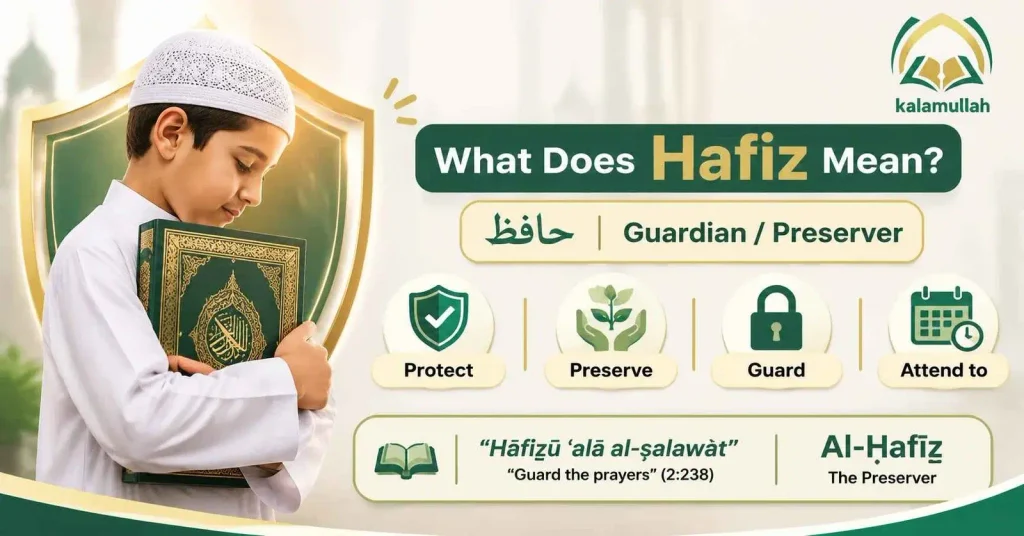
The word Hafiz (حافظ) is the active participle of the Arabic verb ḥafiẓa (حَفِظَ), which means to preserve, guard, protect, and attend to. In English, the closest accurate translation is guardian or preserver — not simply “memorizer.”
That distinction matters because Arabic active participles describe an ongoing role, not a completed act. A Hafiz is not someone who memorized the Quran once; a Hafiz is someone who is currently guarding it.
Classical Arabic usage shows how wide this root runs. Arabs said ḥafiẓa al-māl — he tended and protected his wealth. They said ḥafiẓa al-sirr — he kept a secret. They said ḥāfaẓa ḥarīmahu — he defended what was sacred to him.
The same verb appears in the Quran for punctuality in prayer:
“حَـٰفِظُوا۟ عَلَى ٱلصَّلَوَٰتِ وَٱلصَّلَوٰةِ ٱلْوُسْطَىٰ وَقُومُوا۟ لِلَّهِ قَـٰنِتِينَ”
“Ḥāfiẓū ʿalā al-ṣalawāt” — “Guard the prayers”
(Al-Baqarah 2:238).
Allah’s own Name al-Ḥafīẓ (الحفيظ), The Preserver, shares the root. So the meaning of Hafiz sits inside a family of words about careful, continuous, protective attention.
The hafiza meaning is straightforward: Hafiza (حافظة), also written Hafizah, is the feminine form of the title, used for a woman who has memorized the complete Quran. It carries identical religious and scholarly standing — there is no lesser category for women in Hifz.
The huffaz meaning is equally simple but often confused: Huffaz (حفّاظ) is the Arabic plural, used for a group. One is a Hafiz; many are Huffaz. A common error in English writing is “Hafizs” or “Hafiz’s” as a plural — neither is correct.
| Form | Arabic | Used for |
| Hafiz | حافظ | One male who has memorized the Quran |
| Hafiza / Hafizah | حافظة | One female who has memorized the Quran |
| Huffaz | حفّاظ | Plural — a group of memorizers |
| Hifz / Hifdh | حفظ | The act or process of memorization |
Because the root carries five distinct shades of meaning, the title places five concrete demands on the person who holds it. At Kalamullah Academy we teach these as the Five Guards of Hifz, and they map directly onto the classical Arabic usage above.

Recite the Words of Allah With Confidence
Join Kalamullah Quran Academy for live 1-on-1 lessons with Al-Azhar-trained, Ijazah-holding tutors, from your first Qaida letter all the way to Ijazah.
Book Your Free Trial ClassThe Quran describes those who carry it as holding it internally, not merely reciting it:
“بَلْ هُوَ ءَايَـٰتٌۢ بَيِّنَـٰتٌ فِى صُدُورِ ٱلَّذِينَ أُوتُوا۟ ٱلْعِلْمَ ۚ”
“Rather, it is distinct verses preserved in the breasts of those who have been given knowledge”
The verb used for that preservation is the same root that gives us the title — which is part of what does Hafiz mean at the level of status, not just skill.
The Prophet ﷺ said:
“يُقَالُ لِصَاحِبِ الْقُرْآنِ اقْرَأْ وَارْتَقِ وَرَتِّلْ كَمَا كُنْتَ تُرَتِّلُ فِي الدُّنْيَا فَإِنَّ مَنْزِلَكَ عِنْدَ آخِرِ آيَةٍ تَقْرَؤُهَا”
“One who was devoted to the Qur’an will be told to recite, ascend and recite carefully as he recited carefully when he was in the world, for he will reach his abode when he comes to the last verse he recites.”
(Sunan Abi Dawud 1464).
Scholars read this as tying the Hafiz’s rank to the portion still carried and recited — an ongoing relationship with the text, not a certificate earned once.
In practice, this status shows up in community life. A Hafiz is given precedence in leading congregational prayer, is relied upon during Tarawih in Ramadan, and is often the person a community turns to for correction of recitation.
Read also: How to Memorise the Quran?
Completion time depends on four variables: age, daily study hours, teaching quality, and — the most underestimated — revision discipline.
| Student profile | Daily study time | Typical completion |
| Child (6–12) | 2–4 hours | 2–4 years |
| Teenager (13–18) | 3–5 hours | 1.5–3 years |
| Adult, full-time | 4–6 hours | 1–2 years |
| Adult, part-time | 1–2 hours | 3–5 years |
These are instructional ranges, not guarantees. The decision rule we give adult students is simple: if your daily revision load exceeds your new-memorization time within the first three months, your pace is too fast.
New pages added faster than old pages can be maintained to produce a student who has “finished” the Quran and cannot recite half of it.
The most common failure pattern is treating Hifz as a forward-moving project. It is two projects running in parallel: acquiring new material and holding everything previously acquired. The second project grows every single day while the first stays the same size.
Adults who begin with a weak recitation base compound this, because every error memorized must later be unlearned — a mispronounced letter repeated through fifty pages has to be corrected fifty times over.
A focused Quran Reading Course for Adults removes that cost before it accumulates, by fixing articulation while the memorized portion is still small.
These titles describe different achievements that are frequently confused, and the distinction affects how students plan their studies. Knowing what does Hafiz mean also means knowing what it does not claim.
| Title | Core achievement | Primary skill |
| Hafiz / Hafiza | Complete Quran memorization | Preservation and recall |
| Qari / Qariah | Mastery of Tajweed and recitation | Rule-correct, beautiful recitation |
| Muqri | Certification in multiple Qira’at | Transmitting recitation styles |
| Alim / Alimah | Full Islamic sciences curriculum | Scholarship and legal reasoning |
A Hafiz holds the text; a Qari masters how it sounds; a Muqri is authorized to transmit multiple canonical readings; an Alim has studied Fiqh, Hadith, Tafsir, Usul, and Arabic.
The titles overlap in many individuals but are earned separately. Memorization is commonly the foundation students build first, because carrying the text internally makes every later science faster to study.
Recite the Words of Allah With Confidence
Join Kalamullah Quran Academy for live 1-on-1 lessons with Al-Azhar-trained, Ijazah-holding tutors, from your first Qaida letter all the way to Ijazah.
Book Your Free Trial ClassYou do not need a strong memory to become a Hafiz — you need a correct method, a qualified teacher listening to every line, and a revision system that holds what you build.
Kalamullah Academy pairs you with specialist Quran instructors who structure both halves of the work: new memorization and systematic Muraja’ah, scheduled around your actual week.
Explore Our Hifz Courses

So, what does Hafiz mean? Literally, a guardian — someone who preserves and protects. Applied to the Quran, it means a Muslim who has memorized all 114 surahs, verified that memorization with a qualified teacher, and continues to maintain it through daily revision. The feminine form is Hafiza; the plural is Huffaz.
The full meaning of Hafiz is best understood through the Arabic root it comes from: guarding the text, the schedule, the tongue, the self, and the continuity.
Memorization completes; guardianship does not. That is the distinction that separates someone who once memorized the Quran from someone who truly carries the title.

These are the questions students and parents most often ask when researching the meaning of Hafiz and what the title requires.
In English, Hafiz means guardian or preserver. It is commonly translated as “one who has memorized the Quran,” but the Arabic root ḥ-f-ẓ carries the sense of protecting and maintaining, not merely storing in memory.
Yes. A woman who memorizes the complete Quran is called Hafiza or Hafizah, the feminine form of the same word. The hafiza meaning is identical in substance to Hafiz, and the title carries full religious and scholarly recognition.
Yes. Adults memorizing 1–2 hours daily typically complete Hifz in 3–5 years. Adults often retain better than children because they understand the meaning of what they memorize, which strengthens recall.
Yes. Memorization without correct Tajweed is considered incomplete, because mispronunciation can alter meaning. Correct articulation is part of what the Hafiz is guarding.
The plural is Huffaz (حفّاظ). The huffaz meaning is simply “those who memorize and preserve” — used when referring to a group, such as the Huffaz of a particular country or institution.
No. The title requires memorization of the complete Quran — all 30 Juz’ — verified by recitation to a qualified teacher. Memorizing selected Juz’ is a valued achievement but does not carry the title of Hafiz.

Articles teach theory — a live teacher hears you. Book a free one-on-one trial class this week.
Book Free TrialHifz Hifz
 Hifz