 2:45
Parent Progress Review (Live)
Live one-to-one lesson example.

Kalamullah’s Noor Al-Bayan online classes are taught live and one-to-one by qualified teachers who know how to keep a young child engaged as easily as an adult beginner. Your child learns at home, in lessons timed around your family’s day, with a teacher who celebrates every word they manage to read.
 6–9
Our online Quran classes are built around a simple idea: real, live teaching from a qualified tutor, delivered one-on-one, on a schedule that fits your life. After a short assessment, every student — child or adult, complete beginner or returning learner — is placed into the track that matches their current level, then guided step by step through pronunciation, Tajweed and recitation with regular feedback.
Noor Al-Bayan is a step-by-step reading method created by the educator Tariq Al-Saeed to teach Arabic reading and writing through gradual, carefully ordered stages. Students learn the letters and how their shapes change within a word, then the short vowels (Harakat) and the long vowel letters, then Tanween and Sukoon, and finally Shaddah, sun and moon letters, simplified Tajweed, and the features of the Quranic script.
This course needs no prior knowledge at all. It is the natural first step for children as young as four [confirm the youngest starting age with the academy], for adults who never learned to read Arabic, and for new Muslims opening the Quran for the first time. Parents who prefer a method that teaches reading and writing together often choose it over other primers. Every lesson is one-to-one, so a shy child is never compared with others and an adult beginner can learn with complete privacy.
The Noor Al-Bayan method only works as well as the teacher who delivers it. Young children need patience, energy, and a teacher who knows exactly when to repeat and when to move on. Every teacher in our Noor Al-Bayan online classes holds a recognized Quran qualification and has experience teaching non-Arabic-speaking beginners, so each stage is explained simply and practiced until it sticks.
No alphabet knowledge is assumed. The very first lesson begins with a single letter and its sound, so even the youngest learner or a new Muslim feels successful straight away.
Students learn how each letter looks at the start, middle and end of a word. This is the step many beginners miss, and the reason they later struggle with joined-up text.
Lessons for young children are broken into small activities: pointing, repeating, reading aloud and writing. Short attention spans stay engaged, and every lesson ends on a success.
Correct pronunciation, sun and moon letters and simplified Tajweed are built into the method itself. Good habits form from the first stage instead of being corrected years later.
Families can ask for a female teacher for daughters, mothers and young children, or a male teacher for sons and fathers, whichever suits your household.
Book a free first class and we will identify the right level and next milestone.
Book a free trialThe course follows the stages of the Noor Al-Bayan book in order. Each stage introduces one new idea and gives plenty of practice before moving on. Your teacher checks that every stage is secure before turning the page, so no gap is carried into the next one.
How long the whole book takes depends on the student's age, attention and number of lessons per week. Young children usually move more slowly than adults, and that is exactly how the method is meant to work. [Confirm typical completion times with the academy]
After a free taster lesson where the teacher gets to know the student, the course begins with the Arabic alphabet. Each letter is introduced with its name, its sound and the correct way to pronounce it.
Students then learn how each letter changes shape depending on where it sits in a word. They practise recognising and writing these forms until they can pick them out quickly.
Next come Fathah, Kasrah, and Dammah, the small marks that turn letters into syllables. Students read each letter with each vowel until the sounds become automatic.
They then learn the long vowel letters alif, waw and ya, and the difference between a short sound and a stretched one. This difference is essential for reading the Quran correctly.
Students then practice Sukoon, the mark of a letter with no vowel. They learn how it closes a syllable onto the letter before it, and keep practicing until they can read closed syllables smoothly.
Students then practise sukoon, the mark of a silent letter. They learn how it joins two sounds together, and they keep practising until they can read closed syllables smoothly.
Students learn Shaddah, the mark that doubles a letter, and practice it in every combination: with each short vowel, with Tanween, and followed by a long vowel. They also learn how the “al” at the start of a word is pronounced before sun letters and moon letters.
Simplified rules of Tajweed are introduced here as part of reading, so students begin to recite, not just decode.
In the final stage, students learn how the Quranic script differs from standard Arabic spelling and how to read Hamzat al-Wasl and Hamzat al-Qat’ correctly. This prepares them to read directly from the Mushaf.
They then put everything together by reading short verses and surahs. When the book is complete and the final check is passed, they receive a Kalamullah certificate.
Every skill below matches a stage of the method and is confirmed by the teacher before your child moves on, so you can ask your child to read to you and hear each one for yourself.
Your child can look at an unfamiliar vowelled word, sound out each letter and blend the sounds into the complete word on their own.
This is the moment reading truly begins, when words stop being shapes and start being sounds.
Your child can write each letter correctly in its beginning, middle and end forms and join letters to make simple words.
Writing and reading reinforce each other, so this skill also makes their reading faster and more accurate.
Your child can read pairs of words where only the vowel length changes and pronounce each one correctly.
Getting this right early protects their future Quran recitation from one of the most common beginner mistakes.
Your child can read words ending in tanween and words containing sukoon at a steady pace, without stopping to work out each mark.
Their reading starts to flow as connected speech instead of separate syllables.
Pronounce "Al" Correctly Before Sun and Moon Letters
Your child can read words beginning with "al" and correctly decide whether the lam is pronounced or merged into the next letter.
It is a small rule, but it appears on almost every page of the Quran, and your child will now handle it with ease.
Your child can open the Mushaf and read a short surah in the Quranic script, vowel by vowel, with correct pronunciation.
For many families, this first surah read unaided is the proudest moment of the whole course.
Watch real lessons below and see how our teachers guide children from single letters to their first words.
Short class snippets show how the teacher explains, listens, corrects and confirms progress.
2:45Live one-to-one lesson example.
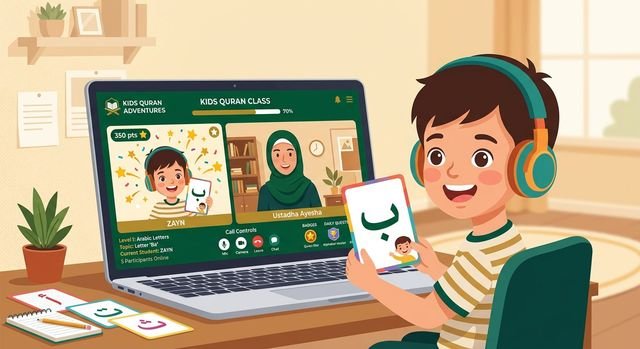 2:45
Live one-to-one lesson example.
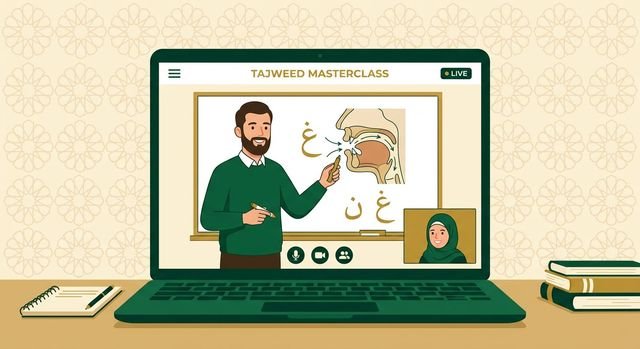 2:45
Live one-to-one lesson example.
Unscripted words from the people who took the course — recorded after their final class.
“Live correction made my recitation clearer and gave me a practical path to keep improving.”
“Live correction made my recitation clearer and gave me a practical path to keep improving.”
“Live correction made my recitation clearer and gave me a practical path to keep improving.”
Teacher language, speciality and availability are considered before the regular schedule starts.
Read what parents say about their child’s first steps in reading with Kalamullah.
“The teacher gives clear correction and a practical next step every week.”
“The teacher gives clear correction and a practical next step every week.”
“The teacher gives clear correction and a practical next step every week.”
See measurable examples from learners who started at different levels.
Follows a weekly target and muraja’ah plan independently.
Applies core rules naturally with fewer corrections.
Reads short surahs with stronger fluency and confidence.
Compare nearby routes before choosing the best starting point.
BeginnerUnderstand recurring Quranic vocabulary and sentence patterns.
View courseBeginnerBeginnerBeginnerBeginnerA quick answer to the questions that come up most often before someone books their first trial class — a mix of questions specific to this course and questions about the academy as a whole.
Your teacher can advise which suits your child better, and you can compare it with our Noorani Qaida Course.
Children can usually begin from age [X], as long as they can sit for a short lesson and repeat sounds after the teacher.
Not necessarily. The teacher checks what your child already knows in the free taster lesson and can begin at a later stage if the earlier ones are secure.
Yes. The method works for any complete beginner, and adult lessons move at a pace that suits grown-up learners, in complete privacy.
Yes. Just mention it when you book, and your daughter will be matched with a female teacher.
It depends on the student's age and how many lessons they take each week. Older children and adults often move faster than young children.
Book the free first class. We will check level, match the teacher and show the next milestone.
7 free trial spots remaining this week
Choose the weekly frequency that fits the learner after the free trial.