 2:45
Parent Progress Review (Live)
Live one-to-one lesson example.

Kalamullah’s Quran Recitation Course teaches students of all ages how to recite the Quran correctly, with accurate Makharij, applied Tajweed rules and a structured progression. Lessons are live and one-on-one with a dedicated tutor, available across time zones.
Whether a complete beginner or a returning student correcting long-held mistakes, every learner starts at the right point and moves forward at a pace that builds real recitation accuracy, not surface-level familiarity with the text.
 6–9
Kalamullah’s Quran Recitation Course covers the full range of recitation skills, from Arabic letter recognition through Noorani Qaida to applied Tajweed at the passage level. Tutors teach English-speaking students to recite with accuracy and proper Makharij from the first session.
Students with no prior background begin with foundational sound training before moving to Tajweed rule application. Those at an intermediate level enter directly at Tajweed drills. Every placement decision is made after a free diagnostic session, ensuring no learner repeats ground they have already covered or skips ground they still need.
Because every lesson is one-on-one, each minute of tutor time goes to your own recitation errors, and you move forward only when a skill holds up without prompting.
Every instructor is assessed on recitation accuracy and on teaching non-native speakers before being assigned to students in the Quran Recitation Course.
Every session in Kalamullah's Quran Recitation Course is one-on-one and live. Tutors correct Makharij errors in real time, replay the student's recitation, and demonstrate the accurate articulation point until the student can reproduce it independently.
Kalamullah maintains a dedicated panel of female instructors for the Quran Recitation Course. Sisters and girls are matched with a qualified female tutor from the first session, with no additional enrollment steps required.
Sessions run mornings, afternoons, evenings and weekends, so students working full-time or managing school schedules can book lessons when their day allows.
The course moves through letter sounds, Makharij, Noon and Meem Saakinah rules, Ghunnah, Qalqalah and Madd, and finally Waqf and passage-level fluency, in that order. No stage is passed until the tutor confirms you can apply it without prompting.
Book a free first class and we will identify the right level and next milestone.
Book a free trialKalamullah's Quran Recitation Course follows a staged structure that moves every student from sound recognition to fluent, rule-accurate recitation.
Students who are new to Arabic begin with Noorani Qaida, which introduces the Arabic alphabet, vowel sounds, joining rules, and basic phonetics before any Quranic text is introduced.
Tutors use minimal-pair exercises — two words that differ by a single sound — to separate letters English speakers commonly confuse, such as Ḥaa (ح) and Haa (ه). Learners do not advance to Quranic text until they can read Qaida passages cleanly and without hesitation.
Makharij training focuses on the nine Arabic sounds non-native speakers most often mispronounce: Ḥaa (ح), Khaa (خ), Ṣaad (ص), Ḍaad (ض), Ṭaa (ط), Ẓaa (ظ), ʿAyn (ع), Ghayn (غ) and Qaaf (ق).
Tutors isolate each sound and drill it in pairs, in words, and then in short Quranic phrases before the student moves forward. This is not a one-session review. A single Makharij point may occupy three or more sessions until the tutor confirms consistent, unprompted accuracy.
Tajweed rules are taught as active reading decisions, not passive definitions. Students learn to recognize the conditions for Idhaar, Idghaam, Iqlaab, and Ikhfaa by scanning ahead in the text and applying the correct rule in real time.
Once the Noon Saakinah track is secure, the Meem Saakinah rules follow: Ikhfaa Shafawi, Idghaam Shafawi and Idhaar Shafawi. Tutors teach both sets as one connected system rather than separate lists, which makes correct application during independent recitation far more reliable.
Ghunnah is taught using counted beats rather than subjective descriptions. Students hold the nasal resonance for exactly two counts, practiced first on isolated letters, then in words, then across verse transitions where Ghunnah interacts with Idghaam.
Qalqalah is drilled through a stop-and-release method that produces the natural echo of the five Qalqalah letters without forcing or exaggerating the sound. Madd categories, including Madd Tabee'i, Madd Muttasil, and Madd Munfasil, are introduced in sequence, each tested in live recitation before the next is taught.
Waqf training teaches students where to stop, where stopping is permitted, and where a pause would distort meaning or grammar. Lessons begin with meaning-first analysis of Waqf symbols before moving to recitation application.
Students learn Waqf Lazim, Waqf Jaiz, and Waqf Mamnoo as active choices made while reading, not decorative marks to observe passively.By the end of this phase, learners can recite unfamiliar passages with accurate stops, planned breathing and consistent Tajweed throughout.
Every outcome below is a demonstrable recitation skill, assessed by the tutor in live sessions before progression continues. These are not topics covered. They are skills the student can perform.
Students open an unfamiliar page of the Quran and recite it correctly on sight, applying Tajweed rules without stopping to recall definitions. Fluency is tested regularly on passages the student hasn’t practiced.
Learners identify their own Tajweed errors during independent practice, naming whether the mistake was in Makharij, Madd length, or a Ghunnah rule. This diagnostic skill is trained explicitly through recorded recitation review and tutor-guided error analysis.
Students recite Al-Fatihah and the Surahs most commonly used in daily prayer with correct pronunciation, measured pacing, and consistent Tajweed under performance conditions. Speed, clarity, and rule application are tested in the same session.
Learners apply Waqf Lazim, Waqf Jaiz, and Waqf Mamnoo correctly while reciting full passages. Students plan breath points before reciting and understand why each stop is required, permitted or prohibited based on the meaning of the verse.
Students produce all 28 Arabic letters from the correct articulation points, including the nine sounds most frequently mispronounced by non-native speakers. Accuracy is assessed in isolation, in words, and in live Quranic passage recitation before this outcome is confirmed.
Through short daily recitation targets set by the tutor, students build a consistent routine, such as after Fajr or before sleep. Tutors track consistency as its own outcome, separate from accuracy.
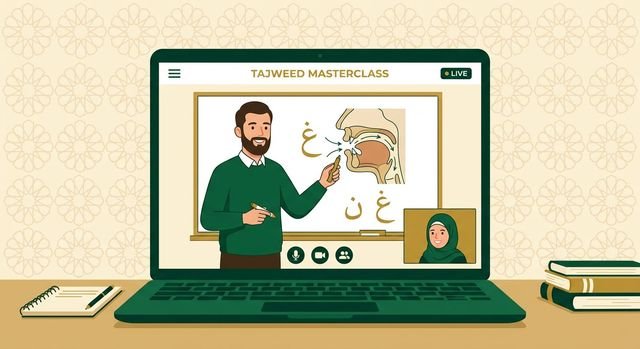
Watch how a tutor corrects Makharij and Tajweed in a live one-on-one recitation lesson.
Short class snippets show how the teacher explains, listens, corrects and confirms progress.
2:45Live one-to-one lesson example.
 2:45
Live one-to-one lesson example.
 2:45
Live one-to-one lesson example.
Unscripted words from the people who took the course — recorded after their final class.
“Live correction made my recitation clearer and gave me a practical path to keep improving.”
“Live correction made my recitation clearer and gave me a practical path to keep improving.”
“Live correction made my recitation clearer and gave me a practical path to keep improving.”
Teacher language, speciality and availability are considered before the regular schedule starts.
Read what students and parents say about the Quran Recitation Course.
“The teacher gives clear correction and a practical next step every week.”
“The teacher gives clear correction and a practical next step every week.”
“The teacher gives clear correction and a practical next step every week.”
See measurable examples from learners who started at different levels.
Follows a weekly target and muraja’ah plan independently.
Applies core rules naturally with fewer corrections.
Reads short surahs with stronger fluency and confidence.
Compare nearby routes before choosing the best starting point.
BeginnerUnderstand recurring Quranic vocabulary and sentence patterns.
View courseBeginnerBeginnerBeginnerBeginnerA quick answer to the questions that come up most often before someone books their first trial class — a mix of questions specific to this course and questions about the academy as a whole.
Yes. Absolute beginners start in the Noorani Qaida track, building letter recognition and vowel sounds before any Quranic text or Tajweed rule is introduced.
Kalamullah's Quran Recitation Course accepts students from age four through adulthood. Children and adults are placed with tutors trained specifically for their age group and learning stage.
Kalamullah maintains a full panel of certified female tutors for the Quran Recitation Course. Sisters and girls are matched with a female instructor from the first session, with no waiting period required.
Sessions can be rescheduled up to 24 hours in advance with no penalty.
Tutors assess Makharij accuracy, Tajweed rule consistency, reading fluency, and self-correction ability each month. Progress reports are sent based on recorded recitation samples reviewed by the assigned instructor.
Complete the enrollment form on this page. Kalamullah's team contacts you within 24 hours to confirm a free trial session. No payment is required before the trial class takes place.
Book the free first class. We will check level, match the teacher and show the next milestone.
7 free trial spots remaining this week
Choose the weekly frequency that fits the learner after the free trial.