 Islamic StudiesIslamic Studies

Most people learning about Islam meet both words in the same week and assume they are two halves of one book. They are not. Knowing what is the difference between the Quran and Hadith is the first thing that makes Islamic knowledge organise itself in your mind instead of sitting in a pile.
The Quran is the speech of Allah, revealed in its exact wording. Hadith are reports about what the Prophet Muhammad ﷺ said, did, or silently approved. Both guide Muslims, but they differ in origin, in wording, in how they were transmitted, and in the level of authority they carry.
This article explains that difference precisely — including Hadith Qudsi, the category that trips up almost every beginner — and gives you a practical check you can apply to any narration you come across.
What you’ll learn in this article:
The core of the difference between Quran and Hadith is the authorship of the wording. In the Quran, both the meaning and the exact words are from Allah, delivered through the Angel Jibreel. In hadith, the meaning may be divinely guided, but the words are the Prophet’s own, reported later by his companions.
Everything else — transmission, authority, use in prayer — follows from that single point. Readers who ask “What is the difference between the Quran and Hadith?” usually expect a list of unrelated facts; in reality every item on that list traces back to who chose the words.
The Quran is the speech of Allah, sent down upon the Prophet Muhammad ﷺ through the Angel Jibreel in its precise meaning and precise wording, and transmitted by tawatur — mass transmission by numbers so large that agreement on an error is not possible — both orally and in writing.
The word qur’an comes from the root qara’a, “to read” or “to recite,” so the name itself is a verbal noun meaning “the recitation.” The Quran refers to itself by other names, each naming one of its functions: Furqan (criterion), Tanzil (that which is sent down), Dhikr (reminder), and Kitab (scripture).
A hadith is a report — verbal or written — about the Sunnah of the Prophet Muhammad ﷺ. In ordinary Arabic the word simply means news or narration; as a technical term it carries a narrower sense.
Hadith reports cover four things: what the Prophet ﷺ said (qawl), what he did (fi’l), what he approved by staying silent when it happened in front of him (taqrir), and descriptions of his character and appearance (sifa). The word Sunnah refers to his normative example; hadith is the documentary evidence that preserves it.
Each narration has two parts: the sanad, the chain of narrators, and the matn, the text itself. Scholars examine both separately — a sound-sounding text with a broken chain is still rejected.
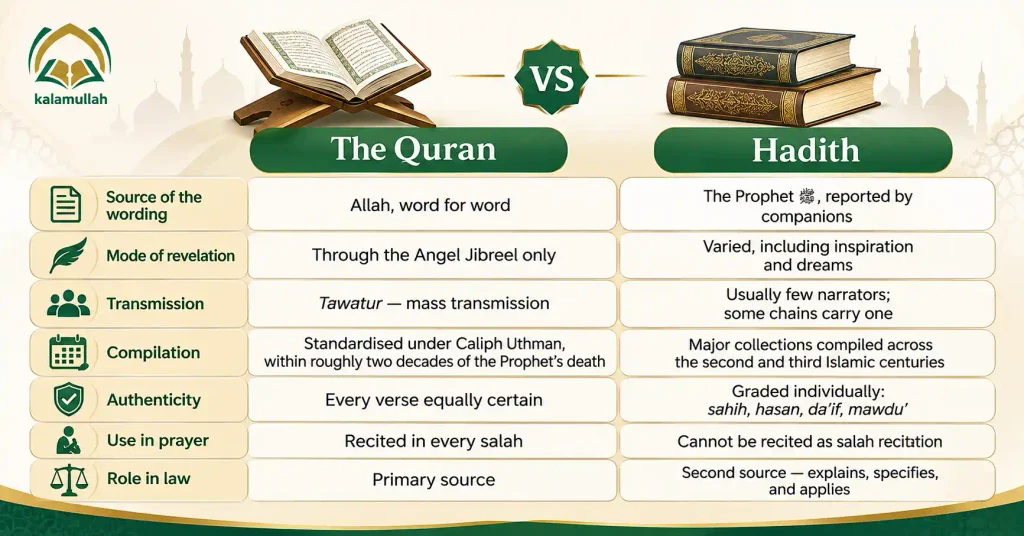
Once you know that the wording differs in origin, the rest of the distinctions line up predictably. This table is the fastest way to hold the whole Quran vs Hadith picture at once.
| Feature | The Quran | Hadith |
| Source of the wording | Allah, word for word | The Prophet ﷺ, reported by companions |
| Mode of revelation | Through the Angel Jibreel only | Varied, including inspiration and dreams |
| Transmission | Tawatur — mass transmission | Usually few narrators; some chains carry one |
| Compilation | Standardised under Caliph Uthman, within roughly two decades of the Prophet’s death | Major collections compiled across the second and third Islamic centuries |
| Authenticity | Every verse equally certain | Graded individually: sahih, hasan, da’if, mawdu’ |
| Use in prayer | Recited in every salah | Cannot be recited as salah recitation |
| Role in law | Primary source | Second source — explains, specifies, and applies |
Imam as-Suyuti, following al-Juwayni, explained it with an image worth keeping. A king may tell his messenger, “Go and tell this man to do such and such” — and the messenger delivers the order faithfully in his own phrasing. Or the king may write a letter and say, “Read this to him,” and the words arrive untouched.
The Sunnah belongs to the first kind. The Quran belongs to the second. This is exactly why a hadith may be reported bi al-ma’na — by meaning — with two companions wording the same event differently, while no such latitude exists in a single letter of the Quran.
The Quran was written and memorised simultaneously from the start. Scribes recorded revelation on parchment and palm leaves while thousands of companions committed it to memory, and each stream verified the other.
Hadith began as oral transmission inside a living scholarly community, and the written collections came later — not as a replacement, but as the product of that oral tradition once the verification method was rigorous enough to be worth committing to a book. Imam al-Bukhari is reported to have examined around 600,000 narrations before selecting roughly 7,000 for his collection.
One point often confuses newcomers studying how hadith differs from the Quran: if the Quran has several recognised modes of recitation (qira’at), isn’t that the same kind of variation found in hadith wording?
No. The qira’at are themselves transmitted by tawatur, taught and certified through unbroken chains of recitation, and were revealed as modes of reading rather than produced by narrators paraphrasing.
Variation in hadith wording comes from human reporting; variation in qira’at comes from the revelation itself and is transmitted with the same certainty as the text. This distinction is taught from the first lessons at Kalamullah, because a student who misses it tends to misunderstand everything that follows.
Recite the Words of Allah With Confidence
Join Kalamullah Quran Academy for live 1-on-1 lessons with Al-Azhar-trained, Ijazah-holding tutors, from your first Qaida letter all the way to Ijazah.
Book Your Free Trial ClassThe Quran carries absolute authority. Hadith carries binding authority, but conditional on authentication, which is why scholars built an entire discipline — ‘ilm al-rijal, the evaluation of narrators — around it.
Imam al-Shafi’i set this hierarchy out formally in al-Risala more than 1,200 years ago: after the Quran, the authenticated Sunnah is the binding second source. He grounded it in the Quran’s own instruction,
«“وَمَآ ءَاتَىٰكُمُ ٱلرَّسُولُ فَخُذُوهُ وَمَا نَهَىٰكُمْ عَنْهُ فَٱنتَهُوا۟”»
“Whatever the Messenger gives you, take it. And whatever he forbids you from, leave it” (Surah al-Hashr 59:7).
One nuance students rarely hear: the majority of classical jurists held that hadith cannot abrogate a Quranic ruling, though it can restrict, specify, or explain a general one.
A minority, notably within the Hanafi school, allowed mass-transmitted Sunnah a wider role in specifying Quranic generalities. That is a genuine juristic difference, not a dispute about whether hadith is authoritative at all.
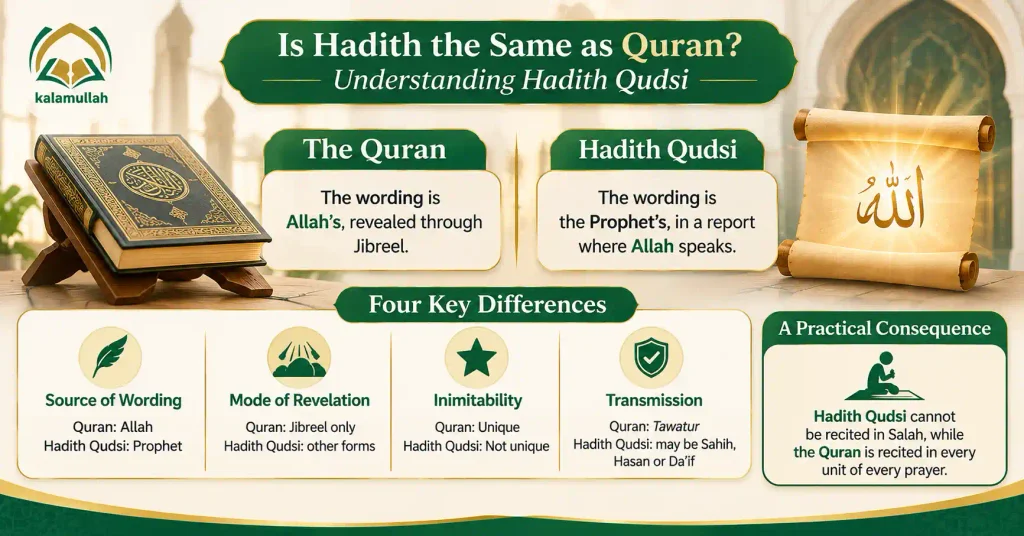
No. Hadith is not the Quran, and the category that makes people ask “Is hadith the same as Quran?” is Hadith Qudsi — a report in which the Prophet ﷺ quotes Allah directly, in the first person, outside the Quran.
Qudsi means holy or pure. An example: Abu Hurairah reported that the Messenger of Allah ﷺ said,
“قَالَ اللَّهُ إِذَا أَحَبَّ عَبْدِي لِقَائِي أَحْبَبْتُ لِقَاءَهُ، وَإِذَا كَرِهَ لِقَائِي كَرِهْتُ لِقَاءَهُ”
“Allah, Mighty and Exalted is He, said: If My servant likes to meet Me, I like to meet him; and if he dislikes to meet Me, I dislike to meet him.” (Sahih al-Bukhari 7504)
Both the Quran and Hadith Qudsi carry meaning from Allah, which is why the confusion is reasonable. The separation rests on four points. In the Quran the wording is Allah’s, while in Hadith Qudsi the wording is the Prophet’s.
The Quran came only through Jibreel, while a hadith qudsi may have come through another form of inspiration, including a dream. The Quran is inimitable and unique; a hadith qudsi is not. And the Quran is transmitted by tawatur and is beyond doubt, while a hadith qudsi may be graded sahih, hasan, or even da’if.
One practical consequence settles the question of whether hadith is the same as Quran: a hadith qudsi cannot be recited in salah and carries no quantified recitation reward, while the Quran is recited in every unit of every prayer.
Read also: What Does Aqeedah Mean?
The Quran gives the command; the hadith shows the demonstration. Neither functions alone in practice, which is why scholars describe the relationship as complementary rather than competitive.
The Quran itself assigns this explanatory role:
“وَأَنزَلْنَآ إِلَيْكَ ٱلذِّكْرَ لِتُبَيِّنَ لِلنَّاسِ مَا نُزِّلَ إِلَيْهِمْ”
“And We have sent down to you ˹O Prophet˺ the Reminder, so that you may explain to people what has been revealed for them” (Surah An-Nahl 16:44).
The Quran commands prayer repeatedly, but does not specify the number of rak’ahs, the bodily positions, or what is recited at each one. All of that reaches us through hadith. The Prophet ﷺ said,
“صَلُّوا كَمَا رَأَيْتُمُونِي أُصَلِّي”
“Pray as you have seen me praying” (Al-Bukhari 6008)
An instruction preserved in hadith and followed in every mosque since.
Fasting follows the same pattern: the Quran establishes the obligation in Ramadan; the hadith supplies when the fast begins and ends, what breaks it, and the practice of the last ten nights.
Zakat is commanded in the Quran; the thresholds (nisab), the percentages, and the eligible recipients come from the Sunnah.
This is also why the most trusted method of Quranic commentary is tafsir bi al-ma’thur — interpretation through transmitted reports. When a scholar explains a verse, the first evidence consulted is what the Prophet ﷺ said about it.
Studying the two sources side by side rather than separately is how Kalamullah structures its lessons, so a verse and the practice that explains it arrive together instead of years apart.

A modern movement known as the Qur’aniyyun, or Quranists, argues that Muslims should follow the Quran alone and set hadith aside. Mainstream scholarship has rejected this position, on grounds taken from the Quran itself.
The Quran repeatedly pairs obedience to Allah with obedience to the Messenger. Scholars point out the practical consequence: the only record of what obeying the Messenger actually looks like is the hadith corpus.
Remove it and the number of daily prayer units, the method of ablution, the rules of fasting, and the thresholds of zakat become impossible to perform uniformly.
The rejection is also historical. Discarding hadith means discarding ‘ilm al-rijal, a centuries-long scholarly effort in which narrators’ memory, character, and chronology were examined individually. Classical scholars themselves acknowledged that respected collections can contain weaker material — and built the grading system to identify it, rather than abandoning the corpus.
Here is the practical framework that turns all of the above into something you can use. Before acting on any text you are told is from Islam, ask three questions in order.
The most frequent error is treating any Arabic-sounding quotation as authoritative. The second is assuming the late date of written hadith collections means the content was invented — the books were the end product of a verified oral tradition, not its origin.
The third is the reverse error: assuming every narration in circulation is equally sound. The grading system exists precisely because the scholars themselves said otherwise. A fourth mistake is quieter. Many learners meet da’if reports about virtues and build whole habits on them.
Checking the grading before adopting a practice takes a minute and saves years. Teachers at Kalamullah Quran Academy build this habit into lessons from the start, so students learn to verify rather than collect.
Read also: What Are the 5 Pillars of Islam?
Recite the Words of Allah With Confidence
Join Kalamullah Quran Academy for live 1-on-1 lessons with Al-Azhar-trained, Ijazah-holding tutors, from your first Qaida letter all the way to Ijazah.
Book Your Free Trial ClassReading about the difference between the Quran and Hadith gives you the map. Studying both with a teacher who takes you through recitation, tajweed, meaning, and the hadith sciences in order is what turns the map into knowledge you can use.
Kalamullah Quran Academy teaches online, one-to-one, with certified instructors and a pace set by you rather than by a class schedule. Lessons run from the first letter through to applied study, and you can start with a trial session before committing to anything.
Explore Our Islamic Courses:

The difference between the Quran and Hadith comes down to one point with wide consequences: the Quran is Allah’s speech in His exact wording, transmitted by mass transmission and certain in every letter, while hadith are reports of the Prophet’s words, actions, and approvals, transmitted by named narrators and graded individually for strength.
That single distinction explains the rest of the Quran vs Hadith comparison — why the Quran is recited in prayer and hadith is not, why hadith is authenticated report by report, and why the Quran holds primary authority while the authenticated Sunnah holds the second. It also explains why Hadith Qudsi, despite carrying meaning from Allah, is not a second scripture.
Use the two together as they were meant to be used — the Quran for the command, the Sunnah for the demonstration — and check the grading of any narration before you build on it.
That habit, more than more than any single fact about the difference between the Quran and Hadith, is what separates is what separates a careful student from a casual reader.
These are the questions readers most often ask. These are the questions readers most often ask after learning the difference between the Quran and Hadith. Each answer opens with the direct response, so you can scan straight to the one you need.
No. The Quran is Allah’s speech in His exact wording, while hadith are reports of the Prophet’s words and actions in his own wording. Only the Quran is recited in prayer, and only the Quran is certain in every letter.
Partly. Much of the Quran’s moral guidance, narratives, and central message can be understood by reading the text with a reliable translation or commentary. But acts of worship such as prayer, fasting, and zakat require the Prophet’s practice for their details.
No. In Hadith Qudsi the meaning is from Allah but the wording is the Prophet’s, and it did not necessarily come through the Angel Jibreel. It cannot be recited in salah, unlike any verse of the Quran.
No. Hadith scholars grade narrations as sahih (authentic), hasan (good), da’if (weak), or mawdu’ (fabricated). Check the grading and the source collection before relying on any narration.
The Quran was recorded and memorised during the Prophet’s lifetime and standardised under Caliph Uthman within roughly twenty years of his death. Hadith were preserved orally first and compiled into formal collections once the narrator-verification method was fully developed.
The majority of classical jurists, including Imam al-Shafi’i, held that hadith cannot abrogate the Quran. It can specify, restrict, or explain a general Quranic ruling, which is a different function from overriding one.

Articles teach theory — a live teacher hears you. Book a free one-on-one trial class this week.
Book Free TrialIslamic Studies Islamic Studies