Home›Blog›What Are The 5 Pillars Of Islam? Meaning, Order And How Each One Is Practiced
Islamic StudiesNov 27, 2026· 10 min read
What Are The 5 Pillars Of Islam? Meaning, Order And How Each One Is Practiced
By AuthorAuthor
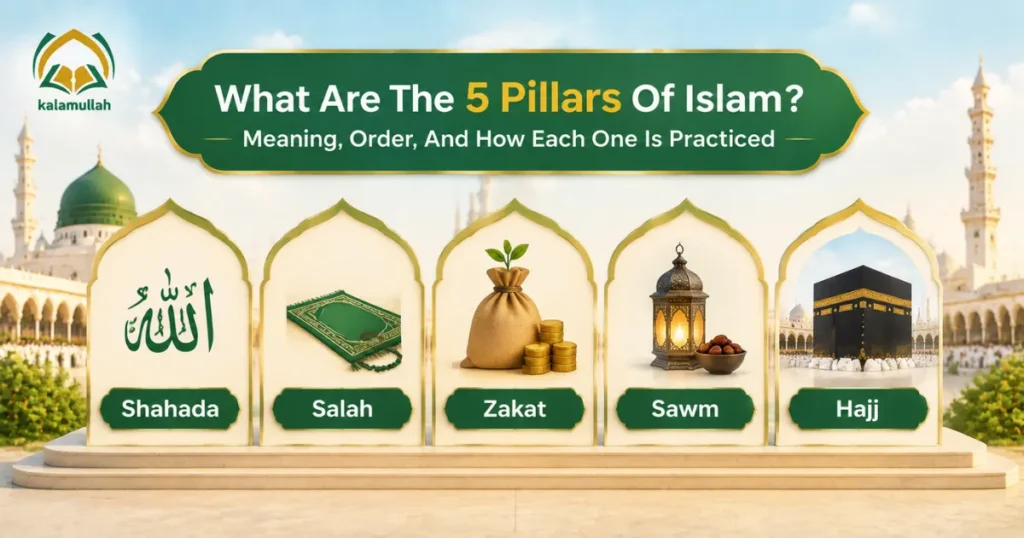
What are the 5 pillars of Islam? The answer comes from one short hadith: “Islam is built upon five.” These five acts are the testimony of faith, prayer, zakat, fasting in Ramadan, and pilgrimage to Makkah.
Together they form the visible structure of a Muslim’s worship. This guide covers the order the Prophet ﷺ gave them in, how often each pillar is due, who is excused, and the mistakes learners often make.
What you’ll learn in this article:
The full pillars of Islam list in its correct order, with the evidence for each.
What each pillar means and how Muslims practice it.
How often each pillar is required: daily, yearly, or once in a lifetime.
How the pillars of Islam differ from the pillars of faith (Iman).
Common misunderstandings about the 5 pillars of Islam.
What are the 5 pillars of Islam?
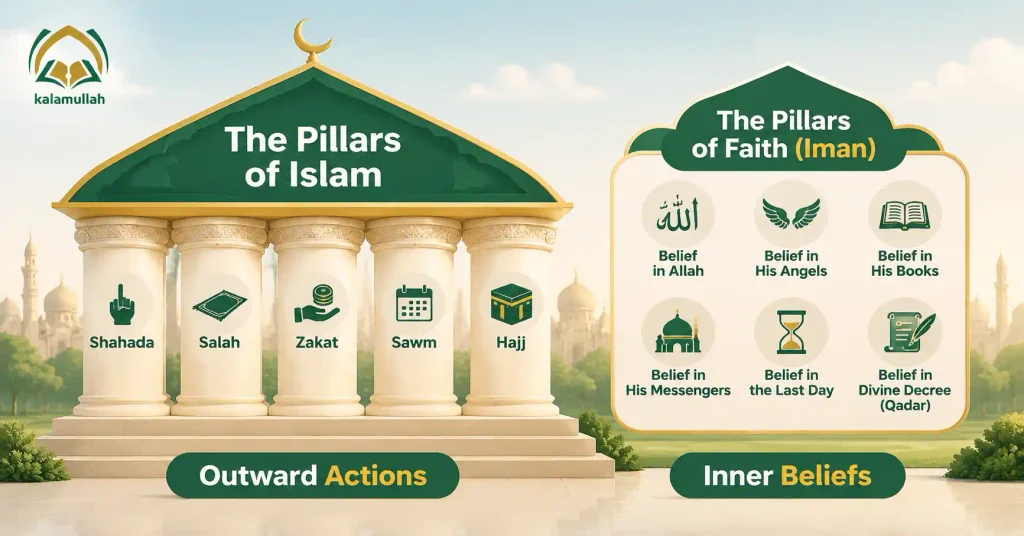
The 5 pillars of Islam are the five core acts of worship that Islam is built on: Shahada (declaring faith), Salah (prayer), Zakat (obligatory charity), Sawm (fasting in Ramadan), and Hajj (pilgrimage to Makkah). Every adult Muslim must fulfil them according to their ability.
The evidence is the hadith of Ibn Umar:
“Islam is built upon five: testifying that there is no god but Allah and that Muhammad is the Messenger of Allah, establishing prayer, giving zakat, Hajj, and fasting Ramadan” (Sahih al-Bukhari 8).
In Sahih Muslim, Ibn Umar confirmed the order as fasting first, then Hajj.
The same five also appear in the hadith of Jibril (Sunan an-Nasa’i 4990). Two ideas explain how they fit into the religion as a whole: what “pillar” means, and how these acts relate to faith in the heart.
What does “pillar” mean in Islam?
In Islam, a pillar (rukn) is an essential act that the religion cannot stand without. The Prophet ﷺ compared Islam to a building resting on five columns. Other good deeds are part of that building, but they depend on the columns. Neglecting any of the five weakens a Muslim’s whole religious practice.
How are the pillars of Islam different from the pillars of faith (Iman)?
The pillars of Islam are outward actions. The six pillars of faith (Iman) are inner beliefs: belief in Allah, His angels, His books, His messengers, the Last Day, and divine decree (Qadar).
When the word “Islam” or “Iman” is used alone, it includes the other. When the two are mentioned together, Islam refers to outward submission and Iman to belief in the heart. Allah says:
“۞ ..قَالَتِ ٱلْأَعْرَابُ ءَامَنَّا ۖ قُل لَّمْ تُؤْمِنُوا۟ وَلَـٰكِن قُولُوٓا۟ أَسْلَمْنَا وَلَمَّا يَدْخُلِ ٱلْإِيمَـٰنُ فِى قُلُوبِكُمْ ۖ” “Some of˺ the nomadic Arabs say, “We believe.” Say, ˹O Prophet,˺ “You have not believed. But say, ‘We have submitted'” (Al-Hujurat 49:14).
The five pillars of Islam in order: the complete pillars of Islam list
The five pillars of Islam follow a fixed order: Shahada, Salah, Zakat, Sawm, then Hajj. In Sahih Muslim (16), a man listed Hajj before fasting, and Ibn Umar corrected him:
“فَقَالَ رَجُلٌ الْحَجِّ وَصِيَامِ رَمَضَانَ قَالَ لاَ . صِيَامِ رَمَضَانَ وَالْحَجِّ . هَكَذَا سَمِعْتُهُ مِنْ رَسُولِ اللَّهِ صلى الله عليه وسلم” “No — fasting Ramadan, then Hajj. This is how I heard it from the Messenger of Allah ﷺ.No (it is not the Pilgrimage first) but the fasts of Ramadan precede the Pilgrimage.”
Anyone asking what are the 5 pillars of Islam in order can use the sequence below. Each pillar comes with its meaning, its evidence, and the practical details that matter.
1. Shahada: the declaration of faith
The Shahada is the testimony that “there is no god but Allah, and Muhammad is the Messenger of Allah” (Ashhadu an la ilaha illa Allah, wa ashhadu anna Muhammadan rasul Allah). It affirms that Allah alone deserves worship (Tawheed) and that Muhammad ﷺ is His Messenger.
The Shahada comes first because every other act of worship depends on it, and an act performed without this belief is not accepted. Saying it sincerely, with understanding, is how a person enters Islam.
2. Salah: the five daily prayers
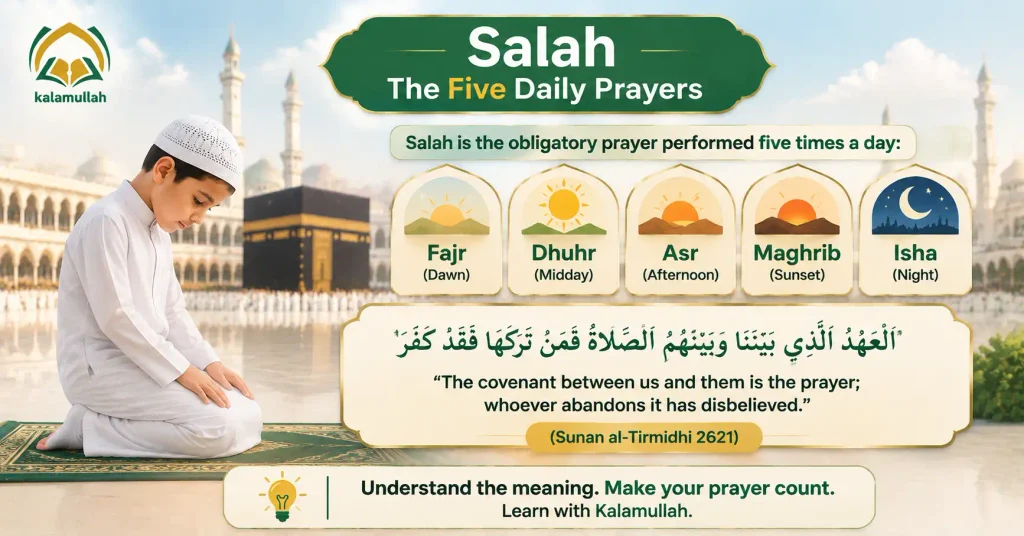
Salah is the obligatory prayer performed five times a day: Fajr (dawn), Dhuhr (midday), Asr (afternoon), Maghrib (sunset), and Isha (night). It is performed facing the Kaaba in Makkah and includes reciting Al-Fatiha, bowing (ruku’), and prostrating (sujud).
Prayer is the most important pillar after the Shahada. The Prophet ﷺ said:
“الْعَهْدُ الَّذِي بَيْنَنَا وَبَيْنَهُمُ الصَّلاَةُ فَمَنْ تَرَكَهَا فَقَدْ كَفَرَ” “The covenant between us and them is the prayer; whoever abandons it has disbelieved” (Sunan al-Tirmidhi 2621).
The other pillars come yearly or once in a lifetime, while prayer returns five times every day. If you want your prayer to go beyond memorised words, studying what you recite helps. Kalamullah offers guided learning that connects the words of the prayer to their meaning.
3. Zakat: obligatory charity
Zakat is a set portion of wealth that a Muslim gives each year to specific categories of people in need. The standard rate on savings is 2.5%. It is due only when wealth reaches the minimum threshold (nisab) and is held for one full lunar year (hawl).
The nisab is commonly calculated as the value of 85 grams of gold or 595 grams of silver. Allah pairs zakat with prayer throughout the Quran (Al-Bayyinah 98:5; At-Tawbah 9:5, 9:11; Al-Hajj 22:41). It comes right after prayer because its benefit reaches others as well as the giver.
Recite the Words of Allah With Confidence
Join Kalamullah Quran Academy for live 1-on-1 lessons with Al-Azhar-trained, Ijazah-holding tutors, from your first Qaida letter all the way to Ijazah.
Sawm is the act of worship in which a Muslim, with intention, stops eating, drinking, and marital relations from dawn until sunset throughout Ramadan. Allah says:
“يَـٰٓأَيُّهَا ٱلَّذِينَ ءَامَنُوا۟ كُتِبَ عَلَيْكُمُ ٱلصِّيَامُ كَمَا كُتِبَ عَلَى ٱلَّذِينَ مِن قَبْلِكُمْ لَعَلَّكُمْ تَتَّقُونَ ١٨٣” “O believers! Fasting is prescribed for you—as it was for those before you—so perhaps you will become mindful ˹of Allah” (Al-Baqarah 2:183).
The fast also covers behaviour. The Prophet ﷺ said:
People who are sick or travelling may break the fast and make up for the missed days later (Al-Baqarah 2:184).
5. Hajj: the pilgrimage to Makkah
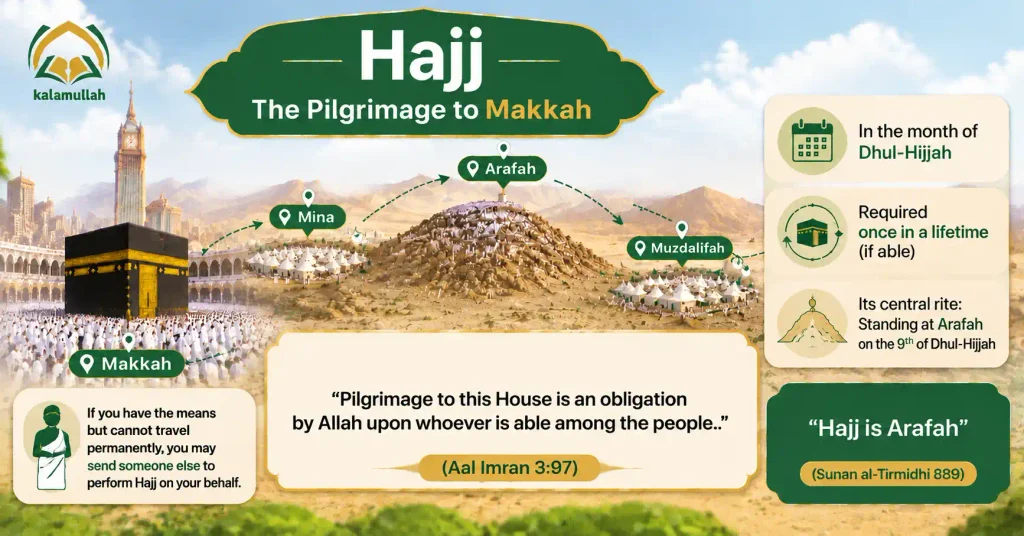
Hajj is the pilgrimage to Makkah to perform set rites in the month of Dhul-Hijjah. It is required once in a lifetime of every Muslim who is physically and financially able.
“وَلِلَّهِ عَلَى ٱلنَّاسِ حِجُّ ٱلْبَيْتِ مَنِ ٱسْتَطَاعَ إِلَيْهِ سَبِيلًا ۚ” “Pilgrimage to this House is an obligation by Allah upon whoever is able among the people..” (Aal Imran 3:97).
Its central rite is standing at Arafah on the 9th of Dhul-Hijjah, which is why the Prophet ﷺ said:
How often is each pillar required? A daily–yearly–lifetime map
Another way to answer what are the 5 pillars of Islam is by how often each one is due: daily, yearly, or once in a lifetime. Scholars also sort them by type: bodily worship (prayer, fasting), financial worship (zakat), and a combination of both (Hajj).
Pillar
Type of worship
How often
Who must do it
Shahada
Belief and speech
Once to enter Islam, then lived permanently
Everyone who becomes Muslim
Salah
Bodily
5 times daily
Every sane adult Muslim
Zakat
Financial
Once a year
Muslims whose wealth reaches the nisab for one lunar year
Sawm
Bodily
One month a year (Ramadan)
Healthy adult Muslims who are not travelling
Hajj
Bodily and financial
Once in a lifetime
Muslims who are physically and financially able
This map gives a practical rule: secure the daily pillar first, prepare for the yearly ones in advance, and plan for the lifetime one. A learner who prays consistently has the hardest part in place.
Common mistakes when learning the five pillars of Islam
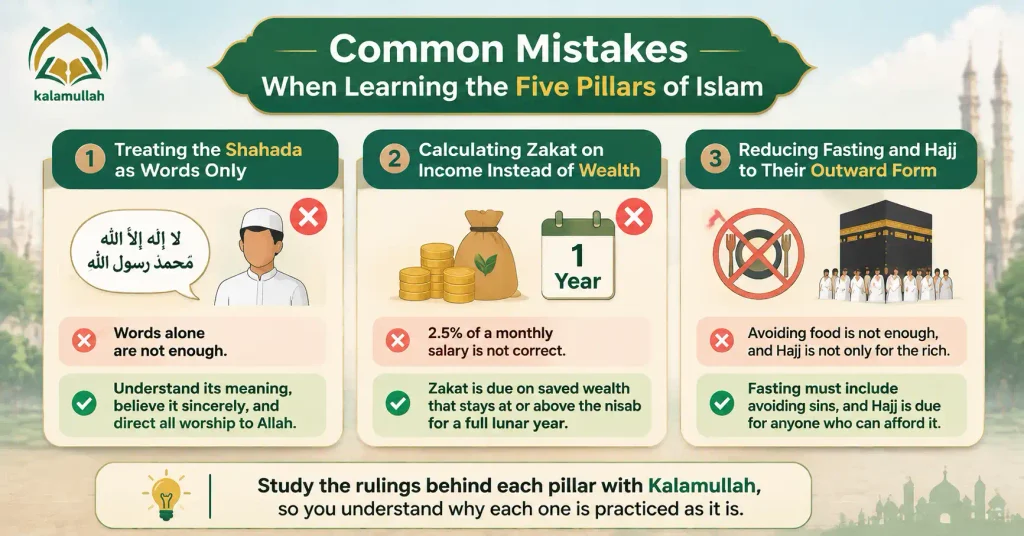
Many people who search what are the 5 pillars of Islam can recite the pillars of Islam list but misunderstand how individual pillars work. These three errors come up most often.
Treating the Shahada as words only: The Shahada does not take effect as a phrase alone. It requires knowing its meaning, believing it sincerely, and directing all worship to Allah alone.
Calculating zakat on income instead of saved wealth: A common error is paying 2.5% of a monthly salary. Zakat is due on wealth that stays at or above the nisab for a full lunar year, so the figure that counts is your qualifying savings on your zakat date.
Reducing fasting and Hajj to their outward form: A fast that avoids food but includes lying or arguing misses its purpose. Hajj is not only “for the wealthy.” It is due from anyone with the physical and financial ability, and that ability is assessed for each person.
Details like these are where self-study often falls short. With Kalamullah, you can study the rulings behind each pillar together with their evidence, so you understand why each one is practiced as it is.
Join Kalamullah Quran Academy for live 1-on-1 lessons with Al-Azhar-trained, Ijazah-holding tutors, from your first Qaida letter all the way to Ijazah.
Book your first class and build your practice on the five pillars
Knowing the list is the first step. Practicing each pillar correctly requires guidance on the prayer recitations, zakat calculations, and the details of fasting and Hajj.
Kalamullah offers structured Islamic learning to help you understand and practice each pillar with confidence. Start today and build your worship on a clear foundation.
So, what are the 5 pillars of Islam? They are Shahada, Salah, Zakat, Sawm, and Hajj, in that order, as the Prophet ﷺ taught and Ibn Umar confirmed. The Shahada is the foundation, prayer is the daily sign of commitment, zakat follows because it benefits others, and fasting and Hajj complete the structure.
The pillars follow a deliberate sequence and timescale: daily, yearly, and once in a lifetime. Understanding why each one is required, and from whom, turns a memorised list into a practice you can sustain.
Start with the pillar that comes back every day. Pray on time, learn the meaning of what you recite, and set aside your zakat when it falls due. The yearly and lifetime pillars are easier to keep once that daily foundation is in place.
FAQs about the 5 pillars of Islam
These are the questions people ask most often after learning what are the 5 pillars of Islam. Each answer is short and direct for quick reference.
1. What are the five pillars of Islam in order?
The five pillars of Islam in order are Shahada (declaration of faith), Salah (prayer), Zakat (charity), Sawm (fasting in Ramadan), and Hajj (pilgrimage). This order is confirmed in Sahih Muslim 16.
2. What is the most important pillar of Islam?
The Shahada is the most important pillar of Islam because every other act of worship depends on it. After the Shahada comes prayer, which the Prophet ﷺ described as the covenant that distinguishes believers from those who abandon it.
3. Are the 5 pillars of Islam mentioned in the Quran?
Yes, each of the 5 pillars of Islam is commanded in the Quran: prayer and zakat in Al-Bayyinah 98:5, fasting in Al-Baqarah 2:183, and Hajj in Aal Imran 3:97. Their grouping as “five pillars” comes from the authentic Sunnah.
4. How can children learn the 5 pillars of Islam?
Children learn the 5 pillars of Islam best through simple daily practice. Saying the Shahada, praying alongside parents, saving coins for charity, and trying short fasts are good starting points, supported by age-appropriate lessons.
5. Can a Muslim be excused from any of the pillars?
Yes, some pillars depend on ability. Zakat applies only when wealth meets the nisab, Hajj only applies to those who are able, and the sick or travelling may make up missed fasts later. The Shahada and prayer remain required of every sane adult Muslim.
 Islamic Studies