 2:45
Parent Progress Review (Live)
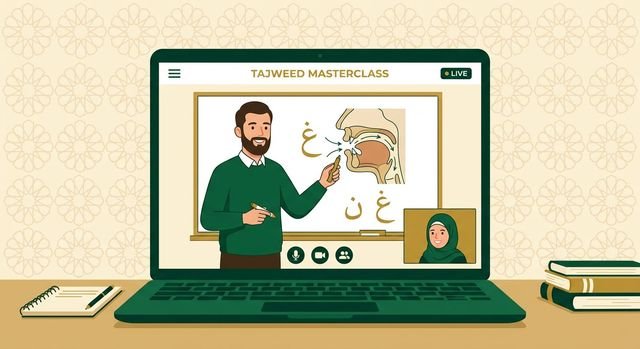
Live one-to-one lesson example.

Kalamullah’s Modern Standard Arabic course takes you from the alphabet and Harakat to reading unvoweled formal texts such as news articles. You study the trilateral root system, nominal and verbal sentences, core MSA vocabulary, and the grammar that governs written Arabic in media, education, and professional settings.
 6–9
Lessons are explained in English, so learners with no prior Arabic can start with confidence. A short placement assessment before enrollment puts you at the right starting point, so no lesson is spent on material you already know.
Lessons are explained in English, so learners with no prior Arabic can start with confidence. A short placement assessment before enrollment puts you at the right starting point, so no lesson is spent on material you already know.
Live one-on-one lessons mean your tutor hears every word you read and corrects pronunciation and grammar on the spot — before small errors become habits, a common problem for learners who study only with apps or books.
Every Kalamullah instructor teaching standard Arabic learning holds verified academic credentials, including Al-Azhar University graduates with extensive MSA teaching experience. Credentials are checked before any tutor joins the platform.
Kalamullah runs every MSA Arabic lesson as a private one-on-one session, not a group class. The instructor adapts pacing, corrects pronunciation in real time, and focuses entirely on the individual learner's current weaknesses rather than a fixed classroom average.
Kalamullah provides qualified female instructors for the Modern Standard Arabic course, available for sisters and women learners who prefer to study with a female teacher. Preference is recorded at enrollment and matched before the first session.
Kalamullah's Fusha Arabic course runs across a wide range of daily time slots, including early mornings and late evenings, so working adults can maintain consistent weekly sessions without rearranging professional or family commitments.
Kalamullah's Modern Standard Arabic course teaches vocabulary through the trilateral root system rather than isolated word lists. Learning how root patterns expand into related nouns, verbs, and adjectives accelerates MSA vocabulary retention significantly beyond standard memorization methods.
Book a free first class and we will identify the right level and next milestone.
Book a free trialEach phase of the Modern Standard Arabic online program builds directly on the previous, moving learners from script recognition to fluent formal reading in a clear sequence.
Learners begin by recognizing all 28 Arabic letters in their four positional forms: isolated, initial, medial, and final. Sound-position drills are used from the first session to prevent letter confusion that becomes difficult to correct at later stages.
Writing practice runs alongside recognition work so letter formation habits are correct from the start, not retrofitted after errors have already set in.
The Harakat — Fatha, Kasra, and Damma — together with Sukun, Shadda, and Tanwin, determine how every Arabic word is read aloud. Kalamullah gives this stage dedicated lessons before moving to vocabulary, preventing the reading errors that appear when it is rushed.
Learners who complete this phase read fully voweled MSA sentences accurately before moving on, rather than guessing vowels throughout intermediate study.
Vocabulary in the Modern Standard Arabic course is introduced through the trilateral root system. Learners study how roots like K-T-B (writing) and D-R-S (studying) expand into related nouns, verbs, and adjectives, building a large working vocabulary from a manageable set of core patterns.
High-frequency MSA words across pronouns, conjunctions, question words, and common nouns are prioritized so learners engage real texts as early as possible in the progression.
MSA grammar covers nominal sentences (Mubtada’ and Khabar, with no verb required) and verbal sentences (a verb and its subject, with an object when the verb needs one). The case system, I’rab, is introduced early so you understand why word endings change with grammatical function.
The three verb forms — past (al-Madi), present (al-Mudari’), and imperative (al-Amr) — are practiced side by side, so you learn to recognize how one verb changes across all three.
Reading fluency is developed across three graded text stages. Fully voweled short paragraphs come first, then partially voweled texts where grammar knowledge fills the gaps, then unvoweled formal MSA writing drawn from newspaper articles and structured academic material.
At each stage, pronunciation accuracy and comprehension are assessed by the instructor before the learner advances, ensuring no stage is completed without the fluency level needed to support the next.
Every outcome below is a demonstrable skill tested by the instructor, not a subject area covered. Kalamullah tracks each learner's progress against these benchmarks across the Modern Standard Arabic course.
Learners read and write all 28 Arabic letters in all four positional forms without hesitation. Letter recognition is tested through both isolated reading drills and connected text, confirming accuracy before vocabulary study begins.
Learners read fully voweled MSA sentences aloud accurately, applying Fatha, Kasra, and Damma correctly without prompting. This is assessed through cold reading of new voweled paragraphs not seen in prior sessions.
Learners identify the trilateral root of an unfamiliar MSA word and produce related nouns, verbs, and adjectives from the same root. Demonstrated through real-time derivation exercises rather than translation tasks alone.
Learners construct grammatically correct nominal and verbal sentences, applying I'rab case endings accurately. Assessed through written composition tasks using structures introduced during Fusha Arabic grammar sessions.
Advanced learners read unvoweled MSA newspaper excerpts and identify main ideas without relying on Harakaat markers. Comprehension is confirmed through instructor-led questions on passages not pre-studied in previous sessions.
You conjugate high-frequency MSA verbs in the past, present, and imperative across persons, genders, and singular, dual, and plural forms, demonstrated through live substitution drills rather than static fill-in-the-blank exercises.
live one-on-one session.
Short class snippets show how the teacher explains, listens, corrects and confirms progress.
2:45Live one-to-one lesson example.
 2:45
Live one-to-one lesson example.
 2:45
Live one-to-one lesson example.
Unscripted words from the people who took the course — recorded after their final class.
“Live correction made my recitation clearer and gave me a practical path to keep improving.”
“Live correction made my recitation clearer and gave me a practical path to keep improving.”
“Live correction made my recitation clearer and gave me a practical path to keep improving.”
Teacher language, speciality and availability are considered before the regular schedule starts.
Read what adult learners say about their lessons with Kalamullah tutors.
“The teacher gives clear correction and a practical next step every week.”
“The teacher gives clear correction and a practical next step every week.”
“The teacher gives clear correction and a practical next step every week.”
See measurable examples from learners who started at different levels.
Follows a weekly target and muraja’ah plan independently.
Applies core rules naturally with fewer corrections.
Reads short surahs with stronger fluency and confidence.
Compare nearby routes before choosing the best starting point.
BeginnerBeginnerBeginnerUnderstand recurring Quranic vocabulary and sentence patterns.
View courseBeginnerUnderstand recurring Quranic vocabulary and sentence patterns.
View courseBeginnerUnderstand recurring Quranic vocabulary and sentence patterns.
View courseA quick answer to the questions that come up most often before someone books their first trial class — a mix of questions specific to this course and questions about the academy as a whole.
Yes. Kalamullah places learners at the correct entry level through a brief pre-enrollment assessment. Complete beginners start at the Arabic alphabet and Harakaat stage with no prior knowledge required.
Kalamullah's Modern Standard Arabic course is designed for adult learners and older teens. Younger learners should inquire directly, as instructor matching depends on the student's current level and prior Arabic exposure.
Yes. Female Arabic tutors are available. Your preference is recorded at enrollment and confirmed before your first lesson is scheduled.
Kalamullah schedules sessions across mornings, evenings, and weekends to accommodate learners in different time zones and working hours. Session times are agreed at enrollment based on the learner's availability.
Instructors assess each learner against defined benchmarks at every stage of the Modern Standard Arabic course, covering reading accuracy, vocabulary retention, grammar application, and pronunciation before advancing to the next level.
Modern Standard Arabic is the formal Arabic used today in news, books, and official communication across the Arab world. Classical Arabic is the older form found in the Quran and classical literature; it shares MSA’s grammar but uses older vocabulary and style. Dialects such as Egyptian Arabic are the everyday spoken languages of each country. This course focuses on MSA; for Classical texts or a spoken dialect, see our Fusha and Egyptian Arabic courses.
Book the free first class. We will check level, match the teacher and show the next milestone.
7 free trial spots remaining this week
Choose the weekly frequency that fits the learner after the free trial.