 2:45
Parent Progress Review (Live)
Live one-to-one lesson example.

Kalamullah's Arabic course for beginners takes students from core everyday vocabulary and correct pronunciation through gender, pronouns, simple sentences, and basic verbs, straight to reading, writing, and speaking short passages in Modern Standard Arabic.
 6–9
Kalamullah's Arabic classes for beginners cover core vocabulary for daily life, correct pronunciation, greetings and introductions, masculine and feminine nouns, singular and plural, pronouns and demonstratives, simple nominal and verbal sentences, the present and past verb, and question words, before moving to reading, writing, and discussing short texts on familiar topics.
This course is designed for students who can already read the Arabic letters with vowel marks, through Kalamullah's Arabic Alphabet course or elsewhere, but have never studied the language itself.
Kalamullah teaches Arabic for beginners as a language to use, not a list of rules to memorize. Every lesson combines new words, simple grammar, and speaking practice, so beginners hear and use Arabic from the very first session.
Every teacher assigned to this course has formal study in Arabic and experience teaching beginners. Credentials are verified before assignment, so pronunciation and usage are modeled correctly from the first session.
Kalamullah's Arabic lessons for beginners start with vocabulary for greetings, family, home, school, work, and daily routines. Students use every new word in short sentences during the same lesson, so it is remembered rather than forgotten.
Every beginner lesson at Kalamullah is private, so the teacher adjusts the pace to each student. Errors in pronunciation or sentence building are corrected in the moment, and difficult points are repeated until they are clear.
Kalamullah provides qualified female Arabic teachers for students who prefer or require a same-gender teacher. The preference is selected at registration and honored from the trial session onward, with no change to scheduling or lesson content.
Kalamullah's beginner curriculum moves from vocabulary to grammar, verbs, and short texts in a fixed order. No step is skipped, and the teacher confirms each one is applied correctly, not simply covered, before the student advances.
Book a free first class and we will identify the right level and next milestone.
Book a free trialEach module builds directly on the previous one, giving beginners a clear path from their first Arabic words to reading and discussing short texts.
The course opens with a short check of the student's reading of voweled Arabic and any words they already know. The teacher uses this to confirm readiness and set a comfortable starting pace.
Students who cannot yet read the letters confidently are guided to strengthen their reading first, since every lesson uses written Arabic.
Students learn essential vocabulary for greetings, introductions, family, home, and daily routines, with focus on pronouncing each word correctly. New words are practiced in short spoken exchanges with the teacher.
By the end of this module, students introduce themselves and talk about their family in simple Arabic.
The teacher introduces masculine and feminine nouns, singular and plural, pronouns, demonstratives, and the simple nominal sentence. Every rule is explained in English and practiced immediately in speaking and writing.
Students build their own short sentences with each rule until they form them correctly without prompting.
Students learn the present and past verb for common pronouns, question words, and the simple verbal sentence. Each is practiced in everyday conversations about routines, places, and activities.
The teacher reviews each point in conversation before moving on, so beginners speak with growing confidence.
The final module brings every skill together. Students read short texts on familiar topics, answer questions about them in Arabic, and write short paragraphs of their own.
At the close of this module, students use basic Arabic in speaking, reading, and writing and are ready for the next level of Kalamullah's Arabic Language course.
Every outcome below is something the student can demonstrate to their Kalamullah teacher by the end of the Arabic Language course for beginners, not simply a topic that was covered during sessions.
Students greet, introduce themselves, and talk about their family and daily routine in Arabic.
This is assessed in a live conversation with the teacher.
Students pronounce core vocabulary clearly, including letters that do not exist in English.
They read short sentences aloud with understandable pronunciation.
Students use masculine and feminine nouns, singular and plural, and the correct pronouns.
They match demonstratives to their nouns without teacher prompting.
Students build simple nominal and verbal sentences on everyday topics.
They use present and past verbs correctly for common pronouns.
Students ask and answer questions using the main Arabic question words.
They keep a short conversation going on familiar topics.
Students read a short text on a familiar topic and write a short paragraph of their own.
This is the measurable endpoint of the beginner course at Kalamullah.
Watch real Kalamullah beginner lessons below and see how students speak Arabic from their very first class.
Short class snippets show how the teacher explains, listens, corrects and confirms progress.
2:45Live one-to-one lesson example.
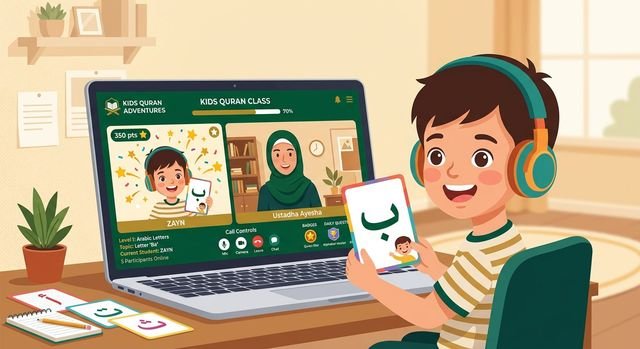 2:45
Live one-to-one lesson example.
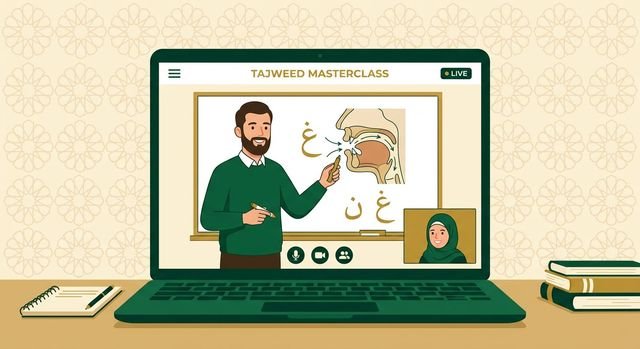 2:45
Live one-to-one lesson example.
Unscripted words from the people who took the course — recorded after their final class.
“Live correction made my recitation clearer and gave me a practical path to keep improving.”
“Live correction made my recitation clearer and gave me a practical path to keep improving.”
“Live correction made my recitation clearer and gave me a practical path to keep improving.”
Teacher language, speciality and availability are considered before the regular schedule starts.
Read what beginners and parents say about learning Arabic with Kalamullah before booking your free trial class.
“The teacher gives clear correction and a practical next step every week.”
“The teacher gives clear correction and a practical next step every week.”
“The teacher gives clear correction and a practical next step every week.”
See measurable examples from learners who started at different levels.
Follows a weekly target and muraja’ah plan independently.
Applies core rules naturally with fewer corrections.
Reads short surahs with stronger fluency and confidence.
Compare nearby routes before choosing the best starting point.
BeginnerBeginnerBeginnerUnderstand recurring Quranic vocabulary and sentence patterns.
View courseBeginnerUnderstand recurring Quranic vocabulary and sentence patterns.
View courseBeginnerUnderstand recurring Quranic vocabulary and sentence patterns.
View courseA quick answer to the questions that come up most often before someone books their first trial class — a mix of questions specific to this course and questions about the academy as a whole.
Students should be able to read Arabic letters with vowel marks. Those who cannot yet read them are advised to begin with Kalamullah's Arabic Alphabet course first.
Yes. Children and adults both enroll in the course. Teachers adjust the pace, topics, and session activities to suit younger learners.
If you can read Arabic letters but cannot yet understand or build simple sentences, this level fits you. Your free trial includes a short check to confirm your starting point.
Students continue to the next level of Kalamullah's Arabic Language course, which builds grammar, conversation, and reading of longer authentic texts.
Yes. Kalamullah provides qualified female Arabic teachers for sisters and girls. The preference is confirmed at registration and matched before the free trial session is booked.
Yes. Kalamullah reschedules sessions without penalty when genuine conflicts arise, with morning, afternoon, and evening slots available seven days a week across all time zones.
Book the free first class. We will check level, match the teacher and show the next milestone.
7 free trial spots remaining this week
Choose the weekly frequency that fits the learner after the free trial.