 2:45
Parent Progress Review (Live)
Live one-to-one lesson example.

You can define Ikhfa, list the letters of Qalqalah, and explain every type of Madd, yet when you open a page you have never recited, the mistakes return. That gap between knowing Tajweed and doing it is exactly what this course closes.
Kalamullah's Amli Tajweed course is almost entirely recitation: you recite, your teacher pinpoints each error, you drill it, and you recite again until the correction holds on any page.
 6–9
Instead of new theory, the course is built on Tajweed application. It starts with a diagnostic test of your recitation, then moves into targeted Tajweed error correction for each mistake you make. Tajweed practice exercises cover Makharij, Noon and Meem rules, Madd, Qalqalah, Tafkheem, and Waqf, followed by continuous recitation of unseen pages from across the Quran and module tests that measure your progress.
Kalamullah designed this practical Tajweed course for students who have already studied the rules, in a Tajweed course or on their own, but cannot yet apply them reliably. If you understand the theory but your recitation does not reflect it, this course is where knowledge becomes habit.
Reading about Tajweed does not change how you recite. Correction does. Kalamullah spends almost every minute of the lesson on your recitation, targets the errors you actually make, and tests you on pages you have never practiced.
Every Kalamullah Quran teacher holds a recognized Tajweed certification, and many hold an Ijazah with a connected chain. Teachers on this course are experienced in identifying and correcting recitation errors, and credentials are verified before assignment. .
No two students make the same mistakes. Kalamullah's teachers design Tajweed practice exercises around your personal error log, so every drill fixes something you actually get wrong.
Every lesson at Kalamullah is private, so the time is spent on your voice, not on others. The teacher stops each error, demonstrates the correction, and has you repeat until it is right.
Kalamullah provides qualified female Tajweed teachers for students who prefer or require a same-gender teacher. The preference is selected at registration and honored from the first session onward, with no change to scheduling or lesson content.
Each module ends with a Tajweed test on unseen pages, compared against your first diagnostic test. You see exactly which errors are gone and which still need work.
Book a free first class and we will identify the right level and next milestone.
Book a free trialEach module targets a group of errors, drills them, and tests Tajweed application on unseen pages before moving on.
The course opens with a recitation test on pages from different parts of the Quran. The teacher records every error by type, letter, rule, length, or stop, in your personal error log.
This log becomes the plan for the whole course, so every module targets the mistakes you actually make.
Errors in Makharij and Sifat are corrected first, since they affect every word. The teacher drills each weak letter in isolation, in words, and in full ayat.
Each letter is retested on unseen text before it is marked as corrected in the log.
Students work through Tajweed practice exercises on Noon and Meem Sakinah, Ghunnah, Madd, Qalqalah, and Tafkheem, focusing on the rules that appear most often in their error log.
Exercises move from marked passages to unmarked ones, so students learn to spot each rule on their own.
Students recite full pages they have not practiced while the teacher tracks errors in real time. Students are also trained to catch and correct their own mistakes.
This builds the reliability needed to recite any page of the Quran correctly.
The course closes with a full Tajweed test on unseen pages, compared directly with the first diagnostic test.
At the close of this module, students see their progress clearly and are ready for Kalamullah’s Intermediate Tajweed, Advanced Tajweed, or Tarteel courses, depending on their level.
Every outcome below is something the student can demonstrate to their Kalamullah teacher by the end of the course, not simply a topic that was covered during sessions.
Students recite without the errors recorded in their first diagnostic test.
Each correction is confirmed by retesting on unseen text.
Students pronounce weak letters correctly in words and full ayat, not only in isolation.
This is assessed in live recitation of unfamiliar pages.
Students identify where each Tajweed rule applies in unmarked text.
They apply it correctly before the teacher points it out.
Students hold every Madd and Ghunnah at its correct length across a full page.
Lengths stay consistent from the first ayah to the last.
Students notice and correct their own errors while reciting.
They repeat the word correctly without the teacher stopping them.
Students recite unseen pages with every error in their log marked as corrected, compared directly with their first diagnostic test.
This measurable improvement is the endpoint of the course at Kalamullah.
See real Kalamullah practical sessions below and watch how each error is caught, drilled, and fixed.
Short class snippets show how the teacher explains, listens, corrects and confirms progress.
2:45Live one-to-one lesson example.
 2:45
Live one-to-one lesson example.
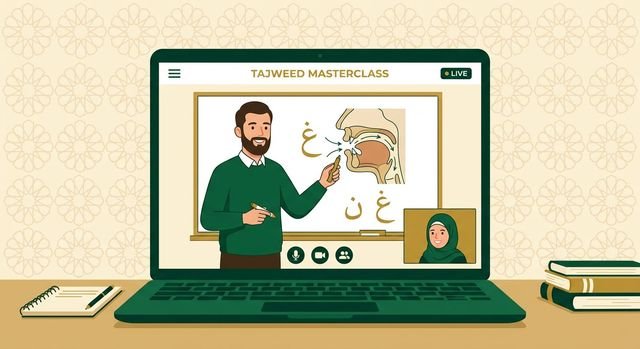 2:45
Live one-to-one lesson example.
Unscripted words from the people who took the course — recorded after their final class.
“Live correction made my recitation clearer and gave me a practical path to keep improving.”
“Live correction made my recitation clearer and gave me a practical path to keep improving.”
“Live correction made my recitation clearer and gave me a practical path to keep improving.”
Teacher language, speciality and availability are considered before the regular schedule starts.
What Students Say About the Practical Tajweed Course
“The teacher gives clear correction and a practical next step every week.”
“The teacher gives clear correction and a practical next step every week.”
“The teacher gives clear correction and a practical next step every week.”
See measurable examples from learners who started at different levels.
Follows a weekly target and muraja’ah plan independently.
Applies core rules naturally with fewer corrections.
Reads short surahs with stronger fluency and confidence.
Compare nearby routes before choosing the best starting point.
BeginnerBeginnerUnderstand recurring Quranic vocabulary and sentence patterns.
View courseBeginnerBeginnerUnderstand recurring Quranic vocabulary and sentence patterns.
View courseBeginnerA quick answer to the questions that come up most often before someone books their first trial class — a mix of questions specific to this course and questions about the academy as a whole.
Yes. The course focuses on application, not theory, so you should already know the main rules. Students who have not studied them are advised to take Kalamullah's Beginner Tajweed Course first.
If you already know the rules for your level but still make mistakes when reciting, especially on unfamiliar pages, this course fits you. If there are rules you haven’t studied yet, the Intermediate Tajweed Course is the better fit. Your free diagnostic session includes a short Tajweed test to confirm.
You recite pages you have not practiced, and the teacher records every error by type. The results are compared with your earlier tests to show your progress.
A regular Tajweed course teaches the rules. The Amli Tajweed course teaches no new rules: it assumes you know them and spends almost all lesson time on recitation, error correction, and testing, built around your personal error log.
Yes. Kalamullah provides qualified female Tajweed teachers for sisters and girls. The preference is confirmed at registration and matched before the free session is booked.
Yes. Sessions can be rescheduled when genuine conflicts arise, with morning, afternoon, and evening slots available seven days a week across all time zones.
Book the free first class. We will check level, match the teacher and show the next milestone.
7 free trial spots remaining this week
Choose the weekly frequency that fits the learner after the free trial.