 2:45
Parent Progress Review (Live)
Live one-to-one lesson example.

Kalamullah’s Quran Recitation Course for Beginners is built for students who cannot yet read a single Arabic letter. Live one-on-one sessions take you from the Arabic alphabet and correct pronunciation through the Noorani Qaida, then into your first Tajweed rules once you can read words on your own.
Every student advances at their own pace, with a tutor listening and correcting in real time so no error becomes a habit. Children, teenagers, and adults all start from exactly where they are, with no prior knowledge required.
 6–9
Kalamullah’s Quran Recitation Course for Beginners takes students from Arabic letter recognition all the way to reading directly from the Mushaf. The curriculum moves through correct Makharij, the Noorani Qaida’s joined letters and vowel marks, and then the core Tajweed rules, including Ghunnah, Ikhfaa and Qalqalah, along with Madd and Waqf signs.
Instruction is delivered in English, so the course is fully accessible to students with no Arabic background. It’s designed for complete beginners who have never opened a Mushaf; students who already read and mainly want to correct their Tajweed are better placed in the Quran Recitation Course.
Kalamullah’s beginner recitation course is taught one-on-one, with every student’s Makharij and Tajweed corrected live in each session.
Every tutor on this course holds an Ijazah in Quranic recitation granted by qualified scholars, authorizing them to teach recitation with Tajweed.
A mispronounced letter practiced repeatedly becomes a habit that is far harder to unlearn. Kalamullah's live format means the tutor hears every sound and corrects it immediately, before it can embed. Students never carry errors forward from one lesson to the next.
Female students and families who prefer a female teacher can request one at enrollment with no additional steps. Kalamullah maintains a roster of qualified female tutors holding the same Ijazah credentials as their male counterparts, available across morning and evening sessions.
Kalamullah offers sessions across seven days a week, including early mornings and late evenings, so working adults and school-age children can both find a consistent slot. The Quran Recitation Course for Beginners fits around existing commitments rather than competing with them.
Kalamullah's beginner curriculum isolates each articulation point and drills it before introducing the next rule. Students cover Makharij, Ghunnah, Ikhfaa, Idgham, Qalqalah, Madd types, and Waqf signs in a fixed sequence that prevents confusion between similar rules.
Book a free first class and we will identify the right level and next milestone.
Book a free trialEvery session follows a clear, repeating structure that moves students forward without leaving gaps in their foundation.
The Quran Recitation Course for Beginners opens with the Arabic alphabet. Each letter is taught with its correct Makharij, the precise point in the mouth or throat from which the sound originates.
A letter learned with the wrong articulation point will sound wrong in every word it appears in. Kalamullah tutors spend the time needed here before moving forward, ensuring the foundation holds.
Students then learn Harakaat, the short vowel marks, followed by Tanween and longer vowel sounds. With these in place, two and three letter combinations become readable.
Progress at this stage tends to feel quick. Letters the student already knows begin forming recognizable syllables, and reading starts to feel real rather than mechanical.
Arabic letters change shape depending on their position within a word. Kalamullah uses the Noorani Qaida to build this skill methodically, introducing each connected form in the correct order before the student opens the Mushaf.
Skipping this stage is the most common reason beginners stall when they try to read verses. The Noorani Qaida closes that gap entirely.
Once students can join letters and read words reliably, Kalamullah introduces Tajweed rules gradually during live Mushaf reading.
Rules covered include Ghunnah, Ikhfaa, Idgham, Iqlab, Qalqalah, Madd types, and Waqf stopping signs.
Each rule is first explained, then drilled in isolation, then applied directly to verses the student is reading. No rule is introduced until the previous one is stable.
Every session opens with a short review of the previous class. New material is only introduced after the tutor has confirmed what came before is solid. Students receive a small amount of home practice to do between sessions.
This loop, reviewed in each lesson and reinforced between sessions, is what turns weekly classes into steady, compounding progress. Consistency across two or three sessions a week produces faster results than a single long session every fortnight.
Each outcome below is a skill the student can demonstrate to their tutor, not simply a topic covered in sessions.
Students can produce each of the twenty-eight Arabic letters from the correct Makharij without prompting. Each sound is tested by the tutor in isolation and within words before the student moves to the next stage of the Quran Recitation Course for Beginners.
Students can open the Mushaf and read an unfamiliar page aloud without transliteration or letter-by-letter help. This milestone marks the end of the Noorani Qaida phase and the start of sustained Mushaf reading.
Students apply Ghunnah, Ikhfaa, Idgham, Iqlab, and Qalqalah correctly during live recitation, not just in drills. The tutor verifies each rule is applied consistently across different Surahs before marking it as mastered within the Quran Recitation Course for Beginners.
Students recognize and apply the different Madd lengths and observe correct Waqf stopping signs during recitation. Madd keeps each vowel at its proper length, and Waqf protects the meaning of the verse, which is why both are verified rather than treated as extras.
Students read letters in their initial, medial, and final positions without pausing to identify which form they are looking at. This skill, built through the Noorani Qaida, is what allows students to read at a natural pace rather than decoding each word character by character.
Students read words carrying all short vowel marks and Tanween endings accurately and without hesitation. Kalamullah tutors test this through unprepared reading of new Mushaf pages, confirming the skill transfers beyond memorized passages the student has seen before.
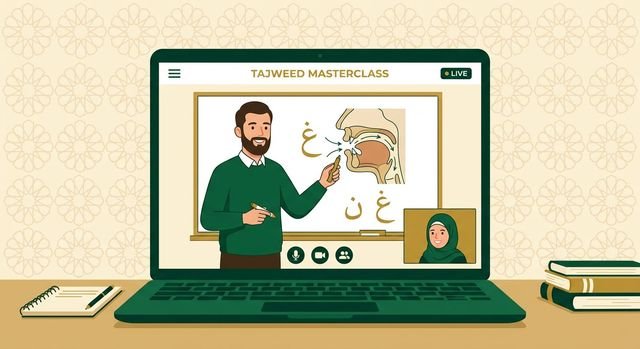
Watch real Kalamullah sessions below to see exactly what a beginner lesson looks like.
Short class snippets show how the teacher explains, listens, corrects and confirms progress.
2:45Live one-to-one lesson example.
 2:45
Live one-to-one lesson example.
 2:45
Live one-to-one lesson example.
Unscripted words from the people who took the course — recorded after their final class.
“Live correction made my recitation clearer and gave me a practical path to keep improving.”
“Live correction made my recitation clearer and gave me a practical path to keep improving.”
“Live correction made my recitation clearer and gave me a practical path to keep improving.”
Teacher language, speciality and availability are considered before the regular schedule starts.
Read what students and parents say about starting their recitation with Kalamullah.
“The teacher gives clear correction and a practical next step every week.”
“The teacher gives clear correction and a practical next step every week.”
“The teacher gives clear correction and a practical next step every week.”
See measurable examples from learners who started at different levels.
Follows a weekly target and muraja’ah plan independently.
Applies core rules naturally with fewer corrections.
Reads short surahs with stronger fluency and confidence.
Compare nearby routes before choosing the best starting point.
BeginnerUnderstand recurring Quranic vocabulary and sentence patterns.
View courseBeginnerBeginnerBeginnerUnderstand recurring Quranic vocabulary and sentence patterns.
View courseBeginnerUnderstand recurring Quranic vocabulary and sentence patterns.
View courseA quick answer to the questions that come up most often before someone books their first trial class — a mix of questions specific to this course and questions about the academy as a whole.
It depends on your reading. If you still sound out words letter by letter, this course is the right start. If you read words smoothly and mainly want to fix your Tajweed, the Quran Recitation Course will be a better fit.
Kalamullah teaches children from around age four, teenagers, and adults of all ages. Each age group learns the same letter-to-Mushaf sequence at a pace and session length suited to them.
Yes. Kalamullah provides qualified female tutors for the Quran Recitation Course for Beginners. Families and female students can request a female tutor at enrollment and the match is arranged without delay.
Kalamullah offers slots across seven days a week including early mornings and late evenings, covering students in every major time zone. Session times are confirmed at enrollment around the student's own schedule.
Tutors send written monthly reports comparing each student's current recitation performance against previous sessions. The Quran Recitation Course for Beginners tracks which letters, vowels, and Tajweed rules have been mastered and which need further work.
Complete the enrollment form on this page and select the free trial option. Kalamullah will confirm a session time within one business day, with no payment required before the trial class takes place.
Book the free first class. We will check level, match the teacher and show the next milestone.
7 free trial spots remaining this week
Choose the weekly frequency that fits the learner after the free trial.