 2:45
Parent Progress Review (Live)
Live one-to-one lesson example.

Kalamullah offers a structured Quran Reading Course for children and adults at every level. Whether you’re still learning how to read Quran from the first letter or want to polish the skills you already have, a short placement session decides where you start, and your tutor guides you step by step toward confident, accurate recitation.
 6–9
The Quran Reading Course at Kalamullah takes students from the Arabic alphabet to fluent Quranic recitation. Along the way, students work through the Noorani Qaida, the vowel marks (Harakaat, Tanween, Sukoon and Shaddah), correct letter articulation (Makharij), the core Tajweed rules, and where to stop and pause (Waqf), all in live private sessions with a dedicated tutor.
Kalamullah's Quran reading classes accept complete beginners with no prior Arabic background. Instruction is delivered in English, making it accessible to students worldwide who want to learn to read Quran correctly without needing any foundation in the Arabic language beforehand.
Kalamullah's Quran Reading Course pairs each student with a single certified tutor who tracks every lesson, corrects pronunciation in real time, and advances the student only when Makharij and Tajweed accuracy meet the required standard.
Every tutor teaching the Quran Reading Course at Kalamullah is a native Arabic speaker holding institutional Tajweed certification. Credentials are verified before any tutor is assigned, ensuring students receive accurate Makharij correction from the first session.
Students confirm their local time zone at signup, and Quran reading classes run seven days a week with morning, afternoon and evening slots. Early-morning and late-evening times are available for learners whose work or school hours leave little midday availability, and sessions can be rescheduled when genuine conflicts arise.
Female students and families who prefer a Sheikha for their daughters can request a female tutor at enrollment. Kalamullah maintains a dedicated pool of certified female Quran tutors assigned exclusively to sisters and girls enrolled in the Quran Reading Course.
Every new student begins with a short placement session in which the tutor listens to how they currently read. Complete beginners start with the Arabic alphabet, while students who already read are placed at the stage that matches their level instead of repeating what they know.
The course moves from letter recognition through Harakaat, Tanween, Madd, Ghunnah, the Noon and Meem Sakinah rules, Qalqalah and Waqf in a fixed order. Students only advance once the tutor has documented that the current stage is mastered, so no gap is carried into the next one.
Book a free first class and we will identify the right level and next milestone.
Book a free trialEach stage builds directly on the previous one, giving students a clear, measurable path from first letter to fluent recitation.
Students begin with the Arabic alphabet, learning each letter's name, written form, and precise articulation point. The tutor drills Makharij al-Huroof until the student produces each sound correctly in isolation and in connected speech.
Letter recognition covers all positional forms, initial, medial, and final, so students can identify letters in the Mushaf before moving to vowelized reading.
Harakaat, Tanween, Sukoon, and Shaddah are introduced systematically through Noorani Qaida exercises. The tutor reads each example aloud and the student repeats, with immediate correction applied to any vowel inaccuracy.
Connecting letters with full vocalization follows, building the student's ability to read short Quranic words fluently before progressing to longer passages.
Core Tajweed rules are introduced one at a time: the Noon Sakinah and Tanween rules (Izhar, Idgham, Iqlab and Ikhfaa), the Meem Sakinah rules, Ghunnah, Qalqalah and Madd lengths. Each rule is applied directly to Quranic ayat so the student hears and produces it in context.
Students learn to recognize Waqf symbols in the Mushaf and understand which stopping positions are obligatory, permissible, or preferred. The tutor identifies common errors students make at verse boundaries and corrects them in live practice.
Correct Waqf application is assessed during longer passage readings from Juz Amma, giving the student direct experience reading consecutive ayat with proper pausing before advancing further.
Students read full Surahs and extended passages under timed recitation conditions. The tutor assesses fluency, Tajweed accuracy, Makharij correctness, and Waqf application together to identify any remaining weak points before the student is confirmed as having completed the course.
A final recorded recitation assessment confirms the student's readiness. Students who meet the standard receive written confirmation from Kalamullah that they have completed the Quran Reading Course.
Each outcome below is a skill the student can demonstrate to their tutor at the end of the Quran Reading Course, not simply a topic that was covered during sessions.
Students can identify and pronounce all 28 Arabic letters in their isolated, initial, medial, and final forms, reading them correctly from the Mushaf without hesitation or confusion between visually similar letters.
Students produce each letter from its verified articulation point, distinguishing between letters that share similar sounds, such as Ḥaa (ح) and Haa (ه), Seen (س) and Ṣaad (ص), and Taa (ت) and Ṭaa (ط), as assessed directly by the tutor in live recitation drills.
Students read fully vowelized Quranic text applying Harakaat, Tanween, Sukoon and Shaddah correctly, producing short and long vowels at the accurate length without the tutor needing to prompt or correct.
Students apply the Noon and Meem Sakinah rules, Ghunnah, Qalqalah and Madd lengths correctly during continuous Quranic recitation, demonstrating consistent rule use across unfamiliar ayat rather than only in practiced passages.
Students identify required, preferred, permissible and prohibited stopping positions in the Mushaf and stop or continue recitation accordingly, demonstrating correct Waqf decisions across a minimum of one full Juz during assessed reading sessions.
Students recite consecutive Quranic ayat fluently with correct Tajweed, Makharij, and Waqf applied simultaneously, meeting the standard required for Kalamullah's written course completion confirmation at the final assessed recitation.
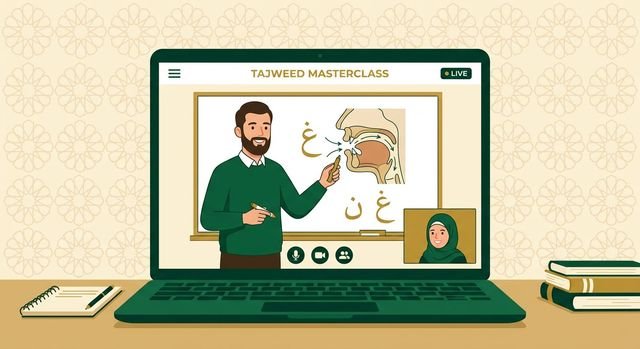
Watch how a live one-on-one lesson actually runs, from letter correction to Tajweed practice.
Short class snippets show how the teacher explains, listens, corrects and confirms progress.
2:45Live one-to-one lesson example.
 2:45
Live one-to-one lesson example.
 2:45
Live one-to-one lesson example.
Unscripted words from the people who took the course — recorded after their final class.
“Live correction made my recitation clearer and gave me a practical path to keep improving.”
“Live correction made my recitation clearer and gave me a practical path to keep improving.”
“Live correction made my recitation clearer and gave me a practical path to keep improving.”
Teacher language, speciality and availability are considered before the regular schedule starts.
Read what students and parents say about learning to read Quran with Kalamullah.
“The teacher gives clear correction and a practical next step every week.”
“The teacher gives clear correction and a practical next step every week.”
“The teacher gives clear correction and a practical next step every week.”
See measurable examples from learners who started at different levels.
Follows a weekly target and muraja’ah plan independently.
Applies core rules naturally with fewer corrections.
Reads short surahs with stronger fluency and confidence.
Compare nearby routes before choosing the best starting point.
BeginnerUnderstand recurring Quranic vocabulary and sentence patterns.
View courseBeginnerBeginnerBeginnerUnderstand recurring Quranic vocabulary and sentence patterns.
View courseBeginnerUnderstand recurring Quranic vocabulary and sentence patterns.
View courseA quick answer to the questions that come up most often before someone books their first trial class — a mix of questions specific to this course and questions about the academy as a whole.
Yes. Kalamullah's Quran Reading Course starts from the Arabic alphabet with no prior knowledge required. Students who cannot yet recognize any Arabic letters begin at the Noorani Qaida stage and progress from there.
Children as young as four can begin the Quran Reading Course at Kalamullah. Tutors assigned to young learners use age-appropriate pacing and short session formats suited to a child's attention and learning ability.
Kalamullah has certified female tutors available for sisters and girls enrolled in the Quran Reading Course. Families select a female tutor at the time of registration and the preference is honored from the first session onward.
Sessions can be rescheduled with reasonable notice when genuine conflicts arise, in line with Kalamullah’s rescheduling policy.
Each tutor records the student's Tajweed accuracy, Makharij correctness, and lesson completion after every session. The student advances to the next stage of the Quran Reading Course only after the tutor confirms the current stage is mastered.
Complete the enrollment form on this page, select your preferred time zone and tutor gender, and Kalamullah will confirm your free trial session. No payment is needed before the trial class takes place.
Book the free first class. We will check level, match the teacher and show the next milestone.
7 free trial spots remaining this week
Choose the weekly frequency that fits the learner after the free trial.