 2:45
Parent Progress Review (Live)
Live one-to-one lesson example.

It is never too late to begin. Our Quran Classes for Adults are built specifically for grown learners who want a calm, structured, and judgment-free path back to the Book of Allah — whether you are starting from the very first letter or returning after years away from regular recitation.
Every class is one-on-one with a qualified tutor, scheduled around your work and family life, so you can learn Quran online for adults at a pace that actually fits your week. No classroom pressure, no comparing yourself to children in a group — just steady, personal progress toward reading, understanding, and eventually memorizing the Quran.
 6–9
Our online Quran classes are built around a simple idea: real, live teaching from a qualified tutor, delivered one-on-one, on a schedule that fits your life. After a short assessment, every student — child or adult, complete beginner or returning learner — is placed into the track that matches their current level, then guided step by step through pronunciation, Tajweed and recitation with regular feedback.
Most Quran curricula are designed for children — short attention spans, playful repetition, slow pacing. This course flips that. It assumes you can think abstractly, ask real questions about grammar and meaning, and want to see measurable progress. Whether you are a complete beginner or someone brushing the rust off childhood lessons, adult quran classes here start with an honest placement conversation, not a generic starting point everyone is pushed through.
The course covers Arabic letter recognition and correct pronunciation (Tajweed) from day one, moves into fluent, confident Quran reading, and layers in word-for-word meaning so you're not just decoding sounds but actually understanding what you recite. It is designed as a genuine quran beginner course for adults, but experienced readers can skip ahead after assessment.
Learning as an adult is different, and this course treats that as an advantage rather than a problem to work around. You bring focus, motivation, and the ability to understand why a rule of Tajweed exists — not just repeat it. That's exactly how we learn Quran for adults here: through explanation first, repetition second.
Your tutor adjusts every session to how you’re actually doing that week, not to a fixed class schedule shared with strangers. If a rule clicks quickly, you move on; if a letter needs another pass, it gets one. Your progress is set by your own reading, not by the pace of a group.
You learn the rule and the “why” behind it: where a sound comes from, why one letter is stretched and another is merged. Adults remember what they understand, so pronunciation sticks instead of being memorized by rote. Your tutor explains first, then has you apply the rule straight away in live recitation.
Sessions are booked around your calendar — early mornings, evenings or weekends — so classes fit around work and family instead of competing with them. If something comes up, you can reschedule with reasonable notice.
Your tutor records specific milestones and shares feedback every few sessions, so you can see which letters, rules and passages you’ve mastered and what still needs work. It’s concrete movement you can check for yourself, not vague encouragement.
Many adults hesitate to start because they’re worried about reading badly or asking a basic question. Here, both are part of the process: you can stop your tutor at any point to ask why, and every mistake is simply corrected and practiced again, with no one else watching.
Book a free first class and we will identify the right level and next milestone.
Book Your Free Trial Class!This course builds foundations first, then layers fluency and understanding on top, so our online Quran classes for adults feel like steady climbing rather than being thrown in at the deep end. Each stage has a clear purpose and a checkpoint where your tutor confirms you’re ready to move forward.
Most students start here. You’ll learn to identify and correctly pronounce all 28 Arabic letters in their different forms — beginning, middle and end of a word — including sounds that don’t exist in English. Once the letters are solid, you’ll add the vowel marks (fatha, kasra and damma), then sukoon, shadda and tanween, and practice joining letters into words until you can read simple words without sounding them out one letter at a time.
If your placement session shows you already read Arabic script confidently, this stage is shortened or skipped, so you move straight into Tajweed instead of repeating what you already know.
Once letters are solid, you move into the rules that govern how the Quran is meant to be recited — elongation (madd), nasalization (ghunnah), and the precise articulation point of each letter (makharij).
These aren’t abstract rules memorized on paper; your tutor listens live and corrects you the moment a sound is off. This stage is where most of the course’s time goes, because pronunciation habits formed here tend to stay with you for years, so getting them right now saves you from having to unlearn mistakes later.
With the rules in place, you begin reading longer passages with a focus on smoothness and confidence, not just technical accuracy. The goal shifts from “can you read this correctly” to “can you read this smoothly, without stalling on every other word.”
Practice combines new passages with regular returns to ones you’ve already read, until reading feels natural — the same way fluency develops in any language through repeated, guided use. This is also where your tutor starts working on Tarteel: a steady, unhurried rhythm instead of rushed or robotic reading.
Alongside continued recitation, you start learning what the verses you're reading actually mean. Much of this connects to Arabic vocabulary you already recognize from daily prayer, so meaning builds on a foundation you already have rather than starting from zero.
This is the stage that turns recitation into something you actually relate to — you stop reciting words and start reciting statements you understand, which is a noticeably different experience for most adult students.
Throughout the course, your tutor runs regular checkpoints and documents exactly what’s mastered and what still needs another pass, so nothing moves forward on a guess.
This final stage brings those checkpoints together into a full review of your reading, Tajweed and understanding. Your tutor then gives a clear recommendation on what comes next: continuing into memorization (Hifz), going deeper into Tafsir, or maintaining and polishing what you’ve built.
By the end of this course, you won’t just have “covered” material — you’ll be able to do specific things with the Quran that you couldn’t do before, and each one is something your tutor can verify in a single session. That’s the real measure of Quran learning for adults.
You'll be able to open any page of the Quran, including passages you've never seen before, and read it aloud with correct pronunciation.
This isn’t recognizing letters strung together — it’s reading steadily, without stalling on individual letters or words. Your tutor can test this at any point by opening to a random page, which is the clearest proof the skill has transferred beyond passages you’ve memorized.
Elongation, letter articulation points, and nasalization stop being things you consciously think through line by line and become automatic in how you naturally recite. The rule stops living in your head as a fact and starts living in your mouth as a habit.
This matters because correct Tajweed under pressure — praying, reciting in front of others — is what actually gets tested in real life, not calm, deliberate practice at home.
You'll be able to explain, in your own words, what frequently recited surahs and verses actually mean, not just recite them from memory without knowing their content.
This includes verses recited daily in prayer that many adults have recited for years without ever learning what they say, so recitation and understanding finally start to develop together.
You'll start recognizing when your own pronunciation is off before your tutor even points it out. This is the clearest external sign that a skill has moved from "taught to you" to "actually yours."
It also means progress continues between sessions — you're not dependent on a tutor's correction to know something needs fixing when you're reciting on your own.
Beyond correct letters and rules, you'll develop a natural, unhurried pacing to your recitation rather than reading in a rushed or robotic way.
This skill usually develops after fluency is in place, which is why your tutor starts working on it in the fluency stage and listens for it closely in later sessions.
By course end, you'll have an honest, tutor-backed answer to whether you're ready to move into memorization (Hifz), continue building reading fluency, or go deeper into understanding through Tafsir.
This isn't a guess or a sales pitch toward the next course — it's based on documented progress from your actual checkpoints throughout the program.
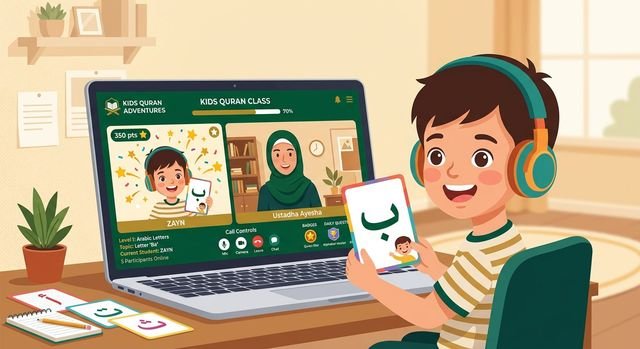
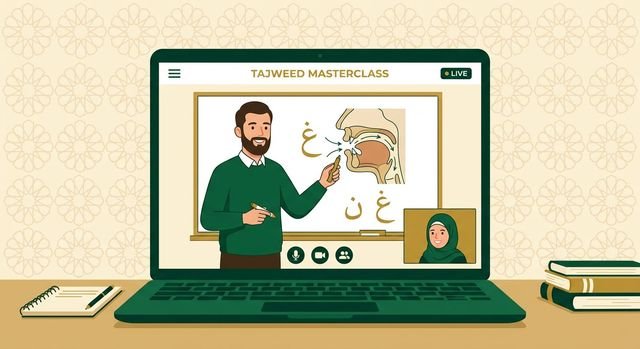
See real classes from this online Quran learning for beginners program below before you book your free trial lesson.
Short class snippets show how the teacher explains, listens, corrects and confirms progress.
2:45Live one-to-one lesson example.
 2:45
Live one-to-one lesson example.
 2:45
Live one-to-one lesson example.
Unscripted words from the people who took the course — recorded after their final class.
“Live correction made my recitation clearer and gave me a practical path to keep improving.”
“Live correction made my recitation clearer and gave me a practical path to keep improving.”
“Live correction made my recitation clearer and gave me a practical path to keep improving.”
Teacher language, speciality and availability are considered before the regular schedule starts.
New to the Quran? Our beginner classes teach you the Arabic letters, correct pronunciation, and basic recitation step by step, with a qualified teacher guiding you at your own pace. Start your first class today.
“The teacher gives clear correction and a practical next step every week.”
“The teacher gives clear correction and a practical next step every week.”
“The teacher gives clear correction and a practical next step every week.”
See measurable examples from learners who started at different levels.
Follows a weekly target and muraja’ah plan independently.
Applies core rules naturally with fewer corrections.
Reads short surahs with stronger fluency and confidence.
Compare nearby routes before choosing the best starting point.
BeginnerUnderstand recurring Quranic vocabulary and sentence patterns.
View courseBeginnerBeginnerBeginnerUnderstand recurring Quranic vocabulary and sentence patterns.
View courseBeginnerA quick answer to the questions that come up most often before someone books their first trial class — a mix of questions specific to this course and questions about the academy as a whole.
A: Yes. Most adult students begin exactly there. Your first session is a placement conversation, not a test, and the course starts with letter recognition before anything else.
A: The pacing, explanations, and reasoning behind Tajweed rules are built for adult comprehension — you get the logic behind a rule, not just repetition until it sticks.
A: Most adult students manage two to three sessions a week alongside work or family commitments; your tutor can adjust frequency based on your schedule and goals.
A: Yes, female students can request a female tutor, and this is arranged before your first paid session.
A: Sessions can be rescheduled with reasonable notice through your student dashboard without losing the class.
A: The course is built specifically for independent Quran reading for adults — meaning you can open any unfamiliar page and read it correctly, not just recite passages you've heard repeated.
Book the free first class. We will check level, match the teacher and show the next milestone.
7 free trial spots remaining this week
Choose the weekly frequency that fits the learner after the free trial.