 2:45
Parent Progress Review (Live)
Live one-to-one lesson example.

Kalamullah’s Noorani Qaida Course gives children and adults the structured foundation they need to read Arabic letters and Quranic words correctly. Students work through every lesson of the Noorani Qaida with a dedicated tutor in live one-on-one sessions, with correct Makharij from the very first class and Tajweed rules built in as the lessons progress.
Every lesson is conducted in English, making the Noorani Qaida Course accessible to complete beginners who have never studied Arabic before. Kalamullah pairs each student with a tutor matched to their level, age, and schedule, so progress is consistent from lesson one onward.
 6–9
The course follows the complete Noorani Qaida syllabus, lesson by lesson: Arabic alphabet recognition, joined letters, Harakaat, Tanween, Madd and Leen letters, Sukoon, Shaddah, the Noon and Meem Sakin rules, and Waqf. Tutors guide each student through every lesson with live correction and structured revision.
The course is open to complete beginners of all ages. Lessons are delivered in English, so students with no prior Arabic background can follow every explanation clearly. Children from age 4 and adults follow the same step-by-step framework, at a pace suited to their age.
Kalamullah teaches the Noorani Qaida entirely through live one-on-one sessions, so every student receives direct tutor correction at every lesson rather than watching pre-recorded content.
Every tutor teaching the Noorani Qaida Course at Kalamullah holds a recognized Tajweed certification from an established Islamic institution. Credentials are verified before any tutor is assigned. Students are not passed to unvetted teachers at any point in the program.
Kalamullah runs all Noorani Qaida Course sessions as private one-on-one classes, not group lessons. The tutor focuses entirely on one student per session, identifying specific Makharij errors and correcting them in real time before incorrect habits are formed.
Kalamullah maintains a roster of qualified female tutors who are assigned to sisters, girls, and young children by request. Parents enrolling daughters in the Noorani Qaida Course can confirm a female teacher before the trial class takes place.
Kalamullah offers Noorani Qaida Course sessions seven days a week, with morning, afternoon, and evening slots available. Sessions run seven days a week, with morning, afternoon and evening slots, and can be moved when your week changes.
The course follows the Noorani Qaida in its correct order, from the alphabet through to Waqf rules and full Quranic word reading. No lesson is skipped, and no topic is condensed to save time at the cost of accuracy.
Book a free first class and we will identify the right level and next milestone.
Book a free trialThe course follows the Noorani Qaida lesson by lesson, grouped into five stages, so students always know what comes next and how each lesson builds on the last.
Students begin with Lesson 1, the individual Arabic letters (Huroof Mufradat). Each letter is taught with its name, its shape and its correct articulation point, with the tutor demonstrating where in the mouth or throat the sound is produced.
Letters that sound alike but differ in Makhraj are practiced side by side, so students learn to tell them apart from the very start rather than correcting it later.
Lessons 2 and 3 cover the compound letters (Huroof Murakkabat), showing how each letter changes shape at the start, middle and end of a word, and the disjointed letters (Huroof Muqatta’at) that open several surahs.
Recognition exercises are repeated until the student can identify each joined form quickly and correctly without prompting.
Lessons 4 through 6 introduce Harakaat (vowel movements), Tanween (nunnation), and vertical standing vowels. The tutor explains how each vowel sign changes the sound of the letter it sits on.
Students read practice lines from the Noorani Qaida text applying all Harakaat and Tanween rules under tutor supervision, with corrections made immediately during the session.
Lessons 7 through 13 cover Madd letters (elongation), Leen letters, Sukoon (Jazm), and Shaddah (doubling). Each rule is introduced with worked examples from the Noorani Qaida text before students read aloud.
Exercises combining Madd with Sukoon and Shaddah with Tanween are practiced in dedicated drill sessions until the student applies all rules together without hesitation.
The final lessons cover the rules of Noon Sakin, Meem Sakin, Waqf (stopping rules), and full Noorani Qaida exercises drawn from Quranic vocabulary. Students read complete Quranic word groups applying all rules learned across the course.
Completion is assessed by the tutor through a reading evaluation. Students who demonstrate consistent accuracy across every lesson of the Qaida are confirmed ready to progress to Quran reading with Tajweed.
Each outcome below is a skill the student can demonstrate to the tutor by the time that lesson group is complete, not simply a topic that was introduced.
Students identify all Arabic letters across their beginning, middle, and end forms without prompting. They can name each letter, trace its shape, and locate it within a line of Quranic text at normal reading pace.
Students apply Madd elongation, read letters carrying Sukoon without adding a vowel, and double the sound on Shaddah letters correctly when reading Noorani Qaida exercises. Combined exercises mixing all three rules are read without error before the student is moved to the next lesson group.
Students apply the Noon Sakin and Tanween rules (Izhar, Idgham, Iqlab and Ikhfaa) and the Meem Sakin rules when reading Quranic word examples. The tutor confirms correct application through a dedicated reading drill using targeted Noorani Qaida exercise lines.
Students apply Madd elongation, Sukoon stops, and Shaddah doubling correctly when reading Noorani Qaida exercises. Combined exercises mixing all three rules are read without error before the student is moved to the next lesson group.
Students demonstrate the rules of Noon Sakin and Meem Sakin, including Ikhfaa, Idgham, and Iqlab, when reading Quranic word examples. The tutor confirms correct application through a dedicated reading drill using targeted Noorani Qaida exercise lines.
Students apply the rules of Waqf correctly when stopping on Quranic words. By the final lesson, each student reads connected Quranic word groups from the Noorani Qaida exercises accurately and at a consistent pace without tutor prompting.
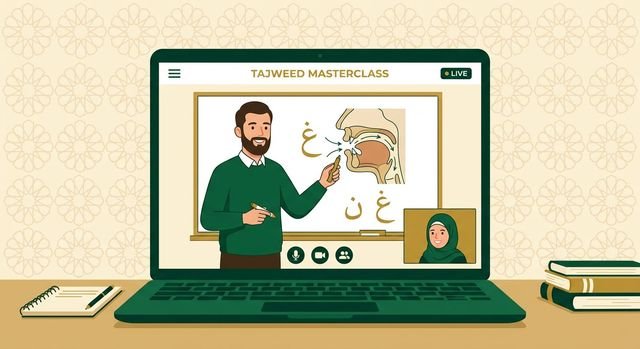
Watch how a tutor takes a student through letters, vowels and live correction in a one-on-one Qaida class.
Short class snippets show how the teacher explains, listens, corrects and confirms progress.
2:45Live one-to-one lesson example.
 2:45
Live one-to-one lesson example.
 2:45
Live one-to-one lesson example.
Unscripted words from the people who took the course — recorded after their final class.
“Live correction made my recitation clearer and gave me a practical path to keep improving.”
“Live correction made my recitation clearer and gave me a practical path to keep improving.”
“Live correction made my recitation clearer and gave me a practical path to keep improving.”
Teacher language, speciality and availability are considered before the regular schedule starts.
Read what parents and adult learners say about learning the Qaida with Kalamullah.
“The teacher gives clear correction and a practical next step every week.”
“The teacher gives clear correction and a practical next step every week.”
“The teacher gives clear correction and a practical next step every week.”
See measurable examples from learners who started at different levels.
Follows a weekly target and muraja’ah plan independently.
Applies core rules naturally with fewer corrections.
Reads short surahs with stronger fluency and confidence.
Compare nearby routes before choosing the best starting point.
BeginnerBeginnerUnderstand recurring Quranic vocabulary and sentence patterns.
View courseA quick answer to the questions that come up most often before someone books their first trial class — a mix of questions specific to this course and questions about the academy as a whole.
Yes. The Noorani Qaida Course at Kalamullah starts from the very first Arabic letter. No prior knowledge of Arabic or Quran reading is required to enroll at any age.
Kalamullah accepts children from age 4 into the Noorani Qaida Course. Tutors working with young children are selected for their experience and patience with early learners.
Female tutors are available at Kalamullah and are assigned by request. Parents and female learners can confirm a female teacher before the free trial class is booked.
Lessons can be rescheduled with reasonable notice, in line with Kalamullah’s rescheduling policy.
Each tutor tracks the student's lesson progress through the 17 Noorani Qaida chapters and reports reading accuracy and errors. Parents are updated regularly so they can see exactly where their child stands.
The tutor checks what your child already knows in the trial class. Lessons they’ve genuinely mastered are reviewed quickly rather than repeated in full, but no lesson is skipped, because each one builds on the last.
Book the free first class. We will check level, match the teacher and show the next milestone.
7 free trial spots remaining this week
Choose the weekly frequency that fits the learner after the free trial.