 2:45
Parent Progress Review (Live)
Live one-to-one lesson example.

Kalamullah’s Noorani Qaida Course for Beginners is taught live and one-on-one by a dedicated tutor. Complete beginners learn Arabic letter recognition, Makharij, Harakaat, Tanween and foundational Tajweed in private sessions built around their schedule.
Every session runs over video with a dedicated tutor who corrects pronunciation in real time. Students from any background, including those who have never seen an Arabic letter before, follow a clear lesson sequence that moves from individual letters to connected words and into early Quranic text.
 6–9
The course covers every lesson of the Noorani Qaida syllabus in order: Arabic letters and their Makharij, joined letters and the Huroof Muqatta’at, Harakaat and Tanween, Maddah and Leen letters, Sukoon, Tashdeed, the Noon and Meem Sakinah rules, and Waqf. Tutors follow the Qaida lesson by lesson, with review of earlier material built into every session.
No prior Arabic knowledge is required. This beginner Qaida course is conducted in English, making it fully accessible to learners who have never studied Arabic. Students enroll at any point and begin from the very first letter, progressing at the pace their tutor assesses as appropriate for their age and ability.
This beginner Qaida course pairs every student with a single dedicated tutor who tracks their letter-by-letter progress across every session, rather than rotating teachers between classes.
Every tutor teaching this beginner Qaida course is trained to teach Makharij and Harakaat to non-Arab learners with no prior Arabic background, and their recitation credentials are verified before they’re assigned to students.
Private sessions eliminate the group-class problem where one student's pace holds the others back. In Kalamullah's Noorani Qaida Course for Beginners, the tutor moves at the student's demonstrated ability, reviewing difficult letter combinations until pronunciation is accurate before progressing.
Kalamullah maintains a full roster of qualified female tutors for this beginner Qaida course. Female students and families who prefer a sister teacher can request one at enrollment, with no added waiting time or change to the lesson structure.
Sessions are booked in the student’s own local time. Learners choose from morning, afternoon, and evening slots across all days of the week, with no fixed timetable imposed on the family.
Kalamullah's curriculum follows the full 16-lesson Noorani Qaida sequence without skipping exercises. Each lesson introduces one new concept, such as Tanween or Tashdeed, and the tutor does not advance the student until assessment confirms correct application in connected reading.
Book a free first class and we will identify the right level and next milestone.
Book a free trialKalamullah's beginner Qaida course follows a five-stage sequence, moving from letter sounds through to connected Quranic reading.
The opening lessons of Kalamullah's Noorani Qaida Course for Beginners establish the 28 Arabic letters in their individual forms. The tutor demonstrates each letter's articulation point and listens as the student repeats until the sound is accurately produced.
Compound letters and abbreviated letter forms are introduced in this stage, along with initial shape recognition exercises that prepare learners to identify letters in connected text.
Once letters are established, the tutor introduces Harakaat, including Fathah, Kasrah, and Dammah, followed by Tanween in all three forms. Standing movements and vertical Harakaat are covered in this phase with tutor-led reading exercises after each new mark is explained.
Students then complete combined exercises in which letters appear with multiple Harakaat types, building the reading speed needed before Maddah and Leen letters are introduced in the following stage.
Once vowel reading is consistent, the tutor introduces the Maddah letters that lengthen a sound and the Leen letters that soften it, followed by Sukoon (Jazm) and Tashdeed. The later lessons combine these, including Tashdeed with Sukoon and Tashdeed following a Maddah letter.
Each new rule is applied first in isolated examples and then in short reading exercises before the student is assessed and cleared to advance.
Students then move into the rules of Noon Sakinah and Meem Sakinah as separate lessons, with the tutor explaining each ruling and immediately applying it through reading practice from the Qaida text.
Rules of Waqf, including where to pause and stop correctly in a passage, complete this phase. By this point students can read word-level Quranic text without tutor prompting for individual letters.
The final phase applies everything covered in the Qaida to actual Quranic verses. Students read short passages under tutor supervision, with corrections given immediately and re-reading required before moving to new text.
Students who complete every phase are assessed for readiness to move on to a full Quran reading course, with the tutor giving a written recommendation before the transition
Students completing Kalamullah's Noorani Qaida Course for Beginners can demonstrate six specific, testable reading and recitation skills before they advance to Quran reading.
Students can identify all 28 Arabic letters in their isolated, initial, medial, and final forms, and produce each letter from its correct articulation point without tutor prompting. This is verified by the tutor through a letter-reading assessment at the close of the first Qaida stage.
Students read letters carrying Fathah, Kasrah, Dammah, and all three forms of Tanween with correct vowel sounds and no hesitation between marked letters. They distinguish standing movements from standard Harakaat in mixed reading exercises.
Students apply Sukoon and Tashdeed correctly in reading exercises, including the combined exercises in lessons fourteen through sixteen of the Noorani Qaida. Errors in stress and elongation are identified and self-corrected after tutor demonstration.
Students read Maddah and Leen letters with the correct elongation values when they appear in connected text, distinguishing between letter types that share similar visual forms but carry different rulings in reading from the Noorani Qaida exercises.
Students identify and apply the rules of Noon Sakinah and Meem Sakinah as they appear in reading exercises, and observe Waqf rulings by pausing and stopping at the correct positions within a passage without tutor instruction for each occurrence.
By the close of Kalamullah's Noorani Qaida Course for Beginners, students read short Quranic passages aloud, applying all foundational Tajweed rules covered across all 16 lessons. The tutor assesses fluency and accuracy before recommending progression to full Quran reading.
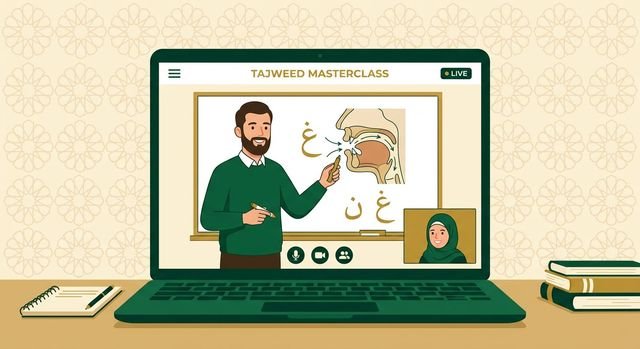
Watch how a tutor guides a beginner through letters, vowels and live correction in a one-on-one lesson.
Short class snippets show how the teacher explains, listens, corrects and confirms progress.
2:45Live one-to-one lesson example.
 2:45
Live one-to-one lesson example.
 2:45
Live one-to-one lesson example.
Unscripted words from the people who took the course — recorded after their final class.
“Live correction made my recitation clearer and gave me a practical path to keep improving.”
“Live correction made my recitation clearer and gave me a practical path to keep improving.”
“Live correction made my recitation clearer and gave me a practical path to keep improving.”
Teacher language, speciality and availability are considered before the regular schedule starts.
Read what parents and adult learners say about starting the Qaida with Kalamullah.
“The teacher gives clear correction and a practical next step every week.”
“The teacher gives clear correction and a practical next step every week.”
“The teacher gives clear correction and a practical next step every week.”
See measurable examples from learners who started at different levels.
Follows a weekly target and muraja’ah plan independently.
Applies core rules naturally with fewer corrections.
Reads short surahs with stronger fluency and confidence.
Compare nearby routes before choosing the best starting point.
BeginnerBeginnerA quick answer to the questions that come up most often before someone books their first trial class — a mix of questions specific to this course and questions about the academy as a whole.
Yes. The course starts from the very first Arabic letter. No prior knowledge of Arabic is required, and all instruction is delivered in English.
Kalamullah enrolls children from age [4 or 5 — confirm with client] as well as adult learners of any age. The tutor adjusts pacing and session style to the student’s age after the first assessment.
Yes. Kalamullah has qualified female tutors available for this course. Families request a female tutor at enrollment with no effect on scheduling or lesson content.
Sessions can be rescheduled with reasonable notice, in line with Kalamullah’s rescheduling policy.
Each tutor in the Noorani Qaida Course for Beginners records which of the 16 lessons has been completed and assessed. Parents of younger students receive regular progress updates from Kalamullah, including confirmation of which skills have been verified before advancement.
Yes. The tutor checks what your child knows in the trial class. Lessons they’ve already mastered are reviewed quickly, but none are skipped, because each one builds on the last.
Book the free first class. We will check level, match the teacher and show the next milestone.
7 free trial spots remaining this week
Choose the weekly frequency that fits the learner after the free trial.