 2:45
Parent Progress Review (Live)
Live one-to-one lesson example.

Arabic is known as the language of the Dad, named after a letter so distinctive that few other languages have anything like it. The same is true of 'Ayn, Ha, Qaf, and the heavy letters: sounds that are hard to learn from someone who did not grow up speaking them. That is why every teacher on this page is a native Arabic speaker.
 6–9
Kalamullah's native Arab teachers cover every stage of Quran learning: Noorani Qaida and reading, Tajweed from beginner to advanced, Hifz and revision, Ijazah preparation, Tafseer, and Quranic Arabic. Many of our native teachers also work as a Quran Arabic tutor, so students can combine recitation with the meaning and vocabulary of what they read.
Students who specifically want a teacher trained at Al-Azhar can also explore our Egyptian Quran Teachers.
Native speakers produce Arabic sounds effortlessly and notice errors that non-native ears often miss. Kalamullah combines that advantage with verified Tajweed qualifications and teaching in English.
Every Kalamullah Arab Quran teacher holds a recognized Tajweed certification, and many hold an Ijazah. Being a native speaker is required, but qualifications are verified separately before approval.
Letters such as Dad, 'Ayn, and Qaf are modeled naturally by teachers who have spoken them all their lives, so students copy correct sounds from the start.
A native Arabic Quran teacher online can explain the roots, word patterns, and nuances of the ayat you recite, making your recitation more meaningful.
Kalamullah provides qualified female native Arab teachers for students who prefer or require a same-gender teacher. The preference is selected at registration and honored from the first lesson.
Every native Quran tutor at Kalamullah also explains clearly in English, so students understand every correction, not only hear it.
Book a free first class and we will identify the right level and next milestone.
Book a free trialFinding the right native teacher takes five simple steps, from telling us your goal to ongoing progress reviews.
You share the student's age, level, goal, schedule, and teacher gender preference, and whether you would like Arabic meaning included in lessons.
This information guides the choice of teacher.
Kalamullah selects a native Arab teacher whose qualifications, experience, and availability fit the student's needs.
Students who want Quranic Arabic alongside recitation are matched with teachers experienced in both.
The student takes a free lesson with the matched teacher, who assesses their pronunciation and level and explains the plan ahead.
If the match does not feel right, Kalamullah arranges a different teacher.
The teacher builds a personal plan and lessons begin on the agreed schedule. Every lesson is live, one-on-one, and tracked.
Lessons can be rescheduled when genuine conflicts arise.
The teacher reviews progress regularly and adjusts the plan as the student advances.
Students can continue with the same teacher into Tajweed, Hifz, or Quranic Arabic courses at Kalamullah.
Every outcome below is something the student can demonstrate to their Kalamullah teacher, depending on their level and goal.
Students pronounce letters such as Dad, ‘Ayn, and Qaf from their correct points of articulation.
This is confirmed in live recitation with their teacher.
Beginners read the Mushaf with correct letters and vowel marks.
They read without hesitation on familiar passages.
Students apply the rules of Tajweed consistently in their recitation.
The teacher verifies each rule in continuous recitation.
Students who include Arabic in lessons recognize and translate common Quranic words.
They explain the meaning of familiar ayat.
Hifz students memorize new portions accurately and recite earlier Juz from memory without losing them.
The teacher confirms retention through regular revision and recitation from random starting points.
Students learn to hear the difference between close letters, such as Sin and Sad or Dal and Dad, in their own recitation.
The teacher confirms this when students correct themselves before being stopped.
Watch real Kalamullah lessons below and hear how naturally our native teachers model every letter.
Short class snippets show how the teacher explains, listens, corrects and confirms progress.
2:45Live one-to-one lesson example.
 2:45
Live one-to-one lesson example.
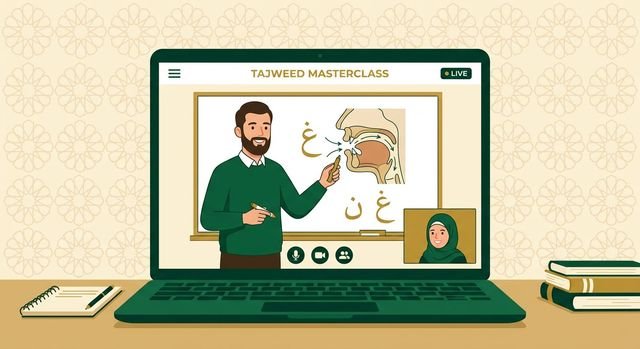 2:45
Live one-to-one lesson example.
Unscripted words from the people who took the course — recorded after their final class.
“Live correction made my recitation clearer and gave me a practical path to keep improving.”
“Live correction made my recitation clearer and gave me a practical path to keep improving.”
“Live correction made my recitation clearer and gave me a practical path to keep improving.”
Teacher language, speciality and availability are considered before the regular schedule starts.
Read what Kalamullah families say about learning with an Arab Quran teacher.
“The teacher gives clear correction and a practical next step every week.”
“The teacher gives clear correction and a practical next step every week.”
“The teacher gives clear correction and a practical next step every week.”
See measurable examples from learners who started at different levels.
Follows a weekly target and muraja’ah plan independently.
Applies core rules naturally with fewer corrections.
Reads short surahs with stronger fluency and confidence.
Compare nearby routes before choosing the best starting point.
BeginnerBeginnerUnderstand recurring Quranic vocabulary and sentence patterns.
View courseBeginnerBeginnerUnderstand recurring Quranic vocabulary and sentence patterns.
View courseBeginnerUnderstand recurring Quranic vocabulary and sentence patterns.
View courseA quick answer to the questions that come up most often before someone books their first trial class — a mix of questions specific to this course and questions about the academy as a whole.
Yes. Every teacher on this page speaks Arabic as their first language and holds verified Tajweed certification.
Yes. Every Arabic Quran teacher online at Kalamullah explains rules and corrections in clear English.
Yes. Native teachers can include Quranic Arabic vocabulary and meaning in your lessons, acting as your Quran Arabic tutor as well.
Everyday dialects do have their own habits, which is why being a native speaker is not enough on its own. Every teacher on this page is trained and certified in Quranic articulation, so they recite in classical Arabic, not their local dialect.
Yes. Kalamullah provides qualified female native Arab teachers for sisters and girls. The preference is confirmed at registration and matched before the free lesson is booked.
Yes. Lessons can be rescheduled when genuine conflicts arise, with morning, afternoon, and evening slots available seven days a week across all time zones.
Book the free first class. We will check level, match the teacher and show the next milestone.
7 free trial spots remaining this week
Choose the weekly frequency that fits the learner after the free trial.